

Federal Emergency Management Advancement of Equity Act or the FEMA Equity Act This bill addresses equity in federal disaster assistance policies and programs. The Federal Emergency Management Agency (FEMA) must develop and implement a process to ensure equity in the provision of federal assistance and throughout all FEMA programs and policies. Additionally, FEMA must establish metrics to measure the efficacy of the process and seek input from relevant representatives of state, regional, local, and tribal governments; community-based organizations; subject matter experts; and individuals from underserved communities impacted by disasters. FEMA must designate a senior official as an equity advisor. The bill establishes in FEMA an Equity Enterprise Steering Group. The chief executive officer of an affected county may submit a request for a presidential declaration that a major disaster exists if (1) the governor of the state or territory in which the county is located does not request such a declaration, (2) the affected county is not included in a request for assistance made by such governor, or (3) the affected county communicates with that governor about the disaster or potential request for a major disaster declaration before the relevant period has lapsed. The Government Accountability Office shall issue a report describing the factors that FEMA considers when evaluating a request from a governor to declare that a major disaster or emergency exists and to authorize specified assistance.
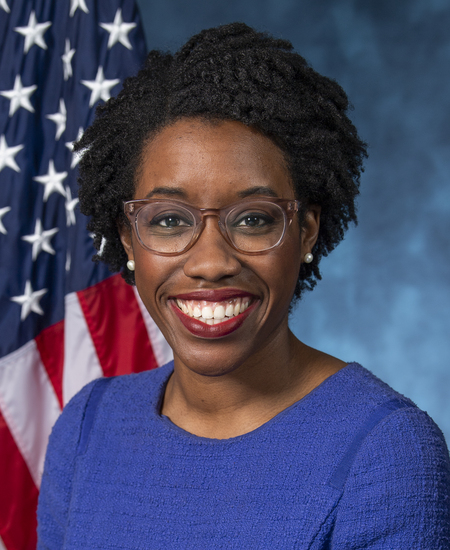
Rep. Lauren Underwood
Sponsored bills
NIH Implementing a Maternal health and PRegnancy Outcomes Vision for Everyone Act of 2022 or the NIH IMPROVE Act This bill provides statutory authority for an initiative of the National Institutes of Health that supports research on improving maternal health outcomes with a particular emphasis on mitigating maternal health disparities.
This resolution recognizes that Black women are experiencing high, disproportionate rates of maternal mortality and morbidity in the United States and that Black Maternal Health Week is an opportunity to deepen the national conversation about Black maternal health.
Congressional Accountability Act Enhancement Act This bill extends the liability of Members of Congress for employment discrimination settlements and awards and expands certain employment protections for congressional employees. Current law requires that a Member who commits an act of harassment in violation of employment-based civil rights protections must reimburse the Treasury for amounts paid as settlements or awards resulting from the act. This bill also requires that Members reimburse the Treasury for amounts paid resulting from any unlawful discrimination and related retaliation. Additionally, the bill grants congressional employees a 10-day period to amend a filing alleging employment discrimination if the hearing officer determines the initial filing failed to state a claim for which relief could be granted. The bill also allows the Office of Employee Advocacy to continue to assist a congressional employee with investigations and proceedings related to a claim of workplace discrimination even after the employee begins federal court proceedings.
Mamas First Act This bill requires state Medicaid programs to cover doula and midwife services, including prenatal, delivery, and postpartum services, in a variety of settings.
Ensuring Lasting Smiles Act This bill requires private health insurance plans to cover diagnosis and treatment of congenital anomalies and birth defects, such as reconstructive services and items. Coverage must include services and items that functionally improve, repair, or restore any body part that is medically necessary for normal bodily functions or appearance, as determined by the treating physician. Coverage limits and cost-sharing requirements for such services and items may not be more restrictive than those applicable to all medical and surgical benefits under the plan.
Continuing Systems of Care for Children Act This bill reauthorizes through FY2027 two behavioral health programs for children, youth, and young adults that are carried out by the Substance Abuse and Mental Health Services Administration. Specifically, it reauthorizes (1) grants for states, Indian tribes, and localities to provide comprehensive community mental health services for children with serious emotional disturbances; and (2) a program for public and private nonprofits to provide substance use disorder treatment and early intervention services for children, adolescents, and young adults.
Emmett Till Antilynching Act This bill makes lynching a federal hate crime offense. Specifically, the bill imposes criminal penalties—a fine, a prison term of up to 30 years, or both—on an individual who conspires to commit a hate crime offense that results in death or serious bodily injury or that includes kidnapping or an attempt to kidnap, aggravated sexual abuse or an attempt to commit aggravated sexual abuse, or an attempt to kill.
9-8-8 Implementation Act of 2022 This bill modifies provisions to increase access to behavioral health services, with a focus on crisis services and the 9-8-8 telecommunication system. (The 9-8-8 system provides callers with mental health or suicide crisis support and resources through the existing National Suicide Prevention Lifeline and is scheduled to take effect by July 16, 2022.) The bill reauthorizes through FY2027 and revises the National Suicide Prevention Lifeline program and requires a national suicide prevention media campaign. In addition, the Substance Abuse and Mental Health Services Administration (SAMHSA) must establish standards for a behavioral health crisis continuum of care that health care providers and communities may use in responding to individuals experiencing a behavioral health crisis. The continuum must include emergency treatment, stabilization, and related services. The bill expands Medicaid and other insurance coverage for such services. The bill further expands Medicaid coverage for behavioral health services. This includes permanently allowing coverage of certain community-based mobile crisis services and exempting some short-term stabilization services from coverage restrictions that apply to institutions for mental diseases. Additionally, the bill establishes (1) an office within SAMHSA to coordinate behavioral health activities; and (2) various grants, including a pilot program for mobile crisis care teams that respond to behavioral health crises rather than law enforcement and a capital improvement program for certain behavioral health facilities. The bill also reauthorizes through FY2027 and expands certain workforce programs for behavioral health providers. It also addresses training for emergency services dispatchers and coordination of the 9-1-1 system with the 9-8-8 system.
Creating a Respectful and Open World for Natural Hair Act of 2022 or the CROWN Act of 2022 This bill prohibits discrimination based on a person's hair texture or hairstyle if that style or texture is commonly associated with a particular race or national origin. Specifically, the bill prohibits this type of discrimination against those participating in federally assisted programs, housing programs, public accommodations, and employment. Persons shall not be deprived of equal rights under the law and shall not be subjected to prohibited practices based on their hair texture or style. The bill provides for enforcement procedures under the applicable laws.