This act designates the facility of the United States Postal Service located at 301 East Congress Parkway in Crystal Lake, Illinois, as the Ryan J. Cummings Post Office Building.
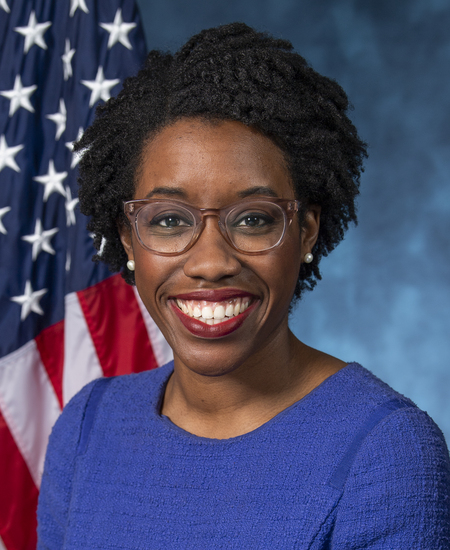
Rep. Lauren Underwood
Sponsored bills
This act designates the facility of the United States Postal Service located at 450 West Schaumburg Road in Schaumburg, Illinois, as the Veterans of Iraq and Afghanistan Memorial Post Office Building.
Aviation Funding Stability Act of 20 21 This bill provides continuing appropriations to the Federal Aviation Administration (FAA) from the Airport and Airway Trust Fund if an appropriations bill for the FAA has not been enacted before a fiscal year begins or a joint resolution making continuing appropriations for the FAA is not in effect. The bill provides appropriations at the rate of operations that was provided for the prior fiscal year to continue programs, projects, and activities for which funds were provided in the preceding fiscal year.
Expanding the Voluntary Opportunities for Translations in Elections Act or the Expanding the VOTE Act This bill expands access to voting materials for individuals with limited proficiency in the English language, including by establishing incentive grants for states and political subdivisions to provide translated voting materials. Additionally, the bill directs the Government Accountability Office to study the impact of (1) reducing the threshold requirement under Section 203 of the Voting Rights Act of 1965, and (2) expanding the definition of language minorities to include native speakers of additional languages.
Health Security and Countering Weapons of Mass Destruction Act This bill makes changes to the Countering Weapons of Mass Destruction (CWMD) office of the Department of Homeland Security (DHS) and provides statutory authority for and expands DHS's Office of Health Security (OHS). Specifically, the bill establishes the new OHS to advise DHS on medical, public health, and workforce safety matters; sets forth the responsibilities of the Chief Medical Officer and a Privacy Officer in OHS; repeals the terminating date for the CWMD office and sets forth the responsibilities of that office, including efforts to counter chemical, biological, radiological, and nuclear (CBRN) threats, as well as other emerging terrorism threats; requires DHS to report to Congress regarding the Securing the Cities program (which seeks to reduce the risk of a successful deployment of radiological or nuclear weapons against major metropolitan areas in the United States); establishes a CWMD Advisory Council; and requires a biodefense review and issuance of a DHS biodefense strategy. The Government Accountability Office must report to Congress on efforts of the CWMD office to prioritize its programs and activities to safeguard against CBRN threats and on other activities of that office.
Protecting America's Retirement Security Act of 2022 This bill makes various changes with respect to the administration of employer-sponsored retirement plans, including establishing additional spousal consent requirements for distributions under such plans and requiring the periodic automatic reenrollment of nonparticipating employees in automatic contribution arrangements that take effect after December 31, 2024. The bill also requires the Department of Education, in consultation with relevant agencies, to establish a personal finance education portal that includes information about savings, investing, borrowing, and managing student loan repayment.
Big Cat Public Safety Act This act revises requirements governing the trade of big cats (i.e., species of lion, tiger, leopard, cheetah, jaguar, or cougar or any hybrid of such species) under the Lacey Act to limit the possession, breeding, and exhibition of big cats. The Lacey Act prohibits any person from importing, exporting, buying, selling, transporting, receiving, or acquiring big cats across state lines or the U.S. border. However, some exemptions are provided for certain entities, such as universities and wildlife sanctuaries. (Sec. 3) The act expands the Lacey Act prohibitions to include a prohibition on possessing or breeding big cats. Breeding means facilitating propagation or reproduction (whether intentionally or negligently), or failing to prevent propagation or reproduction. Owners of big cats that were born before this act's enactment may keep their big cats, but the owners must register them with the U.S. Fish and Wildlife Service. The act modifies the list of entities that are exempt from prohibitions to export, buy, sell, transport, receive, acquire, possess, or breed big cats. The modified list includes exemptions for entities or facilities exhibiting animals to the public if they (1) hold a Class C license in good standing under the Animal Welfare Act, and (2) do not allow individuals to come into direct physical contact with big cats. However, direct contact is allowed if the individual is a trained professional, a veterinarian, or directly supporting conservation programs that do not involve commercial activities and meet other specified restrictions. (Sec. 4) A person who knowingly violates the act must be fined not more than $20,000, or imprisoned for no more than five years, or both. The act considers each violation to be a separate offense. The offense must be deemed to have been committed not only in the district where the violation first occurred, but also in any district in which the defendant may have taken or been in possession of the prohibited wildlife species. (Sec. 5) The act extends forfeiture provisions to fish, wildlife, or plants that are bred or possessed; thus, big cats bred or possessed in violation of the act are subject to forfeiture. (Sec. 6) The Department of the Interior must issue regulations to implement this act.

This act designates the facility of the United States Postal Service located at 303 East Mississippi Avenue in Elwood, Illinois, as the Lawrence M. "Larry" Walsh Sr. Post Office.
Maternal Health Pandemic Response Act of 2022 This bill addresses data collection, public education, workplace safety, and other matters related to maternal health during public health emergencies. Specifically, the bill supports (1) the collection of maternal data (including racial, ethnic, and other demographic data) through surveillance systems of the Centers for Disease Control and Prevention (CDC), and (2) research activities of the National Institute of Child Health and Human Development. Additionally, the CDC and the Centers for Medicare & Medicaid Services must make publicly available and periodically update pregnancy and postpartum data that is collected across COVID-19 surveillance systems. The data must be disaggregated by factors such as race, ethnicity, insurance status, and location. The bill also requires the CDC to educate pregnant people, their employers, and their health care providers about evidenced-based health information concerning COVID-19 and pregnancy; the Department of Health and Human Services to convene a task force to develop recommendations on the provision of maternity care during the COVID-19 (and future) public health emergencies with a particular focus on communities of color and rural populations; the Occupational Safety and Health Administration to issue an emergency temporary standard to protect employees who are at risk from occupational exposure to COVID-19 that considers the risks and needs of pregnant and postpartum employees; and the Government Accountability Office to report on maternal health and public health preparedness, including prenatal, labor and delivery, and postpartum care during the COVID-19 emergency.
VA Employee Fairness Act of 2021 This bill repeals provisions excluding any matter or question concerning professional conduct or competence; peer review; or the establishment, determination, or adjustment of employee compensation from the applicability of collective bargaining rights for Veterans Health Administration employees.