

Maddy summaryHRES 1355 is a non-binding resolution supporting the designation of July 10 as Journeyman Lineworkers Recognition Day. It honors lineworkers who maintain electrical infrastructure under hazardous conditions, including during disasters, and commemorates Henry Miller, the first president of the International Brotherhood of Electrical Workers, who died on July 10, 1896, while troubleshooting an electrical outage. The resolution encourages public recognition of these workers' contributions but does not create new laws or policies.
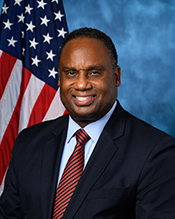
Rep. Jonathan L. Jackson
Sponsored bills
Maddy summaryHRES 1349 is a symbolic House resolution recognizing the success of the Food for Peace Act, which provides U.S. humanitarian food aid to global populations facing hunger. It does not create new policy or funding but formally acknowledges the program’s impact - such as reaching 53 million people with emergency aid in 2022 - and highlights global hunger statistics (e.g., 783 million people hungry in 2022). The resolution urges continued U.S. funding prioritization for the program but has no binding effect or direct policy changes. It directly affects no new groups, as it solely expresses congressional support for an existing aid program.
Maddy summaryHR 8825, the Right to Vote Act, establishes a fundamental right for all citizens of legal voting age to vote in federal elections. It directly affects voters across all states and territories by prohibiting government actions that make voting harder (like restrictive ID laws or reduced polling places) unless those actions are the least restrictive way to serve a significant government interest. The bill creates two legal standards: "retrogression" (diminishing voting access) and "substantial impairment" (making voting significantly harder), allowing voters to sue in federal court to challenge such restrictions. Courts must expedite these cases, and the law applies to all federal elections occurring on or after September 1, 2024.
Maddy summaryHCONRES 118 is a symbolic congressional resolution recognizing the wage disparity faced by Black women in the U.S. It specifically highlights that Black women earn 69 cents for every dollar earned by White, non-Hispanic men, as noted in Census Bureau data. The resolution marks July 9, 2024, as Black Women’s Equal Pay Day to symbolize how long into 2024 Black women must work to earn what White men earned in 2023. It does not create new laws or policies but formally acknowledges this disparity and reaffirms congressional support for equal pay for equal work.
Maddy summaryHR 8933 requires large public companies (with over 100 employees or $300 million+ in capital) to conduct racial equity audits every two years. These audits must assess company policies on diversity and disclose any historical ties to or profits from slavery, with findings reported publicly. Companies failing to comply face daily fines ($20,000/day), with 50% of fines funding Treasury's minority programs and 50% supporting HUD housing initiatives for low-income minority communities. The bill mandates transparency on historical inequities while directing penalties toward targeted community investments.
Maddy summaryHRES 1337 is a ceremonial resolution commemorating the July 4, 2022, Highland Park, Illinois, Independence Day Parade shooting. It honors the seven victims (Katie Goldstein, Irina McCarthy, Kevin McCarthy, Stephen Strauss, Jacquelyn Sundheim, Nicolas Toledo-Zaragoza, and Eduardo Uvaldo) and over 40 wounded survivors, while acknowledging the community's healing two years post-tragedy. The resolution expresses the House's solidarity with Highland Park residents, first responders, and healthcare providers who aided victims. It does not enact new laws or policies but serves as a symbolic tribute to the victims and survivors. This is a procedural resolution with no concrete policy changes, solely focused on remembrance and support.
Maddy summaryHR 8911, the Worker Rights and Support Act, requires most employers to provide specific breaks to employees under the Fair Labor Standards Act. It mandates 30-minute meal breaks after 6 hours of work (unpaid unless work continues), 10-minute rest breaks every 4 hours (paid), and medical breaks (up to 20 minutes per need, paid) for documented health conditions. The bill ensures breaks are paid if employees aren't fully relieved of work duties or can't leave the premises. It does not override collective bargaining agreements or stricter state laws, and adds enforcement penalties for violations of these break requirements.
Maddy summaryThe CHARTER Act prohibits charter schools receiving federal education funds under the Elementary and Secondary Education Act (ESEA) or Individuals with Disabilities Education Act (IDEA) from contracting with for-profit entities to manage school operations - including curriculum, budgets, or staff decisions. It directly affects public charter schools and their charter management organizations that receive these federal funds. The bill allows contracts with for-profits for specific services like food, payroll, or facilities maintenance but bans profit-driven management arrangements. The law takes effect 3 years after enactment and applies only to new or renewed contracts after that date, closing a loophole identified in a 2006 court case where for-profit schools reorganized as nonprofits to retain federal funding.
Maddy summaryThe SAFES Act creates a federal tax credit for individuals who purchase gun safes, allowing them to deduct 90% of the cost, up to $500 per person or $1,000 for joint returns. For purchases made before 2030, any qualifying gun safe qualifies; after 2029, only safes meeting standards set by the Secretary of Health and Human Services (HHS) will be eligible, based on an HHS report required within five years of enactment. The bill prohibits requiring taxpayers to disclose firearm ownership details to claim the credit. This policy directly affects individual firearm owners seeking to reduce tax liability through safe storage purchases.
Maddy summaryThis bill bans developers and deployers of AI algorithms from using them to deceive voters about election procedures (like voting locations or registration rules) or intimidate people from voting. It requires clear disclaimers - such as "AI Disclaimer: This output was generated by artificial intelligence" - on AI-generated election content, including fake candidate videos or altered voting information. The law sets safety standards for election-related AI, requiring developers to ensure algorithms are "safe and effective" before use. The Federal Trade Commission enforces these rules, with violations potentially leading to fines or up to one year in prison.