Maddy summaryThis bill requires the State Department to obtain specific congressional authorization and submit a detailed reorganization plan before making any structural changes. The plan must cover impacts on diplomatic operations, consular services, workforce transitions, and risks to U.S. foreign policy interests. If the department bypasses these requirements, federal funds cannot be used for State Department efficiency activities or official travel by politically appointed officials. The bill directly affects State Department leadership and congressional committees, mandating strict oversight before any reorganization takes effect.
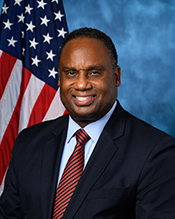
Rep. Jonathan L. Jackson
Sponsored bills
Maddy summaryHCONRES 25 is a symbolic congressional resolution stating that the Trump administration's planned 25% tariffs on imports from Canada and Mexico violate the USMCA trade agreement. It directly addresses the administration's tariff announcement (set for April 2, 2025), which Congress claims undermines the USMCA's terms. The resolution emphasizes that these tariffs threaten established trade relationships, harm the $1.6 trillion annual trade between the U.S. and these nations, and contradict the agreement's goal of maintaining a level playing field. As a non-binding expression of congressional opinion, it does not alter tariffs but highlights concerns about USMCA compliance.
Workplace Violence Prevention for Health Care and Social Service Workers Act This bill requires the Department of Labor to address workplace violence in health care, social service, and similar sectors. Specifically, Labor must issue an occupational safety and health standard that requires certain employers to take actions to protect workers and other personnel from workplace violence. The standard applies to employers in the health care sector, in the social service sector, and in sectors that conduct activities similar to those in the health care and social service sectors. Among other elements, the standard must require each employer to (1) develop a workplace violence prevention plan, (2) promptly investigate incidents of workplace violence, and (3) provide relevant training and education to employees. The bill requires certain hospitals and skilled nursing facilities to comply with this standard as a condition of Medicare participation.
Sanctioning Russia Act of 2025 This bill imposes penalties on certain persons (individuals and entities) if the President determines that the Russian government or a person acting at Russia's direction is involved with (1) refusing to negotiate a peace agreement with Ukraine; (2) violating a negotiated peace agreement; (3) initiating another invasion of Ukraine; or (4) overthrowing, dismantling, or seeking to subvert the Ukrainian government. If the President makes such a determination, the bill requires certain actions including the President must impose visa- and property-blocking sanctions on specified persons such as the Russian president, certain Russian military commanders, and any foreign person that knowingly provides defense items to the Russian armed forces; the President must increase the rate of duty on all goods and services imported from Russia into the United States to at least 500% relative to the value of such goods and services; the President must increase the rate of duty on all goods and services imported into the United States from countries that knowingly engage in the exchange of Russian-origin uranium and petroleum products to at least 500% relative to the value of such goods and services; the Department of the Treasury must impose property-blocking sanctions on any financial institution organized under Russian law and owned wholly or partly by Russia, and any financial institution that engages in transactions with those entities; and the Department of Commerce must prohibit the export, reexport, or in-country transfer to or in Russia of any U.S.-produced energy or energy product.
Maddy summaryHR 2587, the Youth Mental Health Research Act, establishes a new NIH research initiative to coordinate studies on youth mental health across federal health institutes. It focuses on two key areas: researching community resilience and early intervention strategies for at-risk youth, and improving how mental health services are delivered in schools, communities, and other settings where young people spend time. The bill authorizes $100 million annually for fiscal years 2025 through 2030 to fund this research. This initiative directly supports future evidence-based approaches to youth mental health, without altering current services or directly affecting individuals.
Maddy summaryThe Heating and Cooling Relief Act (HR 2486) expands the Low-Income Home Energy Assistance Program (LIHEAP) to help low-income households struggling with energy costs. It increases funding to cover all eligible households (those with incomes up to 250% of poverty level or 80% of State median income), sets a goal that no household should spend more than 3% of income on energy, and requires states to operate assistance programs year-round. The bill includes new protections against utility shutoffs for 2 years after assistance is received, prohibits late fees during the 6 months following assistance, and mandates weatherization and energy efficiency improvements in low-income housing. It also requires states to develop extreme heat response plans and addresses the $21 billion in residential utility arrears as of September 2024.
Maddy summaryThis bill directs the U.S. Department of Health and Human Services to launch a national public education campaign about abortion access. The campaign must provide medically accurate information on where to obtain abortion services (including medication abortion), legal rights for out-of-state care, identifying misleading anti-abortion centers, spotting disinformation, and protecting personal health data. It specifically targets underserved communities like people of color, immigrants, LGBTQ+ individuals, rural residents, and those with low incomes, while prohibiting the promotion of misinformation or abstinence-only programs.
Save America's Forgotten Equines Act of 2025 or the SAFE Act of 2025 This bill permanently prohibits the slaughter of equines (e.g., horses and mules) for human consumption. (Current law prohibits the slaughter of dogs and cats for human consumption. This bill extends the prohibition to equines.) Specifically, this bill prohibits a person from knowingly (1) slaughtering an equine for human consumption; or (2) shipping, transporting, possessing, purchasing, selling, or donating an equine to be slaughtered for human consumption or equine parts for human consumption. The bill subjects a violator to a fine. The bill applies to conduct in or affecting interstate or foreign commerce or within the special maritime and territorial jurisdiction of the United States. However, it does not apply to an activity carried out by an Indian for a religious ceremony. As background, in recent years, the appropriations acts have prohibited the Department of Agriculture (USDA) from using federal funds to inspect horses before they are slaughtered for human consumption. Therefore, there are currently no USDA-inspected horse slaughter facilities in the United States.
Maddy summaryThis bill, HR 2411, directs the U.S. government to immediately resume funding for the United Nations Relief and Works Agency for Palestine Refugees (UNRWA) by repealing two prior funding restrictions. It requires the State Department to restart payments to UNRWA under existing authorities and mandates the President to rescind a 2025 executive order ending UNRWA support. The bill affects Palestinian refugees in Gaza, Jordan, Lebanon, Syria, and the West Bank who rely on UNRWA for humanitarian aid, as well as U.S. funding mechanisms. It also requires quarterly reports through 2028 on UNRWA’s progress implementing accountability reforms from an independent review led by Catherine Colonna.
Maddy summary# Summary of the American Housing and Economic Mobility Act of 2025 This comprehensive legislation addresses housing affordability, civil rights, financial inclusion, and tax policy through multiple titles: **Fair Housing Expansion (Title I):** - Expands protections under the Fair Housing Act to include gender identity, sexual orientation, marital status, source of income, and veteran status - Requires housing providers receiving federal assistance to comply with enhanced accessibility standards (twice as many units must be accessible) **Community Reinvestment Act Strengthening (Title II):** - Requires banks to form diverse Community Advisory Committees in each metropolitan area - Mandates regular biannual consultations between bank executives and community advisory groups - Requires detailed data collection on lending practices by demographic factors (including race, ethnicity, and disability status) - Establishes new requirements for banks to analyze and report on disparities in access to credit **Veterans' Housing Access (Title III):** - Expands eligibility for VA home loans to include direct descendants of veterans who served between June 22, 1944, and April 11, 1968, who are first-time, first-generation homebuyers **Public Housing Improvements (Title IV):** - Requires public housing agencies to analyze where participants live and develop strategies to increase access to higher-opportunity neighborhoods - Mandates regional collaboration among housing agencies to reduce disparities in access - Requires HUD to develop mapping tools to help agencies analyze neighborhood access **Estate Tax Reforms (Title V):** - Increases estate tax rates for large estates (over $13 million) - Reduces the basic exclusion amount from $13 million to $3.5 million - Imposes a 10% surtax on estates exceeding $1 billion - Increases the exclusion limit for farm real property from $750,000 to $3 million - Increases the exclusion for land subject to conservation easements from $500,000 to $2 million - Creates a new 5-8% surcharge on high-income estates and trusts **Additional Provisions:** - Strengthens credit union service to underserved areas - Raises public welfare caps for banks to increase investments in low-income communities - Requires new data collection and reporting requirements for financial institutions This legislation represents a significant expansion of housing rights, financial inclusion, and tax policy reforms aimed at reducing disparities in access to housing and financial services while reforming the estate tax system.