

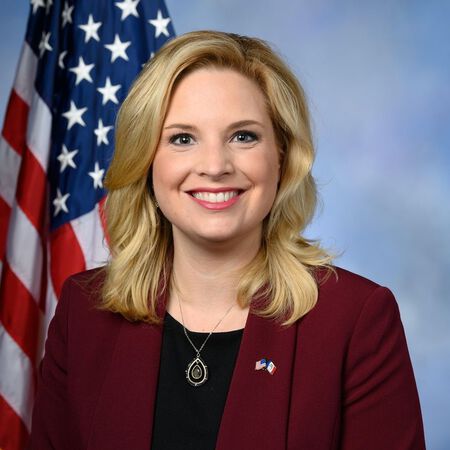
Photo of Ashley Hinson
R United States House · District 2 · Iowa

Rep. Ashley Hinson

Compare
Total votes
2,837
all sessions
Attendance
99%
32 missed
Near the chamber average
With party
93%
of cast votes
Higher than 86% of chamber peers
Bipartisan score
4%
crosses aisle rarely
Lower than 87% of chamber peers
Sponsored
1,027
bills & resolutions
Near the chamber average
Committees
5
assignments
1,027 bills and resolutions

Sponsored bills

Total
1,027
Primary
96
Co-sponsor
931
This page
1,027
matching current filters
Co-sponsor HR 1131
In committee · Indiana House · Co-sponsor
Family Farm and Small Business Exemption Act

Maddy summaryHR 1131 exempts certain family farms and small businesses from being counted as assets when calculating financial need for federal student aid under the Higher Education Act. Specifically, it amends the law to exclude the net value of a family farm where the family resides and small businesses (with ≤100 employees) owned by the family from need analysis calculations. This change directly affects students from qualifying family farm or small business households when applying for federal financial aid. The exemption applies to need analysis conducted for award years beginning after the bill's enactment date. The bill modifies Section 480(f)(2) of the Higher Education Act of 1965 to implement this policy change.

In committee Feb 7, 2025 1 co-sponsor
Co-sponsor HR 1151
In committee · Indiana House · Co-sponsor
Freedom to Invest in Tomorrow’s Workforce Act

Maddy summaryThis bill expands 529 college savings account flexibility by allowing funds to cover costs for industry-recognized postsecondary credentials, not just traditional degrees. It defines "qualified expenses" to include tuition/fees for recognized credential programs (like certifications or apprenticeships), required testing fees, and continuing education needed to maintain credentials. To qualify, programs must meet specific criteria, such as appearing on state lists under the Workforce Innovation and Opportunity Act or being listed in VA or Defense directories. The change applies to 529 distributions made after the law's enactment, giving families more options to use these accounts for job-focused training.

In committee Feb 7, 2025 1 co-sponsor
Co-sponsor HR 1121
In committee · Indiana House · Co-sponsor
No DeepSeek on Government Devices Act

Maddy summaryHR 1121, the "No DeepSeek on Government Devices Act," prohibits U.S. federal executive agencies from using the DeepSeek application (or any successor by High Flyer) on government information technology devices. It requires the Office of Management and Budget to develop removal standards within 60 days, directing agencies to remove the application while complying with existing security rules. Exceptions are permitted for national security, law enforcement, and security research activities, but agencies must document risk mitigation plans for any authorized use under these exceptions. The bill directly affects all executive agencies covered under federal information technology policies.

In committee Feb 7, 2025 1 co-sponsor
Co-sponsor HCONRES 8
In committee · Indiana House · Co-sponsor
Expressing the sense of Congress that the United States should resume normal diplomatic relations with Taiwan, negotiate a bilateral free trade agreement with Taiwan, and support Taiwans membership in international organizations.

Maddy summaryHCONRES 8 is a non-binding congressional resolution urging the U.S. President to end the current "One China Policy" and recognize Taiwan as an independent country. It specifically calls for resuming normal diplomatic relations (including appointing ambassadors), negotiating a bilateral free trade agreement with Taiwan, and advocating for Taiwan's full membership in international organizations like the UN and WHO. The resolution argues that Taiwan has maintained democratic governance and independence for over 70 years, separate from the People's Republic of China. This resolution does not change U.S. law but expresses Congress's position on foreign policy toward Taiwan.

In committee Feb 6, 2025 1 co-sponsor
Co-sponsor HR 1086
In committee · Indiana House · Co-sponsor
Agriculture Export Promotion Act of 2025

Maddy summaryHR 1086, the Agriculture Export Promotion Act of 2025, increases funding for two key U.S. Department of Agriculture export programs to boost agricultural trade. It raises the Market Access Program budget from $255 million to $489.5 million annually and doubles the Foreign Market Development Cooperator Program base funding from $200 million to $400 million, with cooperator funding increasing from $34.5 million to $69 million. These changes, effective through 2029, address years of stagnant funding while aiming to counter competitive disadvantages from foreign agricultural export programs. The bill directly supports U.S. agricultural producers - from apple growers to seafood exporters - by expanding access to international markets through these programs.

In committee Feb 6, 2025 1 co-sponsor
Co-sponsor HR 1056
In committee · Indiana House · Co-sponsor
To include the Czech Republic in the list of foreign states whose nationals are eligible for admission into the United States as E1 nonimmigrants if United States nationals are treated similarly by the Government of the Czech Republic.

This bill allows a national of the Czech Republic to qualify for E-1 nonimmigrant status if the Czech Republic provides similar nonimmigrant status to U.S. nationals. E-1 classification allows nationals of certain countries (i.e., those with a treaty of commerce and navigation with the United States, those under a qualifying international agreement, or those deemed to qualify through statute) to be admitted solely to engage in international trade, along with their families and employees.

In committee Feb 6, 2025 1 co-sponsor
Co-sponsor HR 1076
In committee · Indiana House · Co-sponsor
WARN Act

Maddy summaryHR 1076, the WARN Act, requires the Comptroller General to study how well local, state, and federal emergency alert systems share timely weather emergency information during events like storms or power outages. The study will examine alert methods (including social media), the clarity of public messages, and outdoor siren systems, using feedback from emergency managers and community groups. It mandates a report to Congress within 18 months of enactment, focusing on identifying improvements to alert systems for public safety. The bill itself does not change existing policies but directs a review to inform future emergency communication strategies.

In committee Feb 6, 2025 1 co-sponsor
Co-sponsor HR 1046
In committee · Indiana House · Co-sponsor
Marc Fischer Memorial Act

Maddy summaryHR 1046, the Marc Fischer Memorial Act, requires the Bureau of Prisons to implement digital mail scanning technology at all federal prisons to detect fentanyl and other synthetic drugs in inmate mail. It mandates a strategy within 90 days of an evaluation, including 100% scanning of all mail, digital copies of mail to inmates within 24 hours, and physical mail delivery within 30 days for non-contaminated items. The bill directly affects federal prison staff, inmates, and the Bureau of Prisons by aiming to reduce drug-related overdoses and alleviate staff workload tied to mail processing. Implementation must be completed within three years, with annual reports tracking detected drugs and strategy efficiency. The legislation focuses on concrete technological and procedural changes to enhance safety, referencing a successful pilot program at two facilities.

In committee Feb 6, 2025 1 co-sponsor
Co-sponsor HR 987
In committee · Indiana House · Co-sponsor
Fair Access to Banking Act

Fair Access to Banking Act This bill places restrictions on certain banks, credit unions, and payment card networks if they refuse to do business with a person who complies with the law. Restrictions include prohibiting the use of electronic funds transfer systems and lending programs, termination of an institution's depository insurance, and specified civil penalties. Banks and other specified financial institutions are allowed to deny financial services to a person only if the denial is justified by a documented failure of that person to meet quantitative, impartial, risk-based standards established in advance by the institution. This justification may not be based upon reputational risks to the institution. The bill establishes the right for a person to bring a civil action for a violation of this bill.

In committee Feb 5, 2025 1 co-sponsor
Showing 241 to 250 of 1,027 bills
Previous 1 … 24 25 26 … 103 Next