

Noncontiguous Shipping Reasonable Rate Act of 2023 This bill provides that a rate for service in noncontiguous domestic ocean trade is reasonable if such rate is within 10% of a rate set by a comparable international ocean rate index recognized by the Federal Maritime Commission. (Under current law, a rate is required to be reasonable, and the Surface Transportation Board generally has the authority to determine whether certain rates are reasonable.)
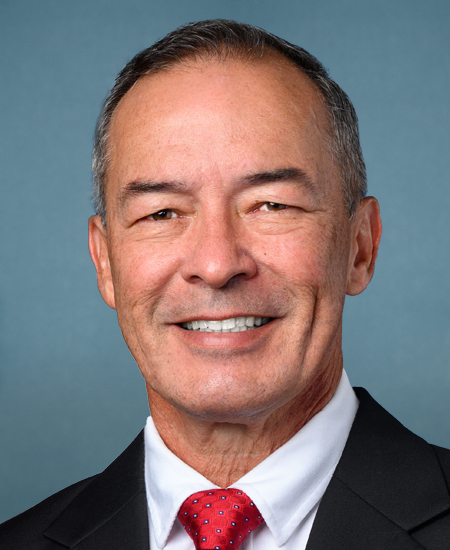
Rep. James C. Moylan
Sponsored bills
Noncontiguous Shipping Competition Act This bill revises coastwise laws, commonly known as the Jones Act, that govern domestic transportation of merchandise or passengers by vessels. The Jones Act generally requires that a vessel transporting merchandise or passengers from one U.S. point to another U.S. point be (1) built in the United States, (2) at least 75% owned by U.S. citizens, and (3) mostly crewed by U.S. citizens. The act also includes several exemptions and exceptions. The bill exempts carriage on a route in noncontiguous trade from Jones Act requirements unless (1) at least three owners or operators of coastwise qualified vessels regularly operate such a vessel on the route, (2) each of such owners or operators transports at least 20% of the volume of goods on that route, and (3) none of such owners or operators are under common ownership. (Generally, noncontiguous trade is trade between two U.S. points where at least one of the points is in Alaska, Hawaii, Puerto Rico, or an insular territory or U.S. possession.)
Maddy summaryThe Panama Canal Zone Veterans Act of 2023 creates a presumption that veterans who served in the Panama Canal Zone between 1958 and 1999 (or until the last military member left) and developed specific illnesses are automatically eligible for VA benefits without needing to prove a direct link between their service and the condition. It lists 16 illnesses, including prostate cancer, lung cancer, diabetes, Parkinson's disease, and several other cancers, as qualifying for this presumption due to presumed exposure to herbicides like Agent Orange during service. The VA will use regulations based on medical evidence to determine which illnesses qualify under this provision. This change directly affects veterans who served in the Panama Canal Zone during the covered period and later developed one of the listed conditions.
Maddy summaryThe PLUS for Veterans Act of 2023 clarifies and updates rules for veterans' benefit claims under the Department of Veterans Affairs. It sets a $12,500 annual fee cap (adjusted for inflation) for agents or attorneys representing veterans, prohibits charging fees for medical exams, and prohibits unauthorized fees with penalties including fines or up to one year in prison. The bill directly affects veterans seeking benefits, their legal representatives, and the VA by standardizing fee agreements, requiring VA reports on agent/attorney suspensions, and ensuring veterans can access free services from VA-recognized organizations. Key provisions include banning fees for medical reports and requiring clear fee disclosures to veterans.
This bill extends a provision that removes numerical limits for visas for certain temporary nonagricultural workers working on Guam or the Northern Mariana Islands. Under this bill, the provision shall apply to qualifying H-2B visa holders who are admitted into Guam or the Northern Mariana Islands before December 31, 2029, whereas currently the provision applies to H-2B visa holders admitted before December 31, 2024. (The provision exempts qualifying H-2B visa holders from the annual numerical limit on such visas. Generally, this exemption applies to H-2B workers performing labor (1) related to construction or facility services associated with the military alignment occurring on Guam or the Northern Mariana Islands; or (2) as a health care worker at a facility that jointly serves Armed Forces members, dependents, and civilians on Guam or the Northern Mariana Islands.)
Maddy summaryThis bill creates a 2-year pilot program to establish or improve state-based nursing workforce centers. It provides $1.5 million annually (2024-2025) for up to six state or regional centers, requiring non-Federal matching funds (1:4 ratio). These centers will analyze nursing workforce data - including education, retention, and shortages - and develop strategies to recruit, retain, and diversify nurses, especially in rural and underserved areas. The program mandates annual reports to Congress on outcomes and best practices for addressing nursing shortages. It directly affects states, nursing schools, healthcare employers, and nursing workforce centers through federal grants and data-driven planning.
Maddy summaryHR 2510 makes the federal adoption credit for children with special needs refundable, meaning families who adopt such children can receive a cash refund even if they don't owe federal income tax. The bill directly affects adoptive parents who claim the credit for children with special needs, allowing them to get the full credit amount as a refund rather than just reducing their tax bill. Key provisions define "special needs adoption expenses" as qualified costs for these adoptions and adjust tax code language to treat this portion as a refundable credit. The changes apply to taxable years beginning after December 31, 2023.
Maddy summaryHR 1362, the Saving America’s Energy Future Act, prohibits federal agencies from banning new oil and gas leasing or drilling permits on federal lands. It directly prevents the Secretaries of Agriculture (for National Forest System lands) and Interior (for other public lands) from implementing moratoriums on these activities. The bill’s key mechanism is a clear statutory ban requiring agencies to continue processing new leases and permits without delay. This policy change affects oil and gas companies seeking access to federal land resources by ensuring leasing processes remain active. The bill does not create new programs or alter environmental standards, only blocking a specific regulatory action.
This resolution commemorates the 190 th anniversary of diplomatic relations between the United States and Thailand. It also looks forward to enhancing the ties of friendship between the peoples of Thailand and the United States.
Maddy summaryHR 1139, the GUARD VA Benefits Act, amends federal law to strengthen penalties for individuals or organizations charging veterans unauthorized fees when helping with VA benefit claims. It directly affects veterans seeking assistance with VA claims and the representatives (like advocates or attorneys) who might charge them fees. The bill adds a new provision making it a violation to solicit, charge, or receive any fee for preparing, presenting, or prosecuting VA claims, punishable by fines under Title 18. This change specifically targets unauthorized fee-charging while excluding fees covered under existing exceptions in sections 5904 or 1984 of the law.