

Maddy summaryThe Merchant Marine Allies Partnership Act establishes a "Foreign Ally Shipping Registry" to allow vessels from designated U.S. allies to engage in U.S. coastwise trade (transporting goods between U.S. ports). Vessels must be wholly owned by nationals or governments of registry countries (including NATO members by default) and flagged in the U.S. or a registry country, with the Secretary of Transportation authorizing trade for up to five years per vessel. The bill exempts these vessels from U.S. crewing requirements (like citizenship rules) and waives duties on repairs made in shipyards of registry countries for documented vessels. Removal of a country from the registry requires congressional notice and a 30-day delay, except during declared war.
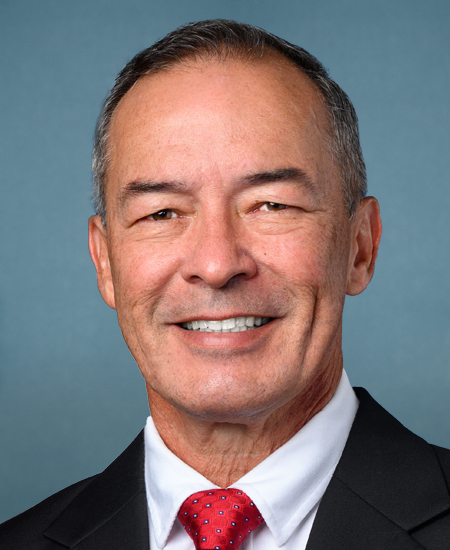
Rep. James C. Moylan
Sponsored bills
Maddy summaryThis bill creates a temporary waiver allowing vessels to bypass standard navigation and vessel-inspection laws when delivering disaster relief cargo to or from specific U.S. territories and states not connected to the mainland. It directly affects shipping companies transporting aid to Puerto Rico, the U.S. Virgin Islands, Guam, American Samoa, the Northern Mariana Islands, Hawaii, or Alaska after a presidential disaster declaration under the Stafford Act. The waiver lasts up to 10 days initially, extendable by another 10 days (with a 45-day maximum total per disaster), and requires agencies to notify relevant congressional committees within 48 hours of issuing or extending a waiver. The law does not change existing disaster relief procedures but streamlines shipping logistics during emergencies in these noncontiguous areas.
Maddy summaryThis bill would create a single online hub for small businesses to find all necessary federal, state, and local permits and licenses. The Small Business Administration’s Director must establish and maintain this website within one year of enactment. The site will organize requirements by business location and type, simplifying how small business owners navigate complex regulatory systems. This directly affects small businesses operating across multiple jurisdictions, replacing scattered information with a centralized resource.
Maddy summaryHR 4793, the SOS Act, requires the government to add a specific graph to annual reports about Social Security trust funds. The graph must compare two different funding assumptions: the amount assumed under current law (based on dedicated funding sources) versus the amount assumed under the Balanced Budget Act of 1985. This bill does not change Social Security payments or benefits; it only modifies how the government reports on trust fund finances. The requirement applies to reports prepared by the Congressional Budget Office and Treasury Department, affecting the transparency of federal budget documentation.
Maddy summaryHR 4814, the Supplemental Security Income Equality Act, extends federal Supplemental Security Income (SSI) benefits to residents of Puerto Rico, the U.S. Virgin Islands, Guam, and American Samoa. It directly affects low-income seniors, disabled individuals, and children in these territories who currently cannot access SSI due to territorial status. Key provisions include removing exclusions from the definition of "state" in the Social Security Act, eliminating payment limits for territories, treating U.S. nationals equally with citizens for eligibility, and including territories in geographic definitions for SSI. The bill also grants the Social Security Commissioner authority to waive requirements to adapt the program to each territory's needs. This would create a concrete policy change, allowing these territories to participate in the federal SSI program.
Maddy summaryThis bill updates the TRICARE Young Adult Program to make healthcare coverage more accessible for military dependents. It directly affects young adults (ages 21-26) who are children of active-duty service members, by eliminating a separate premium they previously paid for coverage. Key changes include removing an extra cost for young adults and adjusting eligibility rules to simplify enrollment. These amendments aim to reduce out-of-pocket expenses and streamline access to health insurance under the program.
Maddy summaryThis bill creates a new Office of Security Assistance within the State Department to improve coordination and effectiveness of security assistance programs. It establishes a Coordinator for Security Assistance who will oversee planning, monitoring, and evaluation, and requires all relevant State Department bureaus and diplomatic posts to designate personnel for coordination. The bill mandates new training for personnel on security assistance processes, creates a common database to track all security assistance programs, and requires regular assessments of program effectiveness. It also establishes a framework for planning security assistance based on country-specific assessments and requires annual reporting to Congress. These changes aim to improve the strategic use of U.S. security assistance to promote U.S. security interests and partner capacity.
Maddy summary# Summary of "Dignity for Immigrants while Guarding our Nation to Ignite and Deliver the American Dream Act" This comprehensive immigration bill proposes multiple pathways to legal status and permanent residency for undocumented immigrants while creating new employment and workforce development programs. ## Key Provisions: 1. **Dignity Program (Subtitle III)**: - Creates a 7-year program for eligible undocumented immigrants requiring $7,000 in restitution payments to an H-1B fund - Provides deferred action on removal, work authorization, and travel privileges - Requires participants to maintain employment/education, pay taxes, and comply with all laws - Upon completion, participants receive "Dignity Status" valid for 7 years with renewal options 2. **Workforce Development (Division C)**: - Directs restitution payments to fund apprenticeships and work-based learning programs - Establishes industry partnerships to support small- and medium-sized businesses - Focuses on "in-demand industry sectors" with targeted training programs - Requires 12 months of post-employment support services for participants 3. **Family Reunification (Section 3111-3115)**: - Expands discretionary authority for family-based relief - Creates new "family purpose" nonimmigrant visa category (90-day limit) - Modernizes military naturalization for service members - Includes protections for children affected by visa backlogs 4. **Backlog Reduction (Section 3201-3203)**: - Creates premium processing for long-pending cases ($20,000 fee) - Increases per-country caps from 7% to 15% - Protects children from "aging out" of family-based visas 5. **Student and Worker Visas (Section 3301-3305)**: - Modernizes student visa categories with "dual intent" provisions - Recognizes doctoral STEM graduates as "extraordinary ability" - Streamlines visa processing through a new Immigration Agency Coordinator The bill aims to balance immigration reform with workforce development, creating a pathway to legal status while directing funds toward American workers through apprenticeships and training programs in high-demand fields.
Maddy summaryHR 4391 authorizes the U.S. State Department to lead a Minerals Security Partnership with international allies, aiming to build secure supply chains for critical minerals used in clean energy, defense, and technology. It establishes mechanisms for joint projects, cost-sharing on infrastructure, and market-based incentives to reduce reliance on countries like China and Russia for minerals such as lithium and cobalt. The bill requires environmental and social standards for project selection and directs the creation of a public database to share project information and attract private investment. This legislation directly affects U.S. foreign policy coordination, international partners, and companies involved in critical mineral supply chains.
Maddy summaryHR 4390, the U.S. Diplomatic Posture Review Act of 2025, requires the State Department to conduct regular reviews of its global diplomatic presence. The bill mandates the Secretary of State to submit an initial report within 180 days of enactment, followed by annual updates, detailing all diplomatic posts (including embassies, consulates, and virtual offices), consular service quality for Americans overseas, resource needs, foreign aid spending by country, and financial obligations. These reports must include an unclassified summary and be accompanied by classified briefings to Congress on proposed adjustments to diplomatic staffing and strategic priorities. The law directly affects the State Department’s operations and requires annual congressional oversight of diplomatic resource allocation.