

Maddy summaryThe MOLD Act (HR 7188) establishes uniform health and safety standards for military housing managed by private contractors, directly affecting approximately 700,000 service members and their families living in privatized housing across 78 developments. It requires the Defense Secretary to set enforceable limits on indoor humidity (below 50%), mandate third-party inspections after tenant complaints or unit turnover, and hold contractors fully responsible for mold remediation, relocation costs, and property damage. The bill also mandates public reporting of complaints, inspection results, and remediation timelines, and requires contractors to use certified professionals for mold assessments. These provisions aim to reduce mold-related health risks and improve accountability in privatized military housing.
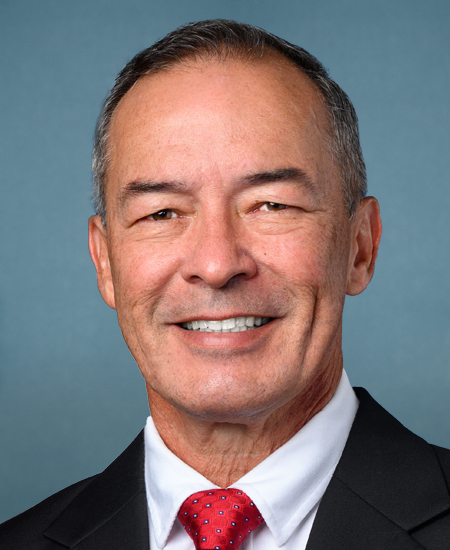
Rep. James C. Moylan
Sponsored bills
Maddy summaryThe AI OVERWATCH Act requires U.S. exporters to obtain a license for sending certain high-performance integrated circuits (defined by specific technical specifications like processing power or bandwidth) to countries designated as "concerns," including China, Russia, Iran, and North Korea. Before approving such licenses, the Commerce Department must submit detailed certifications to Congress, including assurances the export won’t support military/intelligence capabilities of the recipient country and won’t harm U.S. semiconductor availability or AI leadership. The bill also creates an exemption for U.S. companies meeting strict security and ownership standards ("trusted United States persons") to export these chips to non-target countries without a license. Additionally, it mandates a national security strategy assessing how such exports affect U.S. AI competitiveness, particularly regarding China’s semiconductor production and capabilities.
Maddy summaryThe China AI Power Report Act requires the Secretary of Commerce to produce annual reports to Congress assessing China's artificial intelligence capabilities. These reports would cover detailed technical assessments of Chinese semiconductor manufacturing, AI models, research funding, computational capacity, and other key areas related to China's AI development. The legislation mandates specific evaluations of China's chip production, fabrication facilities, semiconductor equipment, AI models, and how these capabilities are being used domestically and internationally. The reports aim to inform U.S. export control policies and maintain U.S. strategic advantage in AI technology, with unclassified summaries to be made publicly available.
Maddy summaryThe PORCUPINE Act amends the Arms Export Control Act to include Taiwan alongside New Zealand and Israel in specific certification and reporting requirements related to U.S. arms exports. This legislative change ensures Taiwan is treated similarly to these allied nations in certain foreign policy contexts involving defense article transfers. The bill also directs the Secretary of State to assess the feasibility of creating an expedited licensing process for military equipment transfers from designated allies to Taiwan within 90 days. Additionally, the act requires biennial reports on the implementation of these amendments and includes a provision stating that the legislation does not alter existing U.S. policy toward Taiwan under the Taiwan Relations Act. The entire measure is set to expire seven years after its enactment.
Maddy summaryHR 7117, the Fast Track To and Through College Act, creates two pathways to accelerate college completion: "early college fast track pathways" that allow high school students to earn college credit through advanced coursework (like AP, IB, or dual enrollment), and "early high school graduation fast track pathways" that provide scholarships for students who graduate early without needing remedial college courses. The bill requires states to develop statewide policies and credit transfer agreements to align high school and college requirements, with competitive grants to help states implement these pathways. It also allows eligible high school students in these pathways to receive Federal Pell Grants while still in high school, with a waiver of the usual 12-semester Pell Grant cap. The bill aims to reduce college costs, improve credit transfer, and increase college completion rates, particularly for first-generation college students and other historically underrepresented groups.
Maddy summaryThe RAYS Act (HR 7092) requires secondary schools to include suicide prevention contact information on student identification cards or, if cards aren't issued, on school websites and student-accessible online platforms. Schools must list the 988 Suicide and Crisis Lifeline, Crisis Text Line, and a local suicide prevention hotline. The bill also allows schools to optionally add more mental health resources and mandates federal outreach to inform students, parents, and staff about these services. It takes effect one year after enactment for physical ID cards and 60 days later for digital methods.
Maddy summaryThis bill allows U.S. territories - American Samoa, Guam, the Northern Mariana Islands, Puerto Rico, and the U.S. Virgin Islands - to contribute statues to the National Statuary Hall Collection, which currently features statues from states. It amends existing law to define "State" in relevant statutes to include these territories, enabling their statues to be placed alongside state statues. The Architect of the Capitol will manage acquiring and installing these statues. The bill does not change voting rights or policy for residents but updates procedural rules for statue placement.
Maddy summaryThis bill modifies federal sentencing for young people under 18 who were previously trafficked, abused, or assaulted before committing violent crimes. It allows judges to sentence below mandatory minimums and suspend parts of a sentence to account for the trauma the offender experienced. The law specifically applies to those convicted of violent offenses after the bill's enactment, provided the court finds clear evidence they were victimized under specific federal trafficking or abuse laws within the prior year. It directly affects minors with documented histories of victimization who commit violent acts, giving judges discretion to consider their trauma during sentencing.
Maddy summaryHR 7043 extends the funding period for the transmission facilitation program under the Infrastructure Investment and Jobs Act. It amends Section 40106(d)(3) by changing the program's authorization from 2022-2026 to 2026-2031. This change directly affects the program's operation, allowing continued support for grid infrastructure projects without altering its scope or eligibility. The bill makes no new policy changes but ensures the program remains active through 2031.
Maddy summaryThis bill creates a new federal tax credit for low-to-moderate income homeowners to offset energy costs. It allows a 75% credit for energy expenses (heating/cooling) exceeding 3% of a taxpayer’s modified adjusted gross income, capped at $1,500 annually ($3,000 for joint filers), and only applies to principal residences. The credit is available to individuals with modified AGI under $75,000 ($150,000 for joint returns), beginning in 2025 and expiring after 2027. It directly affects eligible homeowners facing high energy bills relative to their income, without altering other tax provisions.