

This resolution expresses the sense of the House of Representatives that (1) for purposes of federal law, a person's sex means the person's biological sex at birth; and (2) distinctions between the sexes are justified in certain settings, laws, and policies.
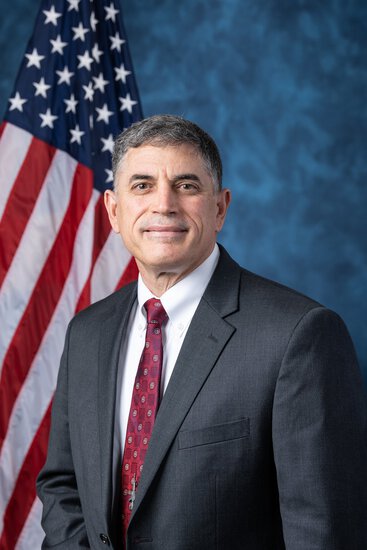
Rep. Andrew S. Clyde
Sponsored bills
Maddy summaryHR 935, the Safety and Opportunity for Girls Act of 2023, amends Title IX of the Education Amendments of 1972 to define "sex" as determined by reproductive biology and genetics at birth, and clarifies that "sex-segregated" means limited to or separated by that sex. The bill explicitly prohibits the Secretary of Education from requiring schools to eliminate sex-segregated bathrooms, locker rooms, or athletic/academic programs as a condition for receiving federal funding under Title IX. It directly affects educational institutions receiving federal funds by preventing federal enforcement actions that might compel them to abandon existing sex-segregated facilities or programs. The bill focuses on altering the legal interpretation of Title IX regarding sex-based accommodations, not creating new programs or services.
Maddy summaryThis bill amends the Higher Education Act to require colleges and universities receiving federal funding to disclose gifts or contracts exceeding $5,000 from groups connected to China's government, Communist Party, or military. It mandates annual reports on joint activities with such groups and requires institutions to publicly post all agreements with them on their websites. The law defines "affiliated" organizations broadly to include state-owned enterprises, think tanks receiving significant Chinese funding, and entities with Chinese officials on their boards. Reports must be filed by January 31 or July 31 each year, detailing donor names, agreement terms, and supporting documentation.
Exposing Lewd Outlays for social Networking companies Act or the ELON Act This bill requires a report on Department of Justice (DOJ) payments to certain companies (i.e., Twitter, Meta, Google, Microsoft, and Apple) and imposes a one-year moratorium on payments to these companies. Specifically, the bill requires the Government Accountability Office to submit a report to specified congressional committees on all payments made by DOJ to these companies since January 1, 2015. Additionally, the bill imposes a one-year moratorium on DOJ that temporarily prohibits the use of federal funds to make payments to these companies, unless such funds are lawfully owed to any such company.
Finish the Wall Act This bill requires the Department of Homeland Security (DHS) to resume activities related to the construction of a barrier system along the U.S.-Mexico border and addresses other border-related issues. DHS must resume all such construction activities that were planned or underway prior to January 20, 2021. DHS must also expend all funds appropriated or explicitly obligated since October 1, 2016, for construction of this barrier system. DHS may not cancel contracts for activities related to such construction entered into on or before January 20, 2021. Furthermore, within 14 days of this bill's enactment, DHS must certify to Congress that U.S. Customs and Border Protection facilities that process adults taken into custody at the border are fully compliant with certain laws related to the collection of DNA. (Among other things, these laws allow for the collection of DNA samples from non-U.S. persons detained under U.S. authority.)
Travel Mask Mandate Repeal Act of 202 3 This bill prohibits federal agencies from mandating the use of masks or face coverings on planes, trains, buses, and other public conveyances and at transportation hubs to prevent the transmission of COVID-19. Specifically, the bill nullifies (1) the rule issued by the Centers for Disease Control and Prevention (CDC) on January 29, 2021, that mandates such use of masks or face coverings; and (2) orders and directives of the Transportation Security Administration that relate to the CDC rule.
Maddy summaryHCONRES 9 is a symbolic resolution passed by the U.S. House of Representatives that formally denounces socialism as incompatible with American values, citing historical examples of socialist regimes causing widespread suffering and authoritarian rule. It states Congress opposes the implementation of socialist policies in the United States. This resolution has no legal effect, does not change any laws, and serves solely as a non-binding statement of congressional opinion. It directly affects no individuals or policies, as it is purely a declarative position.
Maddy summaryHJRES 31 is a procedural resolution seeking congressional disapproval of a specific rule issued by the Department of Veterans Affairs (VA) concerning reproductive health services. It targets the VA's September 2022 rule (published in the Federal Register as 87 Fed. Reg. 55287), which established policies for reproductive health care access for veterans. If passed, this resolution would nullify the VA rule, preventing it from taking effect under the Congressional Review Act (Chapter 8 of Title 5, U.S. Code). The bill directly affects the VA’s ability to implement its reproductive health services policy for veterans.
This resolution condemns Iranian state-sponsored terrorist attacks against U.S. citizens and officials and Iranian dissidents. The resolution also expresses support for the people of Iran who are legitimately defending their rights for freedom against repression and condemns the killing of Iranian protesters by the Iranian regime.
Maddy summaryHCONRES 13 is a concurrent resolution expressing Congress's support for maintaining the current policy that prohibits imposing new fees on local radio stations for playing music. It states that Congress should not impose any performance fee, tax, royalty, or charge on local radio stations for broadcasting sound recordings over the air, or on businesses like bars and restaurants that play music publicly. The resolution argues that such fees would harm local radio stations - critical sources for emergency information and community programming - and jeopardize the economic model that has supported both radio and the music industry for decades. This resolution does not create new law but formally opposes potential legislative changes to the existing fee structure.