

Midland Over Moscow Act This bill imposes sanctions related to the Nord Stream 2 pipeline and revises the expedited approval process for natural gas imports and exports in or out of the United States. (Nord Stream 2 is a pipeline constructed to increase the export of natural gas from Russia to Europe.) Within 10 days of this bill's enactment, the President must impose sanctions on any entity responsible for the planning, construction, maintenance, financing, or operation of Nord Stream 2, as well as any corporate officer or principal shareholder with a controlling interest in such an entity. The bill also revokes the President's authority to waive certain sanctions related to Nord Stream 2 and TurkStream, another Russian natural gas pipeline project. The bill also allows any nation, with specified exclusions, to use an expedited process to receive approval to import or export natural gas in or out of the United States (currently only a nation with a free trade agreement with the United States may use the expedited process). Specifically, the bill excludes any nation (1) subject to U.S.-imposed sanctions or trade restrictions, or (2) excluded by the President or Congress for national security reasons.
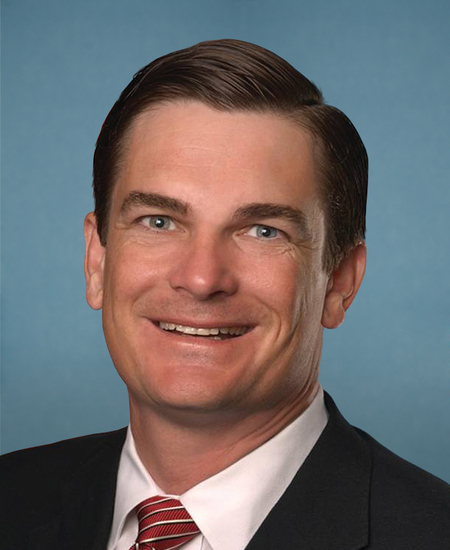
Rep. Austin Scott
Sponsored bills
Stop the Betrayal Act of 2022 This bill prohibits using federal funds to transport an unlawfully present non-U.S. national ( alien under federal law) into a U.S. region that is not within the border jurisdiction of U.S. Customs and Border Protection, unless such transportation is for (1) enforcing immigration laws, or (2) bringing an unaccompanied alien child to a Department of Health and Human Services facility.
American Tech Workforce Act of 2021 This bill eliminates the Optional Practical Training Program and modifies requirements for H-1B visas (nonimmigrant workers in specialty occupations and fashion models). (The Optional Practical Training Program provides an eligible F-1 student visa holder temporary employment authorization before or after completion of the student's studies, or both.) Under this bill, the employer must pay an H-1B visa holder the greater of (1) the annual wage paid to a U.S. worker who did identical or similar work in the two years before the employer's H-1B application; or (2) $110,000, with this amount to be adjusted annually for inflation. Currently, the H-1B visa holder must be paid the greater of (1) the employer's actual wage for similarly qualified U.S. workers in the specific position, or (2) the local prevailing wage for the occupational classification. The bill also removes a requirement for the employer to provide the visa holder with working conditions such that the working conditions of similarly employed workers will not be affected. The bill imposes limits on assigning H-1B visa holders to third-party work sites, such as limiting the visa validity period to one year if the visa holder performs any part of their assignment at a third-party work site. The bill requires the H-1B applications with the highest listed compensation to be granted before those with lower listed compensation.
Halt All Lethal Trafficking of Fentanyl Act or the HALT Fentanyl Act This bill places fentanyl-related substances as a class into schedule I of the Controlled Substances Act. A schedule I controlled substance is a drug, substance, or chemical that has a high potential for abuse; has no currently accepted medical value; and is subject to regulatory controls and administrative, civil, and criminal penalties under the Controlled Substances Act. Additionally, the bill establishes a new, alternative registration process for schedule I research that is funded by the Department of Health and Human Services or the Department of Veterans Affairs or that is conducted under an investigative new drug exemption from the Food and Drug Administration. The bill also makes several other changes to registration requirements for conducting research with controlled substances, including permitting a single registration for related research sites in certain circumstances, waiving the requirement for a new inspection in certain situations, and allowing a registered researcher to perform certain manufacturing activities with small quantities of a substance without obtaining a manufacturing registration.
Removing Waste and Protecting Medicare Act This bill makes several budgetary changes, including (1) prohibiting sequestration orders in 2022, (2) rescinding certain COVID-19 state and local relief funds, and (3) extending certain adjustments under Medicare with respect to sequestration and payments under the physician fee schedule. It also modifies requirements relating to federal programs and benefits, such as permanently requiring taxpayers to include Social Security numbers on their tax returns in order to qualify for the child tax credit.
Public Safety Enhancement Act of 2021 This bill reauthorizes through FY2026 the Community Oriented Policing Services (COPS) grant program. Additionally, the bill requires a certain amount of funds made available under the COPS grant program to be used for the hiring and retention of law enforcement officers.
Keep Food Local and Affordable Act of 2021 This bill freezes the minimum wage for H-2A (temporary agricultural workers) in certain states through December 31, 2022. Specifically, the bill prohibits an increase to the adverse effect wage rate for H-2A workers in any state (1) that had an unemployment rate of not more than 5% in the Bureau of Labor Statistics' August 2021 report; or (2) where the food price index, according to bureau reports, increased by more than 3% between December 2020 and September 2021 and the governor requests a freeze to the adverse effect wage rate. (Generally, the minimum wage for an H-2A worker is the highest of the adverse effect wage rate, the prevailing hourly wage or piece rate, the federal minimum wage, or the applicable state minimum wage.)
Illegal Immigrant Payoff Prohibition Act This bill prohibits the payment of a settlement to an alien for a civil action brought against the United States in connection with the alien's inadmissibility to, or unlawful presence in, the United States.
World Deserves To Know Act This bill requires sanctions on certain members of the Chinese Communist Party (CCP) and officials of Chinese health agencies. It also addresses related issues. The President must impose visa- and property-blocking sanctions on any foreign person who is a CCP official and who is knowingly responsible for or complicit in (1) the disappearances of whistleblowers and citizen journalists in China relating to COVID-19, or (2) limiting free speech and academic freedom in China relating to COVID-19. The President must also impose such sanctions on specified individuals who have leadership positions in China's Center for Disease Control and Prevention and China's National Health Commission (NHC). The authority to impose such sanctions shall end when the President certifies to Congress that an independent and unimpeded investigation into the potential origin of COVID-19 from the Wuhan Institute of Virology has taken place. The bill also bars federal funds and certain federal student assistance from going to institutions of higher education that enter into a contract with any element or China-based affiliate of the NHC. Federal funding to the National Academy of Sciences may not be used to enter into a contract with any element or China-based affiliate of the NHC. The Government Accountability Office must report to Congress a review of all funds that the National Institutes of Health have made available to the NHC since FY2010. This report must also be publicly available.
Firearm Due Process Protection Act This bill expands the grounds for pursuing judicial remedies related to certain firearm transfers. Additionally, the bill establishes procedural rules applicable to actions for judicial remedies. Current law authorizes judicial remedies for an individual who is erroneously denied a firearm (e.g., an individual is denied a firearm but the individual is eligible to receive or possess a firearm). This bill authorizes remedies for an individual who experiences an extended delay (i.e., a delay of more than 60 days) on a firearm transfer. Additionally, the bill requires an expedited hearing on an action for judicial remedies and places the burden of proof on the respondent to show by clear and convincing evidence that the individual was ineligible to receive or possess a firearm.