

Sanctioning Russia Act of 2025 This bill imposes penalties on certain persons (individuals and entities) if the President determines that the Russian government or a person acting at Russia's direction is involved with (1) refusing to negotiate a peace agreement with Ukraine; (2) violating a negotiated peace agreement; (3) initiating another invasion of Ukraine; or (4) overthrowing, dismantling, or seeking to subvert the Ukrainian government. If the President makes such a determination, the bill requires certain actions including the President must impose visa- and property-blocking sanctions on specified persons such as the Russian president, certain Russian military commanders, and any foreign person that knowingly provides defense items to the Russian armed forces; the President must increase the rate of duty on all goods and services imported from Russia into the United States to at least 500% relative to the value of such goods and services; the President must increase the rate of duty on all goods and services imported into the United States from countries that knowingly engage in the exchange of Russian-origin uranium and petroleum products to at least 500% relative to the value of such goods and services; the Department of the Treasury must impose property-blocking sanctions on any financial institution organized under Russian law and owned wholly or partly by Russia, and any financial institution that engages in transactions with those entities; and the Department of Commerce must prohibit the export, reexport, or in-country transfer to or in Russia of any U.S.-produced energy or energy product.
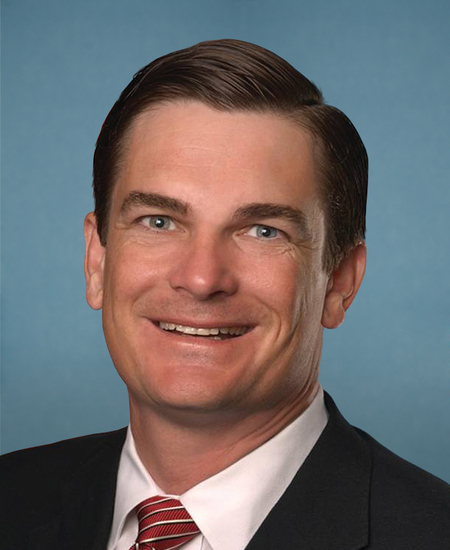
Rep. Austin Scott
Sponsored bills
Securing Our Lands and Resources Act or the SOLAR Act This bill prohibits the Department of Agriculture from providing financial assistance for certain projects that would result in the conversion of covered farmland for solar energy production. Under the bill, covered farmland generally refers to prime farmland, unique farmland, and farmland that is of statewide or local importance. Conversion means any activity that results in the covered farmland no longer meeting certain requirements for agricultural production, activity, or use. The bill includes an exception for certain smaller projects that result in the conversion of (1) less than 5 acres of covered farmland, or (2) less than 50 acres of covered farmland if the majority of the energy produced by the project is for on-farm use. The bill also includes an exception for projects that have the approval or support from the local county and municipality. For these projects, the applicant must (1) develop a farmland conservation plan for the project (e.g., implementing best practices to protect future soil health and productivity), and (2) ensure that sufficient funds are provided for the decommissioning of the solar energy production system and the remediation and restoration of the farmland.
Maddy summaryHR 1417 establishes a new program within the U.S. Department of Agriculture to provide tailored technical assistance to rural health care facilities. The program directly supports facilities like hospitals, clinics, and health centers in rural areas by helping them identify operational needs, improve financial management, and access USDA loan and grant programs. Key provisions include prioritizing facilities in medically underserved areas or facing financial vulnerability, with a $2 million annual funding limit for fiscal years 2026-2030. The program requires annual reports on outcomes and effectiveness to Congress, focusing on preventing facility closures and strengthening rural health care delivery.
Maddy summaryHRES 260 designates March 27, 2025, as "National Women in Agriculture Day" to recognize women's contributions to U.S. agriculture. The resolution highlights that women represent over 1.2 million agricultural producers (more than one-third of all U.S. producers) and generated $222 billion in agricultural sales in 2022. It encourages citizens to recognize women working in agriculture and supports their roles in leading the industry, mentoring future agricultural workers, and advancing food production. This is a symbolic resolution with no new policies or funding, solely celebrating existing contributions during National Women’s History Month and National Ag Week.
Maddy summaryThe SHORT Act (HR 2395) redefines federal firearm definitions to exclude antique and collector firearms from being classified as firearms, and removes distinctions between short-barreled rifles and shotguns in federal regulations. It prevents state laws from imposing taxes or registration requirements on short-barreled rifles and shotguns, requiring state rules to align with federal compliance instead. The bill also mandates the federal government to destroy specific records related to these firearms within one year of enactment.
Maddy summaryThe Freedom from Unfair Gun Taxes Act of 2025 would prohibit states and local governments from imposing taxes on the sale of firearms, ammunition, or firearm parts during interstate or foreign commerce. This bill directly affects state tax policies and manufacturers or dealers selling these items across state lines. It explicitly states that the bill does not change the existing federal tax on firearms and ammunition that funds wildlife conservation programs. The key provision bans state-level taxes for these sales in interstate transactions while preserving current federal funding mechanisms.
Maddy summaryHRES 254 is a non-binding resolution recognizing the 250th anniversary of the United States Marine Corps, to be observed on November 10, 2025. The resolution honors the Corps' founding at Tun Tavern in Philadelphia on November 10, 1775, its history of service in major conflicts, and its values of honor, courage, and commitment. It encourages public participation in commemorative events and local recognition of Marines' contributions to national defense.
Maddy summaryThis bill redesignates the existing Ocmulgee Mounds National Historical Park as Ocmulgee Mounds National Park and establishes a separate Ocmulgee Mounds National Preserve in Georgia. It allows voluntary land acquisition (via purchase, donation, or exchange) for both areas without eminent domain, and requires the Secretary of the Interior to develop a management plan prioritizing cultural resource preservation for the Muscogee (Creek) Nation. The bill mandates tribal consultation, provides hiring preferences for tribal members, and ensures protection of sacred sites. It also places 126 acres of tribal land into federal trust for the Muscogee (Creek) Nation.
Maddy summaryHR 1596 renames the U.S. National Poultry Research Center in Athens, Georgia, as the "Abit Massey Poultry Research Center" for all official government references. This naming bill updates the facility's official designation without changing its operations, funding, or policies. It directly affects the center's administrative and legal documentation but does not alter its research activities or impact any individuals or groups.
Maddy summaryThis bill modifies SNAP (food stamp) program rules to prevent potential misuse. It requires states to suspend SNAP benefits for households making all card transactions out-of-state for over 60 days, unless they prove continued residency in their state through evidence or an investigation. It also prohibits households where members own retail or wholesale food stores from using SNAP benefits at those businesses, with exceptions for publicly owned or government-run stores. These changes directly affect SNAP recipients who move without updating their address or own participating food businesses, aiming to ensure benefits are used by eligible residents. The rules take effect one year after enactment.