

Maddy summaryHR 4889, the Raise the Wage Act of 2023, would gradually increase the federal minimum wage for most workers to $15.50 per hour by 2027, with specific annual targets: $9.50 starting in 2023, rising to $11.00 after one year, $12.50 after two years, and $15.50 after four years. It would also phase out the separate lower minimum wage for tipped employees (starting at $6.00/hour) by aligning their pay with the regular minimum wage by 2028, while requiring employers to let workers keep all tips. The bill includes similar phased increases for workers under 20 and transitions toward fairer wages for workers with disabilities under special certificates, which would sunset after 2028. Future annual increases after 2028 would tie the minimum wage to the median hourly wage of all workers.
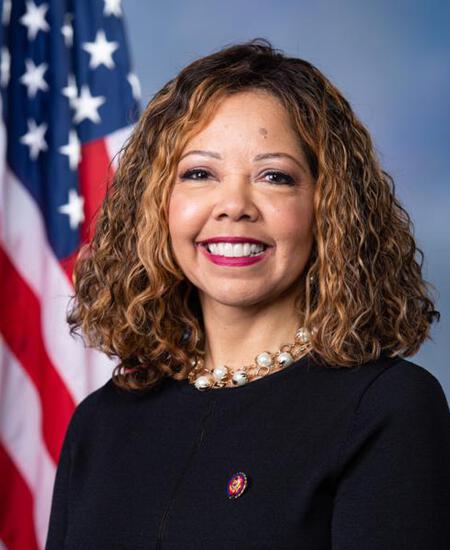
Rep. Lucy McBath
Sponsored bills
Maddy summaryThis bill amends the Child Nutrition Act to extend liability protections for food and pet supply donations. It adds definitions for "pet," "emotional support animal," and "pet supply" to the Act, clarifying that donations of pet food or supplies for pets, service animals, or emotional support animals are covered. The key provision (Section 22(c)(4)) shields donors and nonprofits from civil/criminal liability when donating such items in good faith for direct distribution to animals. It directly affects pet food donors, animal welfare nonprofits, and local governments distributing pet supplies. The bill does not create new programs but modifies existing donation rules to include pet-related items.
Maddy summaryH.J.Res. 25 would remove the 1979 deadline for states to ratify the Equal Rights Amendment (ERA), which was originally proposed in 1972. This bill directly affects states that ratified the ERA after the deadline (such as Nevada, Illinois, and Virginia in 2017-2018) by making their ratifications legally valid. The key provision states that the ERA is valid as part of the Constitution if ratified by three-fourths of states, regardless of the original deadline. The bill does not create new rights but aims to finalize the constitutional amendment process by eliminating the time limit.
Maddy summaryThis bill, HR 1282 (Major Richard Star Act), expands benefits for certain military retirees by allowing them to receive both veterans' disability compensation and military retirement pay simultaneously. It specifically affects combat-related disabled retirees under Chapter 61 of the military retirement system who have fewer than 20 years of service. The key change removes the automatic reduction of military retirement pay when these retirees also receive disability compensation, as amended in Section 1413a(b)(3) of Title 10. Technical updates to the law’s structure and effective date (starting after enactment) complete the provisions.
Maddy summaryHJRES 82 is a non-binding resolution stating that the Equal Rights Amendment (ERA) has been validly ratified by the required 38 states (including Virginia's 2020 ratification) and should be certified as the 28th Amendment to the U.S. Constitution. It directs the Archivist of the United States to fulfill their statutory duty under Title 1, U.S. Code, to certify and publish the ERA without delay. The resolution argues Article V of the Constitution has no ratification deadline, citing precedents like the 27th Amendment. It does not change the Constitution itself but urges the Archivist to complete the certification process. The bill affects the Archivist’s office, requiring them to act on the ERA’s ratification status.
Maddy summaryHRES 580 is a symbolic resolution expressing the House's support for designating "Journeyman Lineworkers Recognition Day." It honors lineworkers who work in hazardous conditions (such as at heights near live wires) and respond to disasters like hurricanes and wildfires, while recognizing their contributions and the legacy of Henry Miller, an early electrical worker who died on the job. The resolution has no legal effect - it solely encourages public recognition and reflection on these workers' service.
Maddy summaryThis bill authorizes $30 million annually (2024-2028) for the National Institutes of Health to expand research on uterine fibroids, including studies on racial disparities (noting Black women are 80% likely to develop fibroids by menopause versus 70% of White women). It also requires the creation of a Medicaid database to track treatment services for fibroids and mandates a congressional report on related costs and coverage. The bill directs the Department of Health and Human Services to develop public education materials about fibroid symptoms, treatment options (including non-hysterectomy care), and racial prevalence differences. It directly affects women with fibroids - particularly those from racial minority groups - and aims to improve data collection and awareness around a condition causing significant health burdens and healthcare costs.
Maddy summaryJaime’s Law requires federal background checks for ammunition purchases by expanding existing firearm background check rules to include ammunition. It mandates that unlicensed buyers must transfer ammunition through a licensed dealer (e.g., a gun store), who conducts the background check before completing the sale. The law includes exemptions for transfers between family members, law enforcement, transfers due to death, immediate self-defense situations, and legitimate shooting or hunting activities (with specific conditions). It explicitly states the law does not create a national ammunition registry and does not override state laws on ammunition.
Maddy summaryHR 4550 creates a federal grant program to help public elementary, secondary, and preschool schools recruit and retain paraprofessionals (school support staff like teaching assistants). The bill directs the Secretary of Education to fund state education agencies, which then distribute subgrants to schools - prioritizing those serving high numbers of low-income students - to support activities like mentoring programs, professional development, and wage increases or certification assistance (e.g., for special education or English learner support). States must report annually on wage baselines, paraprofessional numbers, and program outcomes. This bill directly affects schools and paraprofessionals, with funding authorized for fiscal years 2024-2028.
Maddy summaryThis bill requires national parks to reduce disposable plastic products, primarily targeting plastic water bottles and food containers sold to visitors. Park directors must eliminate these sales where feasible after considering factors like operational costs, waste reduction, infrastructure for refill stations, and impacts on park vendors. Each park must also implement visitor education about water availability and report biennially on progress, including visitor satisfaction and safety metrics. The law directly affects all national park units, concessionaire businesses, and park visitors. It mandates a phased, practical approach without banning all plastics immediately.