

Maddy summaryHRES 1582 is a non-binding House resolution honoring the seven individuals who died in the October 19, 2024, gangway collapse on Sapelo Island, Georgia, during the Gullah Geechee Cultural Day celebration. It specifically names the victims - Isaiah Thomas, Carlotta McIntosh, Jacqueline Crews Carter, Cynthia Alynn Gibbs, Queen Welch, William Lee Johnson, Jr., and Charles League Houston - and extends condolences to their families, the Gullah Geechee community, and those injured. The resolution also expresses hope for the recovery of the wounded and thanks first responders. As a commemorative resolution, it contains no policy changes or legislative mechanisms.
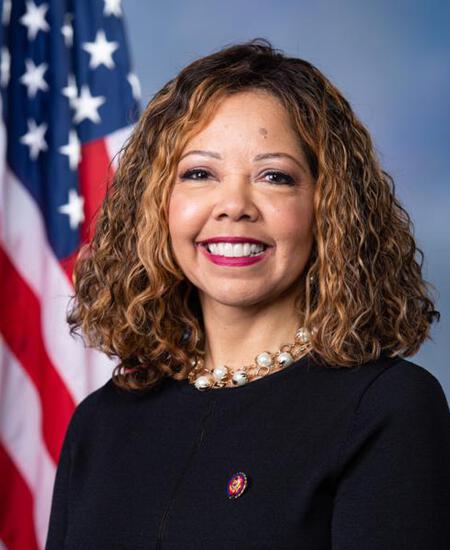
Rep. Lucy McBath
Sponsored bills
Maddy summaryThis bill redesignates the existing Ocmulgee Mounds National Historical Park as "Ocmulgee Mounds National Park" and establishes a separate "Ocmulgee Mounds National Preserve" in Georgia under the National Park System. It authorizes the Secretary of the Interior to acquire land for both areas only through voluntary purchases from willing sellers (not eminent domain), with boundaries defined by a specific map. The bill mandates co-management of the park and preserve with the Muscogee (Creek) Nation, allows tribal members to continue traditional ceremonies and hunting/fishing under state/federal laws, and requires an advisory council with tribal representation. The National Park Service must administer both areas as a single unit while respecting tribal cultural uses and existing wildlife refuge management.
Maddy summaryThis resolution (HRES 1558) is a symbolic House of Representatives measure supporting October as "National Domestic Violence Awareness Month." It does not create new laws or allocate funding but formally expresses the House's support for raising awareness about domestic violence and its impacts, and urges continued backing for existing programs that address domestic violence. The resolution cites statistics on domestic violence prevalence (e.g., 24 people per minute affected by intimate partner violence) to underscore the importance of the observance. It directly affects public awareness efforts but does not change policies or directly impact individuals.
Maddy summaryHRES 1530 is a non-binding House resolution recognizing former President Jimmy Carter's 100th birthday. It honors his life, public service, and key achievements, including his presidency (noting the Panama Canal treaties, Camp David Accords, and founding the Departments of Education and Energy), post-presidency work with the Carter Center, and decades of humanitarian efforts. The resolution does not create new laws or affect any policies; it is purely commemorative. It formally acknowledges his contributions to Georgia, the U.S., and global peace efforts, including his 2002 Nobel Peace Prize. This symbolic gesture has no direct impact on citizens or government operations.
Maddy summaryHRES 1516 is a resolution passed by the U.S. House of Representatives to commend Big Brothers-Big Sisters of America on its 120th anniversary. It recognizes the organization’s work in providing youth mentorship that helps young people graduate from school and plan for their future. The resolution highlights how the organization, operating in over 5,000 communities nationwide, has supported millions of young people through long-term mentor relationships. As a symbolic gesture, it does not create new laws or policies but expresses congressional support for the organization’s mission.
Maddy summaryThis resolution formally censures Representative Glen Clay Higgins (LA-03) for a September 25, 2024, social media post containing racist remarks and false claims about Haitians. The bill requires Higgins to appear in the House chamber to receive the censure, with the resolution publicly read by the Speaker. It specifically references his post describing Haiti as "the nastiest country," falsely accusing Haitians of eating pets, and labeling them "slapstick gangsters and thugs." The censure is a formal disciplinary action by the House, not a policy change.
Maddy summaryHRES 1515 designates October 1, 2024, as "National Animal Rescue Day" to raise public awareness about animal adoption, promote spaying and neutering to reduce pet overpopulation, and encourage more adoptions nationwide. The resolution supports community events, educational efforts, and charitable activities on that day to assist animal shelters and reduce the number of animals euthanized. It is a non-binding symbolic gesture without legal force, intended to unite communities around animal rescue initiatives.
Maddy summaryHR 1719, the Honoring Our Fallen Heroes Act of 2023, establishes a presumption that certain cancers diagnosed in public safety officers (like police and firefighters) are work-related if linked to their duties. It defines 22 specific cancers (including lung, mesothelioma, and WTC-related cancers) as "exposure-related," allowing officers or their families to receive benefits without proving direct work connection, provided they were diagnosed within 15 years of leaving active service. The bill also creates a process for adding new cancers to the list based on scientific evidence, requiring the Bureau to review petitions and make decisions within 180 days. This applies to deaths or disabilities occurring on or after January 1, 2023, directly affecting officers who developed covered cancers during service.
Maddy summaryThis resolution symbolically supports designating September 23-27, 2024, as "National Hazing Awareness Week." It does not create new laws but expresses the House’s endorsement of raising awareness about hazing in college settings. The resolution cites statistics showing 55% of college students experience hazing and references numerous fatalities linked to hazing incidents. It encourages ongoing hazing prevention efforts beyond the designated week and urges the public to observe the week through awareness and education. The resolution directly affects campus communities and student safety initiatives, though it has no binding legal effect.
Maddy summaryHR 9782, the Uterine Cancer Study Act of 2024, directs the U.S. Department of Health and Human Services (HHS) to study whether hair straighteners - specifically chemical products - may be linked to uterine cancer, with a focus on higher rates among women of color. The study will review existing research, examine impacts across racial and ethnic groups, and break down results by product type (e.g., dyed, bleached, or permed straighteners). HHS must submit a study methodology within 45 days of the bill’s enactment and complete the study, reporting findings to Congress within two years. The bill does not impose new regulations but may inform future FDA safety requirements for hair straightening products. This affects women of color disproportionately impacted by uterine cancer and the broader population using such products.