

Pregnant Workers Fairness Act This bill prohibits employment practices that discriminate against making reasonable accommodations for qualified employees affected by pregnancy, childbirth, or related medical conditions. A qualified employee is an employee or applicant who, with or without reasonable accommodation, can perform the essential functions of the position, with specified exceptions. Specifically, the bill declares that it is an unlawful employment practice to fail to make reasonable accommodations to known limitations of such employees unless the accommodation would impose an undue hardship on an entity's business operation; require a qualified employee affected by such condition to accept an accommodation other than any reasonable accommodation arrived at through an interactive process; deny employment opportunities based on the need of the entity to make such reasonable accommodations to a qualified employee; require such employees to take paid or unpaid leave if another reasonable accommodation can be provided; or take adverse action in terms, conditions, or privileges of employment against a qualified employee requesting or using such reasonable accommodations. The bill sets forth enforcement procedures and remedies that cover different types of employees in relation to such unlawful employment practices. The Equal Employment Opportunity Commission must provide examples of reasonable accommodations that shall be provided to affected employees unless the employer can demonstrate that doing so would impose an undue hardship. The bill prohibits state immunity under the Eleventh Amendment to the Constitution from an action for a violation of this bill.
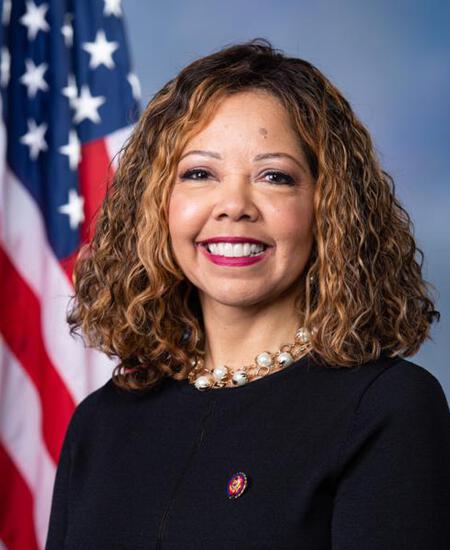
Rep. Lucy McBath
Sponsored bills
Metastatic Breast Cancer Access to Care Act This bill expedites payment of Social Security Disability Insurance (SSDI) benefits and eligibility for Medicare coverage for those with metastatic breast cancer (i.e., breast cancer that has spread to other sites in the body). Specifically, the bill eliminates the 5-month waiting period for SSDI benefits and the subsequent 24-month waiting period for Medicare coverage for individuals with metastatic breast cancer. Under current law, individuals generally must wait five months after the onset of disability to begin receiving SSDI benefits and an additional 24 months to become eligible for Medicare.
I am Vanessa Guillén Act of 2021 This bill addresses the policies and procedures of the Department of Defense (DOD) for cases or allegations of sex-related offenses.
Yes In My Backyard Act This bill requires certain Community Development Block Grant program recipients to submit to the Department of Housing and Urban Development information regarding their implementation of certain land-use policies, such as policies for expanding high-density single-family and multifamily zoning.
Helping Emergency Responders Overcome Act or the HERO Act This bill establishes a series of programs relating to the behavioral health of law enforcement officers, first responders, 9-1-1 operators, and other public safety officers and health care providers. The programs include a public safety officer suicide-reporting system at the Centers for Disease Control and Prevention, a grant program for peer-support behavioral health and wellness programs within fire departments and emergency medical services agencies, and a grant program for behavioral health and wellness programs for health care providers.
Protecting Moms Who Served Act This bill requires the Department of Veterans Affairs (VA) to implement the maternity care coordination program. The VA must provide community maternity care providers (i.e., non-VA maternity care providers) with training and support with respect to the unique needs of pregnant and postpartum veterans, particularly regarding mental and behavioral health conditions in relation to the service of the veterans in the Armed Forces. Additionally, the Government Accountability Office must report on maternal mortality and severe maternal morbidity among pregnant and postpartum veterans, with a focus on racial and ethnic disparities in maternal health outcomes for veterans.
Medical Nutrition Therapy Act of 2021 This bill expands Medicare coverage of medical nutrition therapy services. Currently, Medicare covers such services for individuals with diabetes or kidney disease under certain circumstances; such services must also be provided by a registered dietitian or nutrition professional pursuant to a physician referral. The bill extends coverage to individuals with other diseases and conditions, including obesity, eating disorders, cancer, and HIV/AIDS; such services may also be referred by a physician assistant, nurse practitioner, clinical nurse specialist, or (for eating disorders) a clinical psychologist.
Equity in Neuroscience and Alzheimer's Clinical Trials Act of 2021 or the ENACT Act of 2021 This bill sets out activities and requirements to increase the participation of underrepresented populations in research and clinical trials for Alzheimer's disease and related dementias. Specifically, the National Institute on Aging (NIA) must establish and provide technical assistance to Alzheimer's research centers located in areas with higher concentrations of minority groups. These centers must establish diagnostic and treatment clinics designed to serve minority, rural, and other underserved populations; operate clinical trials; and carry out public outreach to encourage members of minority populations to participate in clinical trials and research. Additionally, the NIA must disseminate information to members of minority populations about participating in clinical trials and take other actions to enhance diversity with respect to the Alzheimer's research that it conducts or supports. The bill also directs the NIA to increase diversity among Alzheimer's researchers by encouraging the participation of individuals who are from groups that are underrepresented in clinical, behavioral, and social sciences.
Save Hotel Jobs Act This bill requires the Department of the Treasury to award grants to hotel owners and operators to assist with payroll costs. Applicants for a grant must provide Treasury with certain assurances, including that (1) the hotel, if in operation, experienced at least a 40% decline in revenue during a three-month period in calendar year 2020 as compared to the corresponding period in 2019; and (2) the hotel owner or operator has a policy to offer employees who have been laid off during the COVID-19 public health emergency any same or similar positions that become available as a result of receiving a grant. All grant funds must be expended during the 270-day period beginning on the date the funds are disbursed. If the hotel owner or operator receives loans through the Paycheck Protection Program, the grant must be reduced by the amount of such loans that are forgiven under the program, including loans received on or before enactment of this bill. For federal tax purposes, the grants are not included as part of the gross income of the hotel owner or operator. The bill also establishes a tax credit equal to 50% of the expenses a hotel owner or operator incurs for qualified personal protective equipment (up to a maximum of $25,000).
Convening Operations Assistance for Childcare Heroes Act or the COACH Act This bill requires the Small Business Administration to maintain a resource guide for small businesses operating as child care providers that includes guidance on topics such as operations, finances, and compliance with relevant laws.