

Maddy summaryHR 2586, the Reentry Act of 2025, amends Medicaid rules to allow incarcerated individuals to receive Medicaid coverage during the 30 days immediately before their release from prison or jail. This directly affects people leaving correctional facilities, ensuring they can access health care as they transition back into communities. The bill requires a report within 18 months analyzing current health care standards in prisons, the number of people who would gain coverage, and current discharge practices to improve Medicaid enrollment for newly released individuals. The report will also assess how to better connect people with community health services and addiction treatment after release.
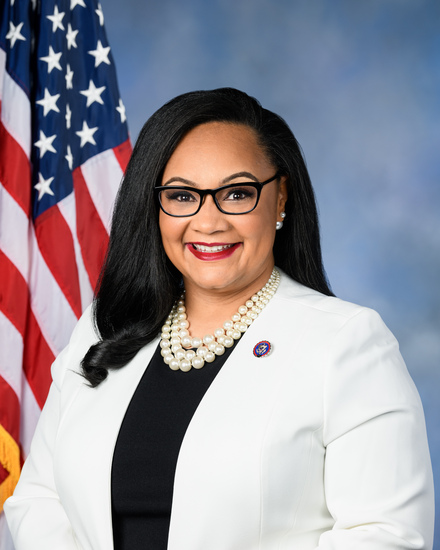
Rep. Nikema Williams
Sponsored bills
Sanctioning Russia Act of 2025 This bill imposes penalties on certain persons (individuals and entities) if the President determines that the Russian government or a person acting at Russia's direction is involved with (1) refusing to negotiate a peace agreement with Ukraine; (2) violating a negotiated peace agreement; (3) initiating another invasion of Ukraine; or (4) overthrowing, dismantling, or seeking to subvert the Ukrainian government. If the President makes such a determination, the bill requires certain actions including the President must impose visa- and property-blocking sanctions on specified persons such as the Russian president, certain Russian military commanders, and any foreign person that knowingly provides defense items to the Russian armed forces; the President must increase the rate of duty on all goods and services imported from Russia into the United States to at least 500% relative to the value of such goods and services; the President must increase the rate of duty on all goods and services imported into the United States from countries that knowingly engage in the exchange of Russian-origin uranium and petroleum products to at least 500% relative to the value of such goods and services; the Department of the Treasury must impose property-blocking sanctions on any financial institution organized under Russian law and owned wholly or partly by Russia, and any financial institution that engages in transactions with those entities; and the Department of Commerce must prohibit the export, reexport, or in-country transfer to or in Russia of any U.S.-produced energy or energy product.
Maddy summaryHR 2498, the "End Dark Money Act," repeals a restriction in the 2024 federal appropriations law that prevented the IRS from using funds to increase transparency around political activities by certain nonprofit organizations during fiscal year 2025. This procedural bill removes a specific funding limitation, allowing the IRS to potentially use its budget for oversight of nonprofits engaged in political spending. It does not create new transparency requirements but enables existing IRS oversight capabilities. The bill directly affects how the IRS administers its budget for nonprofit oversight, not the nonprofits themselves. (1 sentence summary as it is procedural)
Maddy summaryThis bill directs the U.S. Department of Health and Human Services to launch a national public education campaign about abortion access. The campaign must provide medically accurate information on where to obtain abortion services (including medication abortion), legal rights for out-of-state care, identifying misleading anti-abortion centers, spotting disinformation, and protecting personal health data. It specifically targets underserved communities like people of color, immigrants, LGBTQ+ individuals, rural residents, and those with low incomes, while prohibiting the promotion of misinformation or abstinence-only programs.
Maddy summaryHR 2487, the Transgender Health Care Access Act, aims to improve access to gender-affirming care for transgender individuals by funding training and education for healthcare providers. The bill provides $10 million annually for medical schools to develop curricula on gender-affirming care and culturally competent treatment, and $15 million annually for grants to train medical residents, nurse practitioners, and community health centers serving transgender patients. It specifically targets rural providers through $5 million annually for collaborative networks to expand care in underserved areas. The legislation requires a report to Congress within two years detailing progress in improving health equity for transgender populations.
Save America's Forgotten Equines Act of 2025 or the SAFE Act of 2025 This bill permanently prohibits the slaughter of equines (e.g., horses and mules) for human consumption. (Current law prohibits the slaughter of dogs and cats for human consumption. This bill extends the prohibition to equines.) Specifically, this bill prohibits a person from knowingly (1) slaughtering an equine for human consumption; or (2) shipping, transporting, possessing, purchasing, selling, or donating an equine to be slaughtered for human consumption or equine parts for human consumption. The bill subjects a violator to a fine. The bill applies to conduct in or affecting interstate or foreign commerce or within the special maritime and territorial jurisdiction of the United States. However, it does not apply to an activity carried out by an Indian for a religious ceremony. As background, in recent years, the appropriations acts have prohibited the Department of Agriculture (USDA) from using federal funds to inspect horses before they are slaughtered for human consumption. Therefore, there are currently no USDA-inspected horse slaughter facilities in the United States.
Maddy summaryHRES 265 is a symbolic House resolution condemning the Trump administration for allegedly using the Signal messaging app to share highly sensitive or classified military information, directly affecting officials including Vice President Vance, Secretary of Defense Hegseth, and Secretary of State Rubio. The resolution cites risks to national security, noting foreign adversaries like China and Russia have previously accessed U.S. classified data. It calls for investigations into unauthorized communications, mandates review of classified information procedures, and demands accountability for any violations of federal laws governing classified data handling. The resolution does not create new laws but formally expresses disapproval of the administration's communication practices.
Maddy summaryThis bill provides housing loans and education assistance to Black World War II veterans who were denied GI Bill benefits due to racial discrimination, or to their surviving spouses, children, or direct descendants. To qualify, applicants must certify they were denied benefits on racial grounds under the original 1944 GI Bill and apply within five years of the law's enactment. The Department of Veterans Affairs must implement these provisions within 90 days and report to Congress on participation and program costs. It specifically addresses documented historical discrimination where Black veterans were steered toward vocational training instead of college, with only 6% earning degrees compared to 19% of White veterans.
Maddy summaryHRES 256 designates March 2025 as Endometriosis Awareness Month, recognizing endometriosis as a common chronic condition affecting approximately 1 in 10 women of reproductive age. The resolution supports raising public awareness, promoting early detection and culturally competent care for those with the disease, and encourages increased research funding for better treatments and a potential cure. It specifically highlights the significant impacts of endometriosis, including diagnostic delays (3-11 years), chronic pain, high healthcare costs ($13,000+ annually per patient), and reduced workforce participation. This non-binding resolution directly affects women and girls living with endometriosis and aims to foster public education and support through designated awareness activities.
Maddy summaryThis bill would require federal firearms licensees to prohibit sales of specific high-capacity rifles and shotguns to people under 21. It targets semiautomatic centerfire rifles and shotguns capable of holding more than 5 rounds in their magazines, raising the age limit from 18 to 21 for these weapons. Exceptions apply for active military members and certain government employees authorized to carry firearms. The law directly affects gun retailers and individuals under 21 seeking to purchase these specific firearms. It modifies existing federal gun sale rules without changing age requirements for other firearms.