

Maddy summaryHRES 684 is a non-binding House resolution designating September 9, 2025, as "National Firearm Suicide Prevention Day." It aims to raise public awareness about firearm suicide statistics (including that firearms were used in 55% of U.S. suicides in 2023) and promote safe firearm storage as a key suicide prevention strategy. The resolution encourages health professionals to discuss safe storage with patients and supports existing awareness efforts led by organizations like Brady and End Family Fire. It directly affects the public and healthcare providers by emphasizing evidence-based prevention practices, not by creating new laws.
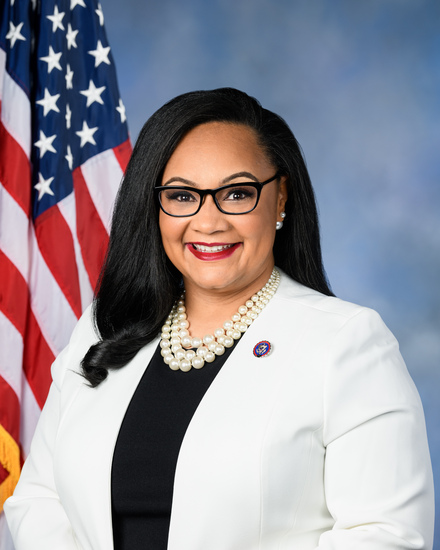
Rep. Nikema Williams
Sponsored bills
Maddy summaryThis bill modifies the Family and Medical Leave Act (FMLA) to extend eligibility to school support staff, including paraprofessionals, cafeteria workers, bus drivers, and clerical staff. It allows these employees to qualify for FMLA leave if they work 60% of their expected monthly hours (instead of the standard 1,250 hours), based on their school’s assigned schedule. Employers must maintain records of expected hours for each staff member. The change directly benefits part-time and seasonal education support staff who previously faced barriers to FMLA coverage.
Maddy summaryThis resolution (HRES 680) recognizes suicide as a serious public health issue and designates September 8, 2025, as "988 Day" to highlight the national three-digit crisis hotline (988 Suicide and Crisis Lifeline). It does not create new laws or funding but formally supports existing efforts to raise awareness about the 988 hotline, which connects people in mental health crisis to 24/7 support services. The resolution emphasizes the hotline's role in suicide prevention, citing data showing it handled nearly 18 million contacts since 2022 and was reported as helpful by 98% of users. It urges continued public education about the hotline, particularly for high-risk groups like LGBTQI+ youth, and encourages broader access to mental health services.
Maddy summaryHR 2181, the Protect Our Watchdogs Act of 2025, strengthens protections for federal Inspectors General (IGs) by requiring the President to have specific, documented reasons to remove them. The bill amends federal law to specify nine grounds for removal, including documented felony convictions, gross mismanagement, waste of funds, abuse of authority, or neglect of duty - each requiring written justification. This directly affects IGs who oversee federal agency accountability and investigations, as it prevents arbitrary removals and mandates transparency in the process. The law applies to all federal Inspectors General across agencies, ensuring their independence is maintained through clear, enforceable standards.
Maddy summaryHR 2808, the Homebuyers Privacy Protection Act, restricts how consumer reporting agencies share credit reports during mortgage applications. It prevents agencies from sending these reports to third parties unless the request is tied to a firm credit offer and the recipient has either the homebuyer’s explicit written consent or is directly involved in the mortgage (like the lender, loan servicer, or the homebuyer’s bank holding an active account). This directly affects homebuyers applying for residential mortgages by limiting unsolicited sharing of their credit information. The law amends the Fair Credit Reporting Act to strengthen privacy protections around mortgage-related credit data.
Maddy summaryThis bill requires most health insurance plans to cover HIV prevention services - including PrEP and PEP drugs, related lab tests, counseling, and monitoring - without cost-sharing (like copays or deductibles) or prior approval. It applies to private insurance, Medicare, Medicaid/CHIP, and federal employee health plans, directly affecting people who use HIV prevention medications. Key provisions mandate 100% coverage for FDA-approved HIV prevention drugs, eliminate cost-sharing for these services, and prohibit insurers from requiring preauthorization for them. The bill defines covered services to include all necessary components of HIV prevention care as outlined in current public health guidelines.
Maddy summaryHR 5126, the HIV Prevention Now Act, appropriates $2.165 billion for the CDC's National Center for HIV, Viral Hepatitis, STD, and Tuberculosis Prevention for fiscal year 2026. This funding is in addition to existing CDC appropriations and must be used exclusively by that specific center for its programs, with no transfer to other entities. The bill directly affects the CDC's public health operations by providing dedicated resources for prevention and treatment programs targeting HIV, viral hepatitis, STDs, and tuberculosis. It does not create new policies or alter eligibility but ensures sustained funding for existing prevention efforts at the federal level.
Maddy summaryThe SAFES Act creates a federal tax credit allowing individuals to deduct 90% of the cost of purchasing new gun safes, with a yearly limit of $500 ($1,000 for joint returns). It requires the Health and Human Services Secretary to publish a report within 5 years identifying gun safe types proven effective at preventing unauthorized access, which will determine eligibility for the credit after 2030. The credit applies only to new safes (not used ones) and prohibits requiring taxpayers to disclose firearm ownership details to claim the benefit. This policy directly affects individual firearm owners purchasing qualifying new safes for tax savings.
Maddy summaryThis bill prohibits federal courts from excluding potential jurors based on disability or age. It amends jury selection laws to require reasonable accommodations (like sign language interpreters or accessible seating) so people with disabilities can serve if otherwise qualified. The law removes automatic disqualification for "infirmity" and ensures individuals aren't barred from jury service solely due to disability when accommodations could enable participation. It directly affects millions of Americans with disabilities and older adults who may have been previously excluded from federal jury duty. The changes apply specifically to jury service in U.S. district courts.
Maddy summaryThe SUN Act (HR 4998) requires the President to submit a detailed report to Congress within 15 days whenever National Guard members are deployed domestically for non-disaster purposes under specific laws. The report must include the legal basis for the deployment, evidence of reduced violence, input from local law enforcement, total costs, and a certification that the deployment won’t interfere with disaster response capabilities. It applies to all domestic uses of the National Guard except for responses to natural disasters under the Stafford Act. The bill aims to enhance congressional oversight of military deployments on U.S. soil.