

Safe from the Start Act of 2021 This bill directs the Department of State to direct U.S. foreign assistance to address humanitarian crises in a manner that aims to prevent and respond to gender-based violence at the onset of an emergency. The State Department shall focus on (1) preventing gender-based violence, (2) protecting survivors of humanitarian crises from the onset of the emergency, (3) promoting standards and activities to prevent and respond to gender-based violence, and (4) advancing and empowering survivors and at-risk individuals. Activities shall include improving access to post-sexual-assault medical and mental health services and ensuring such services are available to hard-to-reach populations. The State Department may provide support to local and international organizations to achieve its goals.
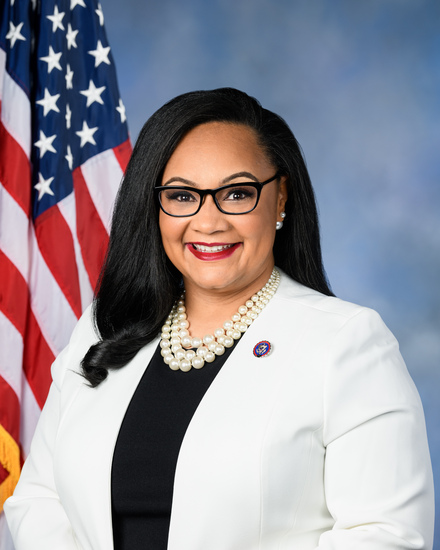
Rep. Nikema Williams
Sponsored bills
Global Health, Empowerment and Rights Act This bill establishes that a foreign nongovernmental organization shall not be disqualified from receiving certain U.S. international development assistance solely because the organization provides medical services using non-U.S. government funds if the medical services are legal in both the United States and the country in which they are being provided. Such foreign organizations shall not be subject to requirements relating to their use of non-U.S. funds for advocacy or lobbying activities, other than those that apply to U.S. nongovernmental organizations. Current U.S. policy prohibits various foreign assistance from going to a foreign nongovernmental organization unless it agrees to not perform or actively promote abortions.
Child Care Workforce and Facilities Act of 2021 This bill requires the Department of Health and Human Services to provide states and tribal entities with grants to increase access to licensed child care services. The grants may be used to develop and expand the child care workforce or child care facilities in locations with insufficient available child care. Specifically, grants cover 50% of the cost of programs to support the education and training of caregivers or projects to build, expand, or renovate child care facilities in these areas.
This bill provides for a grant to establish and operate a national hotline that makes available assistance and information services 24 hours a day to victims of child abuse or neglect, their families, caregivers, and individuals required by law to report suspected child abuse or neglect. The Department of Health and Human Services may award the grant to a nonprofit entity and must prioritize grant applicants with experience operating a hotline and providing such assistance and support.
Officer Brian D. Sicknick Congressional Gold Medal Act This bill requires the Speaker of the House of Representatives and the President pro tempore of the Senate to arrange for the presentation of a Congressional Gold Medal commemorating Officer Brian D. Sicknick for giving his life to protect the Capitol and Members and staff of Congress on January 6, 2021. Following its award, the medal shall be given to Officer Sicknick's parents, Charles and Gladys Sicknick.
Raise the Wage Act of 2021 This bill increases the federal minimum wage for regular employees over a 5-year period, for tipped employees, and for newly hired employees who are less than 20 years old. The bill sets forth a schedule of annual increases in the federal minimum wage for individuals with disabilities. The Department of Labor shall no longer issue special certificates for the payment of subminimum wages to such individuals after the final wage increase under this bill for such individuals takes effect. Labor shall provide, upon request, technical assistance and information to employers to (1) help them transition their practices to comply with wage increases and other requirements under this bill for individuals with disabilities, and (2) ensure continuing employment opportunities for such individuals. The bill eliminates the separate minimum wage requirements for tipped, newly hired, and disabled employees. After a specified period, these employees shall be paid the same minimum wage as regular employees. Labor must publish any increase in the minimum wage in the Federal Register and on its website 60 days before it takes effect.
Health Care Fairness for Military Families Act of 2021 This bill modifies the extension of dependent coverage under TRICARE by allowing a dependent under the age of 26 to be covered without an additional premium. Additionally, the bill authorizes such coverage of dependents without a premium regardless of whether they are eligible to enroll in an employer sponsored plan.
Access Technology Affordability Act of 2021 This bill allows a refundable tax credit equal to the amounts paid for qualified access technology for use by a blind individual who is the taxpayer, the taxpayer's spouse, or a dependent of the taxpayer. Qualified access technology is hardware, software, or other information technology with the primary function of converting or adapting information that is visually represented into forms or formats useable by blind individuals. The credit is limited to (1) costs that are not compensated by insurance or otherwise, and (2) an aggregate amount of $2,000 per blind individual in any period of three consecutive taxable years. The credit must be adjusted for inflation after 2021 and terminates after 2026.
COVID-19 Student Loan Relief Extension Act This bill extends certain temporary relief related to federal student loans and expands eligibility for such relief to additional types of loans. Specifically, the bill extends the current suspension of payments due on federal student loans to 30 days after the end of the COVID-19 (i.e., coronavirus disease 2019) public health emergency. It also extends the suspension of interest due on these loans until the economy shows specified initial signs of recovery. Further, the bill expands eligibility for temporary relief on federal student loans to include Federal Family Education Loans (FFELs) and Federal Perkins Loans that are not held by the Department of Education (ED) and certain health profession and nursing loans. (Currently, these temporary relief provisions are only applicable to certain Federal Direct Loans and FFELs that are held by ED.) Additionally, the bill makes this eligibility retroactive to March 13, 2020. Finally, ED and the Department of Health and Human Services must carry out a program, beginning on August 1, 2021, to provide at least six notices to borrowers that normal payment obligations will resume.
Civics Learning Act of 2021 This bill expands the use of American History and Civics Education—National Activities grants to prioritize innovative civics learning and teaching. Specifically, the bill expands the allowable uses of these grants to include before-, during-, and after-school activities and extracurricular activities; activities that include service learning and community service projects that are linked to school curriculum; activities that encourage and support student participation in school governance; and online and video game-based learning. Further, the Department of Education must ensure that specified percentages of grant funds are awarded on a diverse basis to eligible entities (e.g., institutions of higher education) that serve students and teachers at elementary schools, middle schools, and high schools.