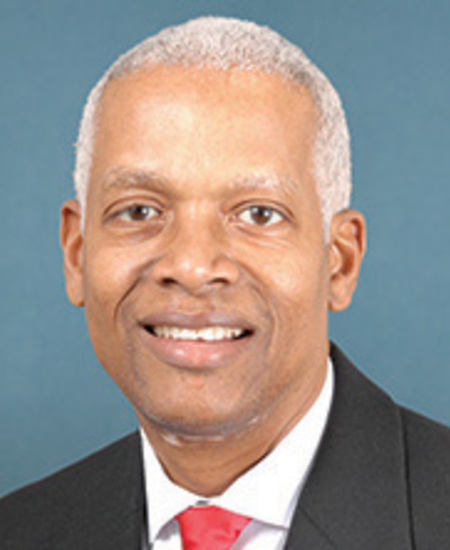
Photo of Henry C. "Hank" Johnson, Jr.
D United States House · District 4 · Georgia On the 2026 ballot

Rep. Henry C. "Hank" Johnson, Jr.

Compare
Total votes
2,837
all sessions
Attendance
97%
72 missed
Near the chamber average
With party
97%
of cast votes
Near the chamber average
Bipartisan score
2%
crosses aisle rarely
Near the chamber average
Sponsored
2,466
bills & resolutions
Higher than 98% of chamber peers
Committees
8
assignments
2,466 bills and resolutions

Sponsored bills

Total
2,466
Primary
84
Co-sponsor
2,382
This page
2,466
matching current filters
Co-sponsor HRES 565
In committee · Indiana House · Co-sponsor
Expressing the sense of the House of Representatives to reduce traffic fatalities to zero by 2050.

This resolution (1) commits to advancing policies that will end roadway fatalities by 2050, and (2) calls on Congress and the Department of Transportation to commit to working together to achieve zero roadway fatalities by the year 2050.

In committee Jul 28, 2021 1 co-sponsor
Co-sponsor HR 4595
In committee · Indiana House · Co-sponsor
Medicaid Saves Lives Act

Medicaid Saves Lives Act This bill requires and provides funds for the Department of Health and Human Services to establish a program that provides health benefits to the Medicaid expansion population in states that have not expanded Medicaid. Specifically, the program must provide coverage for individuals who are newly eligible for Medicaid under the Patient Protection and Affordable Care Act (i.e., the Medicaid expansion population) without premiums and in accordance with Medicaid cost-sharing and other requirements. The bill also extends and increases the temporarily enhanced Federal Medical Assistance Percentage (i.e., federal matching rate) for states that elect to participate in Medicaid expansion if they have not already done so.

In committee Jul 22, 2021 1 co-sponsor
Co-sponsor HR 3985
Passed · Indiana House · Co-sponsor
Averting Loss of Life and Injury by Expediting SIVs Act of 2021

Averting Loss of Life and Injury by Expediting SIVs Act of 2021 or the Allies Act of 2021 This bill increases the number of special immigrant visas available to qualified Afghan nationals who worked for the U.S. government or the North Atlantic Treaty Organization (NATO) missions in Afghanistan. The bill also relaxes certain qualifications for such visas. Specifically, this bill makes available an additional 8,000 visas for principal aliens under this special visa program, to be available until all such visas have been issued. (The numerical limitations in this program apply only to the principal alien who applies for the visa, not to any accompanying spouse or child.) Under this bill, an alien may qualify based on a credible basis for concern about the possibility of an ongoing serious threat in Afghanistan due to their work with the U.S. government or a NATO mission, where currently the alien must have experienced such a threat. The bill also eliminates a requirement for each applicant to submit a credible sworn statement describing that threat. Furthermore, for an applicant qualifying for a visa by performing duties for U.S. military personnel stationed with a NATO mission, this bill eliminates a requirement that the duties performed qualify as sensitive and trusted duties. If an alien submits a visa application that included an accompanying spouse or child but the alien passes away before the application is granted, the surviving spouse or child shall remain eligible to receive a visa under that application. Currently, a surviving spouse or child retains eligibility only if the application was approved before the alien passed away.

Passed Jul 22, 2021 1 co-sponsor
Co-sponsor HR 2467
Passed · Indiana House · Co-sponsor
PFAS Action Act of 2021

PFAS Action Act of 2021 This bill establishes requirements and incentives to limit the use of perfluoroalkyl and polyfluoroalkyl substances, commonly referred to as PFAS, and remediate PFAS in the environment. PFAS are man-made and may have adverse human health effects. A variety of products contain PFAS, such as nonstick cookware or weatherproof clothing. The bill directs the Environmental Protection Agency (EPA) to designate the PFAS perfluorooctanoic acid (PFOA) and perfluorooctanesulfonic acid (PFOS) as a hazardous substances under the Comprehensive Environmental Response, Compensation, and Liability Act of 1980, thereby requiring remediation of releases of those PFAS into the environment. Within five years, the EPA must determine whether the remaining PFAS should be designated as hazardous substances. The EPA must publish human health water quality criteria under the Clean Water Act for each measurable PFAS and class of such substances and establish standards to limit discharges of PFAS from industrial sources into waters of the United States. In addition, the EPA must issue a national primary drinking water regulation for PFAS that, at a minimum, includes standards for PFOA and PFOS. Among other requirements, the EPA must also issue a final rule adding PFOA and PFOS to the list of hazardous air pollutants, test all PFAS for toxicity to human health, and regulate the disposal of materials containing PFAS. The EPA must also require PFAS manufacturers to submit analytical reference standards for PFAS. The EPA and states may use those standards for (1) the development of information, protocols, and methodologies, and (2) activities relating to the implementation of enforcement of requirements. Finally, the bill provides incentives to address PFAS, such as grants to help community water systems treat water contaminated by PFAS and grants to schools for testing and filtrating PFAS from drinking water.


Passed Jul 22, 2021 1 co-sponsor
Co-sponsor HR 564
In committee · Indiana House · Co-sponsor
Comprehensive Paid Leave for Federal Employees Act

Comprehensive Paid Leave for Federal Employees Act This bill provides paid family and medical leave to federal employees. Currently, federal employees are entitled to 12 weeks of administrative leave for one or more of the following reasons: (1) the birth of a child, (2) the adoption or foster care of a child, (3) the care of an immediate family member with a serious health condition, (4) inability to work due to a serious health condition, and (5) exigencies relating to an immediate family member's active duty service in the Armed Forces. However, of these reasons, employees are entitled to paid administrative leave only in connection with the birth, adoption, or foster care of a child (i.e., parental leave). The bill provides 12 weeks of paid administrative leave for any of these reasons, and specifies that this leave is in addition to any annual or sick leave to which employees are entitled.

In committee Jul 20, 2021 1 co-sponsor
Co-sponsor HR 4457
In committee · Indiana House · Co-sponsor
End Double Taxation of Successful Consumer Claims Act

End Double Taxation of Successful Consumer Claims Act This bill allows a deduction from gross income (above-the-line deduction) for attorney fees and court costs in connection with a claim of a consumer protection violation.

In committee Jul 16, 2021 1 co-sponsor
Co-sponsor HR 4442
In committee · Indiana House · Co-sponsor
Green New Deal for Public Schools Act of 2021

Green New Deal for Public Schools Act of 2021 This bill provides environmental and educational resources to public elementary and secondary schools and Bureau of Indian Education (BIE) schools. Specifically, the bill requires the Department of Energy's (DOE's) Office of Energy Efficiency and Renewable Energy to provide climate capital facilities grants to eligible entities (e.g., public schools and BIE schools). Grant recipients must use these funds to construct new, or convert existing facilities into, healthy zero-carbon schools. Healthy zero-carbon school refers to a school with highly energy-efficient facilities that produce or procure sufficient carbon-free and pollution-free renewable energy to meet the school's needs. Next, the bill directs the Department of Education (ED) to award resource block grants to qualified local educational agencies (LEAs) to hire and retain educators and support staff in high-need schools. ED must award grants to eligible consortia of LEAs for educational equity planning and implementation. In addition, ED must establish the Climate Change Resiliency Program to increase the resiliency of public and BIE schools during climate change-related events, natural disasters, and public health crises. Further, ED must establish a related grant program for state educational agencies. Grant recipients must use these funds for certain activities (e.g., green infrastructure projects). The bill establishes the Office of Sustainable Schools within ED to (1) administer the resource block grant and educational equity grant programs, and (2) coordinate with DOE and the White House Office of Domestic Climate Policy on climate capital facilities grants and the Climate Change Resiliency Program.

In committee Jul 16, 2021 1 co-sponsor
Co-sponsor HR 925
In committee · Indiana House · Co-sponsor
Data to Save Moms Act

Data to Save Moms Act This bill expands data collection and research on maternal morbidity and mortality among minority populations. Specifically, the bill adds requirements to a program within the Centers for Disease Control and Prevention (CDC) that supports maternal mortality review committees. To the extent practicable, the committees must use the most up-to-date indicators of severe maternal morbidity; review deaths caused by suicide, overdose, or other behavioral health conditions attributed to or aggravated by pregnancy or childbirth; and consult with representatives of communities about nonclinical factors that may contribute to adverse maternal outcomes. The CDC may also award grants to committees to increase their engagement with local communities, such as by bringing on community representatives as committee members. Additionally, the Centers for Medicare & Medicaid Services and the Agency for Healthcare Research and Quality must consult with diverse stakeholders to review maternal health data collection processes and quality measures and make recommendations to improve them. The Indian Health Service and the Department of Health and Human Services must also arrange for studies on adverse maternal health outcomes among tribal and minority populations, respectively.

In committee Jul 15, 2021 1 co-sponsor
Co-sponsor HR 4429
In committee · Indiana House · Co-sponsor
Semiquincentennial Commemorative Coin Act

Semiquincentennial Commemorative Coin Act This bill directs the Department of the Treasury to mint and issue $25.00 gold coins, $2.50 silver coins, 25 cent clad coins, and proof silver $2.50 coins in commemoration of the 250th anniversary of the establishment of the United States. The designs of the coins shall be emblematic of the semiquincentennial anniversary of the establishment of the United States of America and celebrate 250 years of our nation. On each coin there shall be a designation of the value of the coin; an inscription of the years 1776-2026; and inscriptions of the words Liberty , In God We Trust , United States of America , and E Pluribus Unum . Treasury may issue coins under this bill only during the period beginning on January 1, 2026, and ending on December 31, 2026. All sales of coins issued shall include a surcharge as prescribed by this bill. All surcharges received by Treasury from the sale of such coins shall be paid to the America 250 Foundation to fund the restoration, rehabilitation, and interpretation of units of the U.S. National Park System and its related areas, as a legacy of the semiquincentennial commemoration.

In committee Jul 13, 2021 1 co-sponsor
Showing 2,121 to 2,130 of 2,466 bills