

Ending Sanctuary Cities Act of 2021 This bill makes state or local governments that violate immigration laws ineligible for federal financial assistance. A governmental entity shall be ineligible if it(1) violates federal law by prohibiting its officials from communicating with the Department of Homeland Security (DHS) about the immigration status of any individual, (2) restricts compliance with DHS detainer requests, or (3) has any laws or policies that violate immigration laws. (A DHS detainer request is an order or request to a state or local government to temporarily hold or transport an alien for transfer into federal custody or notify DHS before releasing an alien from custody.) A government or law enforcement officer that complies with a DHS detainer request shall be acting under the color of federal authority, for the purposes of liability or immunity in a lawsuit filed by the detained individual. The bill makes it unlawful for a state or local government to discharge or discriminate against one of its law enforcement officers for complying with a DHS detainer request.
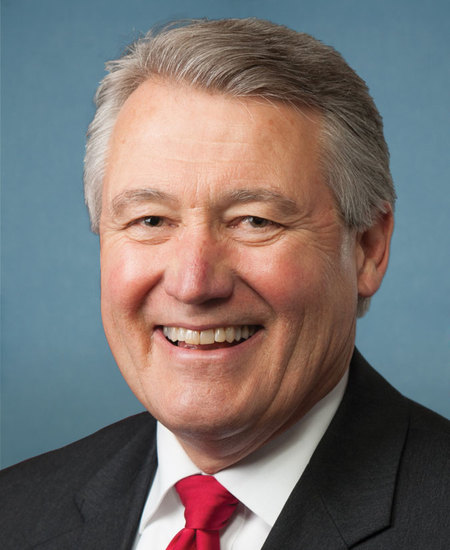
Rep. Rick W. Allen
Sponsored bills
David Dorn Back the Blue Act This bill directs the Department of Justice (DOJ) to provide programs to support the hiring and retention of law enforcement personnel and to increase their salaries. Further, DOJ may make grants to state and local law enforcement agencies for this purpose.
Protect and Serve Act of 2021 This bill establishes a new criminal offense for knowingly assaulting a law enforcement officer and causing serious bodily injury (or attempting to do so) in circumstances that affect interstate commerce. It imposes criminal penalties—a prison term, a fine, or both—on a violator.
Back the Blue Act of 2021 This bill establishes new criminal offenses for killing, assaulting, and fleeing to avoid prosecution for killing a judge, law enforcement officer, or public safety officer. Additionally, the bill expands the list of statutory aggravating factors in death penalty determinations to also include the killing or attempted killing of a law enforcement officer, judge, prosecutor, or firefighter or other first responder; broadens the authority of federal law enforcement officers to carry firearms; and limits federal court review of challenges to state court convictions for killing a public safety officer or judge. Finally, it directs the Department of Justice to make grants to law enforcement agencies and nongovernmental organizations to promote trust and improve relations between law enforcement agencies and the communities they serve.
Safeguarding the Supply Chain Act This bill generally includes maritime employers and employees under the provisions of the Railway Labor Act, which sets forth the procedures for labor relations for the railway and airline industries.
This resolution recognizes the importance of gig workers (i.e., workers hired on a per-project basis) and other independent contractors to the economy.
This resolution congratulates the Atlanta Braves on winning the 2021 Major League Baseball World Series and honors the life and legacy of Henry Louis Aaron.
Supplying America Needs Truckers Aged 18 Act or the SANTA 18 Act This bill exempts drivers who transport goods from a port of entry and another place within the same state from age restrictions and other requirements that apply to federal commercial driver's licenses.
Maddy summaryHRES 754 is a non-binding resolution expressing the House of Representatives' opposition to proposed "punitive natural gas taxes" on U.S. businesses, families, and workers. It cites claims that such taxes would raise average energy bills by 17%, reduce GDP by $9 billion, and eliminate 90,000 jobs, while disproportionately harming low-income households. The resolution argues that opposing these taxes supports U.S. energy security, national security, and continued leadership in reducing emissions through domestic natural gas production. As a procedural resolution, it does not create law but formally states the House's position against this policy approach.
State, Local, Tribal, and Territorial Fiscal Recovery, Infrastructure, and Disaster Relief Flexibility Act This bill allows states, tribes, territories, and localities to use certain COVID-19 relief funds for new categories of spending, including for natural disasters and infrastructure projects. It also makes changes to expenditure deadlines and other aspects of this funding. Specifically, recipients may use funds for emergency relief from natural disasters and associated negative economic impacts of natural disasters. In addition, recipients may use a portion of their COVID-19 relief funds for designated infrastructure projects, such as nationally significant freight and highway projects. Furthermore, the bill allows recipients to expend COVID-19 relief funds on these types of infrastructure projects until September 30, 2026. Under current law, recipients must expend the funds by December 31, 2024. Other changes in the bill include (1) modifying eligibility and allocation requirements for funding set aside for counties and Indian tribes that are near public lands, (2) allowing Indian tribes an additional year to expend their COVID-19 relief funds, and (3) establishing a process for government entities to decline COVID-19 relief funds and requiring any declined funds to be used to reduce the federal deficit.