Keystone XL Pipeline Construction and Jobs Preservation Act This bill authorizes the TransCanada Keystone Pipeline to construct, connect, operate, and maintain the pipeline facilities in Phillips County, Montana, for the import of oil from Canada to the United States.
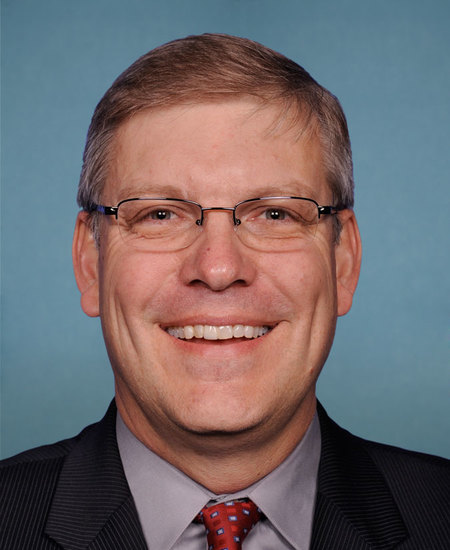
Rep. Barry Loudermilk
Sponsored bills
National Right-to-Work Act This bill repeals those provisions of the National Labor Relations Act and the Railway Labor Act that permit employers to make an agreement with a labor union to require employees to join such union as a condition of employment. Currently, at least 27 states have enacted laws prohibiting employers from compelling employees to become members of a union as a condition of employment.
Fair and Open Competition Act or the FOCA Act This bill prohibits federal construction contracts or controlling documents for federally supported construction projects from requiring or prohibiting project labor agreements. Such documents also may not discriminate against or give preference to a bidder or contractor who signs or refuses to sign a project labor agreement. An agency may exempt a project from this prohibition to avert an imminent threat to public health or safety or to serve the national security.
This resolution honors the life and legacy of Rush Limbaugh and commends him for his devotion to the United States.
Improving Confidence in Veterans' Care Act This bill prescribes oversight requirements for the Department of Veterans Affairs (VA) regarding health care professionals at VA medical centers. Specifically, the bill requires the VA to ensure each VA medical center consistently compiles, verifies, and reviews specified documentation for each VA health care professional (including contractors). The VA shall ensure that specified health care professionals hold an active Drug Enforcement Administration registration. Each VA medical center must implement (1) monitoring of the performance and quality of the health care delivered by each health care professional at the center, and (2) reviews of such care if an individual notifies the VA of any potential concerns relating to a failure to meet generally accepted standards of clinical practice. The bill imposes notification requirements in situations where the VA substantiates a concern relating to the clinical competency of, or quality of care delivered by, a current or former VA health care professional. The VA is prohibited from entering into a settlement agreement relating to an adverse action against a VA health care professional if such agreement includes terms that require the VA to conceal certain information from the employee's personnel file. Such prohibition does not apply to adverse actions determined to be prohibited personnel practices. The VA must provide mandatory training, at least biannually, to employees of each medical center who are responsible for specified tasks (e.g., those who are responsible for compiling, validating, or reviewing the credentials of VA health care professionals).

No taxpayer funding for United Nations Human Rights Council Act This bill prohibits the Department of State from making contributions to the United Nations Human Rights Council, either as a percentage of the U.S. contribution to the regular budget of the United Nations or as a voluntary contribution to the council.
You Must Be Alive To Vote Act of 2021 This bill requires each state, in order to receive certain education and transportation funds, to annually certify that the state has an agreement with the Social Security Administration to share death information for the purpose of removing the names of ineligible voters from the official list of eligible voters.
Stop Corrupt Iranian Oligarchs and Entities Act This bill directs the Department of the Treasury to report to Congress on Iranian individuals and parastatal groups that have close relationships with the Iranian government, including information regarding (1) their known sources of income, (2) their indices of corruption, (3) their involvement in key U.S. economic sectors, (4) the structures and ownership of the parastatal groups, and (5) the potential effects of imposing sanctions on these entities and individuals.
Taking Account of Bureaucrats' Spending Act of 2021 or the TABS Act of 2021 This bill eliminates provisions that fund the Consumer Financial Protection Bureau (CFPB) using transfers from the earnings of the Federal Reserve System. The transfers under current law permit the CFPB to be funded outside of the annual appropriations process, and this bill brings the CFPB into the regular process.
Taking Account of Institutions with Low Operation Risk Act or the TAILOR Act This bill requires federal financial regulatory agencies to (1) tailor any regulatory actions so as to limit burdens on the institutions involved, with consideration of the risk profiles and business models of those institutions; and (2) report to Congress on specific actions taken to do so, as well as on other related issues. The bill's tailoring requirement applies not only to future regulatory actions but also to regulations adopted within the last seven years.