

Federal Firearms Licensee Protection Act of 2025 This bill modifies criminal penalties for an offense involving the theft of a firearm from a licensed importer, manufacturer, or dealer, or from their business premises. Specifically, the bill does the following: increases from 10 to 20 years the maximum prison term, and creates a 3- or 5-year mandatory minimum prison term for an offense that occurs during the commission of a burglary or robbery. An attempt to commit an offense is subject to the same penalties as a substantive offense.
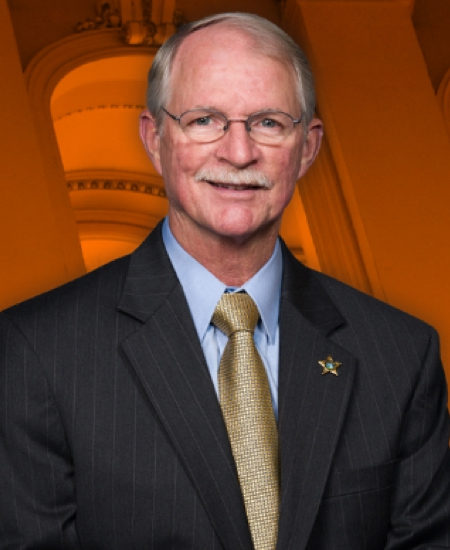
Rep. John H. Rutherford
Sponsored bills
Maddy summaryThis bill protects firearm trace data maintained by the ATF's National Trace Center and related licensee information from public disclosure under FOIA. It directly affects licensed firearms dealers, state/local governments, and other entities that handle this data. Key provisions include adding a new FOIA exemption for this data, imposing fines of $10,000-$25,000 for unauthorized disclosures, and allowing licensed dealers to sue for triple damages or $25,000 per disclosure. The law also prevents sovereign immunity from blocking such lawsuits and specifies that fines apply per individual disclosure.
Maddy summaryThis bill reauthorizes the Project Safe Neighborhoods program through fiscal years 2026-2030, extending funding for a nationwide initiative that helps local law enforcement reduce violent crime. It allows agencies to use funds for hiring crime analysts, covering overtime for officers and support staff, and purchasing technology to aid crime reduction efforts. The bill also requires the Attorney General to submit annual reports to Congress detailing how funds are spent, community outreach activities, and specific violent crime statistics (like murder and assault) in each program area. The program directly affects law enforcement agencies in all 94 federal judicial districts across all 50 states and territories.
Maddy summaryThis bill, HR 1761, would require the U.S. Treasury to print $250 Federal Reserve notes featuring a portrait of Donald J. Trump within one year of enactment, primarily to commemorate the 250th anniversary of the United States. It amends the Federal Reserve Act (Section 3) to mandate this specific currency denomination and attempts to modify existing law (Section 4) to allow living presidents on currency. The bill directly affects the U.S. Treasury's currency printing authority and would override current practices, as $250 bills do not exist in circulation and the Constitution prohibits denominations above $100. This is a symbolic procedural measure with no practical implementation under current U.S. currency law.
Maddy summaryHR 1695, the Guarding Readiness Resources Act, clarifies how the National Guard Bureau handles reimbursement funds from states. It requires that funds received from states (including Puerto Rico, DC, Guam, and the Virgin Islands) for using military property must be credited to specific accounts and can only be used by the Department of Defense for repairing, maintaining, or replacing assets directly supporting National Guard units operating under state control. This bill directly affects states that reimburse the National Guard Bureau and ensures these funds are restricted to maintaining military assets, not general purposes.
Maddy summaryHRES 166 is a non-binding House resolution expressing U.S. support for the Iranian people's desire for a democratic, secular, and nonnuclear republic. It condemns the Iranian regime's terrorism, regional proxy wars, internal suppression of ethnic and religious minorities, and human rights abuses - including executions and repression of women-led protests. The resolution calls for holding the regime accountable through sanctions, supports the Ten-Point Plan for Iran’s democratic transition, and urges protection for Iranian political refugees in Albania. It does not create new laws but affirms U.S. policy alignment with Iranian protesters' demands.
Maddy summaryThis bill awards a Congressional Gold Medal to the 761st Tank Battalion (known as the "Black Panthers"), the first predominantly Black armored unit in World War II's European Theater. It recognizes their combat service from 1944-1946, including key roles in the Battle of the Bulge and breaking the Siegfried Line, despite facing racial prejudice during and after the war. The medal will be displayed at the National Museum of African American History and Culture, with bronze duplicates available for sale to cover costs. The bill commemorates the battalion's 130,000 enemy casualties inflicted, 50% casualty rate, and their 1978 Presidential Unit Citation. It does not create new laws or affect current policies.
Maddy summaryThis bill extends duty-free access for Haitian apparel exports to the U.S. until September 30, 2035, under the Caribbean Basin Economic Recovery Act. It increases the minimum percentage of eligible apparel that qualifies for duty-free treatment to 60% or more and adjusts import limits to 1.25% of the U.S. apparel import market. The bill also restores eligibility for specific apparel items that lost duty-free status due to past tariff schedule changes. These changes directly benefit Haitian apparel manufacturers and U.S. importers of Haitian-made clothing by maintaining market access.
Maddy summaryHR 1631, the Safe Access to Cash Act of 2025, amends federal robbery law to clarify that all network-connected ATMs and cash in transit (being loaded/unloaded) are considered under the care of banks, credit unions, or savings associations. This directly affects financial institutions by expanding their legal responsibility for ATM security, regardless of whether the ATM is on their premises or owned/operated by another entity. The bill defines "ATM" broadly to include any terminal used for withdrawals, deposits, or balance inquiries via a bank-issued card. Key provisions ensure these locations and cash are treated as part of the institution's protected property under robbery statutes. This creates a clear legal standard for holding financial institutions accountable for ATM security.
Maddy summaryThis bill requires the U.S. Department of Agriculture (USDA) to join the Committee on Foreign Investment in the United States (CFIUS) for reviews of certain transactions involving foreign adversaries. It specifically targets acquisitions of U.S. agricultural land, biotechnology, or agriculture-related infrastructure (like transportation, storage, or processing) by entities from China, North Korea, Russia, or Iran. The USDA must notify CFIUS about reportable transactions, prompting the committee to determine if a full review is needed. The provisions expire for any country removed from the official list of foreign adversaries in federal regulations.