

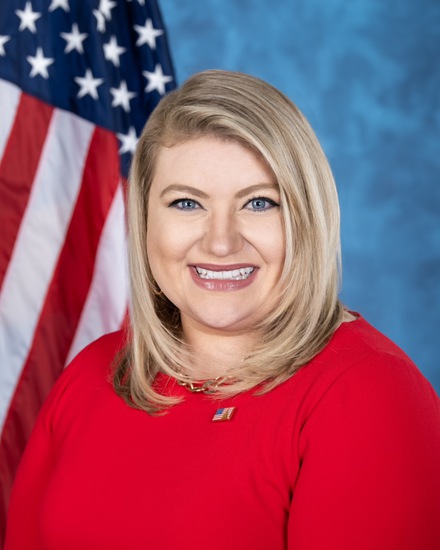
Photo of Kat Cammack
R United States House · District 3 · Florida On the 2026 ballot

Rep. Kat Cammack

Compare
Total votes
2,837
all sessions
Attendance
98%
70 missed
Near the chamber average
With party
91%
of cast votes
Lower than 87% of chamber peers
Bipartisan score
5%
crosses aisle rarely
Higher than 85% of chamber peers
Sponsored
780
bills & resolutions
Lower than 82% of chamber peers
Committees
6
assignments
780 bills and resolutions

Sponsored bills

Total
780
Primary
62
Co-sponsor
718
This page
780
matching current filters
Co-sponsor HR 7195
In committee · Indiana House · Co-sponsor
Protecting the Mailing of Firearms Act

Maddy summaryThis bill repeals a law (18 U.S.C. § 1715) that previously prohibited mailing firearms without a license. It directly affects the U.S. Postal Service, firearm sellers, and individuals mailing firearms by preventing the Postal Service from creating rules that would block firearm mailings or require disclosure of sensitive records like sales receipts or firearm serial numbers. Key provisions include removing the existing ban on mailing firearms and prohibiting the Postal Service from imposing new restrictions on firearm mailings or demanding customer transaction data. The bill ensures that firearm mailings can proceed without these specific federal restrictions, while applying to ongoing legal cases under the repealed law.

In committee Feb 1, 2024 1 co-sponsor
Primary HR 7107
In committee · Indiana House · Lead sponsor
Human Trafficking Awareness Training Act

Maddy summaryHR 7107, the Human Trafficking Awareness Training Act, requires the Federal Law Enforcement Training Centers (FLETC) to create a mandatory training program for state, local, tribal, territorial, and educational institution law enforcement officers. The training covers recognizing human trafficking indicators, understanding victim-centered responses, reporting protocols, relevant federal and state laws, and high-risk locations. The bill authorizes $2.3 million annually from 2024 through 2029 to fund this program and mandates coordination with the Department of Homeland Security’s Blue Campaign. It also requires integrating this training into existing FLETC programs. The law defines human trafficking per the Trafficking Victims Protection Act of 2000.

In committee Jan 29, 2024 0 co-sponsors
Co-sponsor HR 7083
In committee · Indiana House · Co-sponsor
RAZOR Act

Maddy summaryHR 7083, the RAZOR Act, prohibits federal agencies from removing or altering barriers (like fences or fences) built by states along the U.S. border to prevent unlawful crossings. It directly affects federal departments and agencies, such as the Department of Homeland Security, by restricting their ability to modify state-constructed border infrastructure. The key provision is a clear ban on any federal action that would change or remove these state-built barriers. This bill makes a specific policy change regarding federal-state border infrastructure authority without altering broader immigration law.

In committee Jan 25, 2024 1 co-sponsor
Co-sponsor HR 7014
In committee · Indiana House · Co-sponsor
Protect Medicaid Act

Maddy summaryHR 7014, the Protect Medicaid Act, prohibits federal Medicaid funding for the administrative costs associated with providing health benefits to noncitizens who are not lawfully admitted permanent residents and are ineligible for Medicaid due to immigration status. It directly affects states that currently offer health benefits to such noncitizens, requiring them to cover administrative expenses through state funds instead of federal Medicaid dollars. The bill amends federal law to add a specific prohibition on using federal funds for these administrative costs, while leaving the provision of medical care itself unaffected. Additionally, it mandates an Inspector General report analyzing how states separate administrative costs, ensure compliance, and finance these programs, including impacts on drug pricing. The law focuses solely on administrative funding, not on restricting medical benefits for eligible individuals.

In committee Jan 19, 2024 1 co-sponsor
Co-sponsor HRES 974
In committee · Indiana House · Co-sponsor
Expressing support for the designation of the week of January 21 through January 27, 2024, as "National School Choice Week".

Maddy summaryHRES 974 is a non-binding House resolution supporting the designation of January 21-27, 2024, as "National School Choice Week." It encourages parents to learn about K-12 education options - including public schools, charter schools, private schools, and homeschooling - and promotes public awareness of educational choice. The resolution does not create new laws or policies but formally expresses the House's backing for this annual observance. It directly affects parents and students by highlighting available education pathways and urging communities to host events celebrating school choice. The resolution was introduced by multiple House members and referred to the Education Committee.

In committee Jan 18, 2024 1 co-sponsor
Co-sponsor HRES 760
In committee · Indiana House · Co-sponsor
Expressing support for the designation of October 1 through October 7, 2023, as "National 4-H Week".

Maddy summaryThis resolution expresses the U.S. House of Representatives' support for designating October 1-7, 2023, as "National 4-H Week." It recognizes 4-H as the nation's largest youth development organization, serving nearly 6 million young people through programs in health, science, agriculture, and civic engagement, delivered by land-grant universities and over 600,000 volunteers. The resolution does not create new laws or funding but formally acknowledges 4-H's role in empowering youth leadership and encourages public recognition of its impact. It directly affects 4-H members, volunteers, and the broader network of land-grant institutions and the USDA's Cooperative Extension System.

In committee Jan 18, 2024 1 co-sponsor
Co-sponsor HR 7035
In committee · Indiana House · Co-sponsor
Death Tax Repeal Act

Maddy summaryThe Death Tax Repeal Act would eliminate the federal estate tax and generation-skipping transfer tax for estates of people who die on or after the bill's enactment date, and for generation-skipping transfers made after that date. It would also establish a new $10 million lifetime gift tax exemption (adjusted annually for inflation) and replace the existing gift tax rate schedule with a revised structure. These changes would primarily affect high-net-worth individuals and their heirs, as the estate tax and gift tax typically apply to large estates or gifts exceeding the new exemption threshold. The bill's provisions would take effect on the date of enactment, with transitional rules for the year the bill is signed into law.

In committee Jan 18, 2024 1 co-sponsor
Co-sponsor HR 7042
In committee · Indiana House · Co-sponsor
RIFLE Act of 2024

Maddy summaryThe RIFLE Act of 2024 changes how the federal government handles violations by firearms licensees, affecting gun dealers and manufacturers who hold federal licenses. It creates a graduated penalty system where non-willful violations require the Attorney General to work with licensees to fix issues before taking action, while willful violations may lead to license suspension or revocation only after proper notice, hearing, and evidence of continued noncompliance. The bill establishes new procedures for administrative hearings, defines "willful" violations more clearly, and gives licensees 90 days to liquidate inventory after license expiration or revocation, with extensions possible for reasonable cause. These changes aim to create a more transparent process for addressing violations while maintaining public safety standards.

In committee Jan 18, 2024 1 co-sponsor
Co-sponsor HR 3925
In committee · Indiana House · Co-sponsor
Youth Coastal Fishing Program Act of 2023

Maddy summaryHR 3925 establishes a federal grant program to fund youth fishing projects in coastal and Great Lakes areas. The bill authorizes $2 million annually (2024-2028) for grants to eligible entities like nonprofits, schools, state/local governments, or Tribal organizations to cover equipment, transportation, licenses, and educational components for youth. Priority is given to projects serving underserved communities, defined as groups facing systemic barriers due to race, disability, poverty, or inequality. Recipients must report annually on grant usage and participant numbers to Congress.

In committee Jan 18, 2024 1 co-sponsor
Showing 281 to 290 of 780 bills
Previous 1 … 28 29 30 … 78 Next