

Maddy summaryThe Flight Refund Fairness Act would require airlines to provide refunds for cancelled or significantly delayed flights. It adds a provision exempting small business ticket agents (such as small travel agencies) from this refund requirement. This means small travel agencies selling airline tickets would not have to follow the same refund rules as airlines or larger agencies. The bill's key mechanism is creating a small business exemption to reduce regulatory burden in the travel sector.
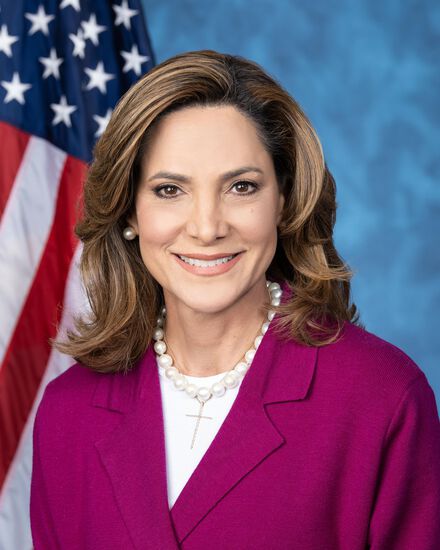
Rep. Maria Elvira Salazar
Sponsored bills
Maddy summaryThis resolution (HRES 1446) formally condemns Cuba's labor export program, which deploys medical personnel abroad under conditions described in the 2024 U.S. Trafficking in Persons (TIP) Report as involving forced labor and human trafficking. It directly affects Cuban medical workers deployed in 72 countries over five years, who reportedly have wages withheld, passports confiscated, and face restricted movement. The resolution urges host governments to pay medical workers directly (bypassing Cuba) and calls for U.S. visa revocations against officials from Cuba, Brazil, Honduras, Mexico, and the Pan American Health Organization involved in these programs. It cites the State Department’s finding that Cuba profits $6-8 billion annually from this system while failing to meet international labor standards.
Maddy summaryThe NO FAKES Act of 2024 establishes legal rights for individuals (living or deceased) to control how their voice and visual likeness are used in digital replicas (highly realistic computer-generated representations that are readily identifiable as the individual). It requires authorization from the individual or their designated right holder for any digital replica, with specific rules for licenses (including 10-year limits for living individuals, 5-year limits for minors, and post-mortem rights for 10 years with possible 5-year renewals). The bill creates civil liability for unauthorized production or distribution of digital replicas, with exceptions for news, documentaries, commentary, and other protected uses. Online services are provided safe harbors if they follow notice-and-takedown procedures for unauthorized digital replicas after receiving proper notifications. The law preempts some state laws but leaves others in place, and applies to conduct occurring after the bill's enactment date.
Maddy summaryHRES 1437 is a ceremonial resolution designating the week beginning September 9, 2024, as "National Hispanic-Serving Institutions Week." It recognizes Hispanic-serving institutions (HSIs) - colleges and universities with at least 25% Hispanic enrollment - and their role in educating low-income students, advancing economic mobility, and serving 31.7% of all undergraduate students. The resolution calls for the public and organizations to observe this week with ceremonies and activities during Hispanic Heritage Month. It does not create new laws, allocate funding, or change existing policies - it is purely a symbolic gesture of recognition.
Maddy summaryThis bill, HR 9545 (Visa Processing Improvement and Paperwork Reduction Act), streamlines visa communications by allowing electronic transmission. It directly affects visa applicants and the State Department by replacing mandatory mail communication with electronic methods under two specific provisions: Section 222 of the Immigration and Nationality Act (allowing email for applicant communications) and Section 833(a)(5)(A) (permitting electronic transmission of domestic violence information). Key mechanisms require applicants to provide an email address for electronic communication, which satisfies all mail-based requirements under these sections. The bill reduces paperwork and processing time without altering visa eligibility or standards.
Maddy summaryHR 7089, the Global Anti-Human Trafficking Enhancement Act, expands the U.S. State Department's authority to investigate cross-border human trafficking cases. It authorizes the Secretary of State to probe violations of federal trafficking laws (Title 18, Chapter 77) when part of the crime occurs outside the U.S. or involves foreign nationals. The bill amends the State Department Basic Authorities Act to explicitly include these transnational trafficking investigations under the Secretary's existing powers. This change directly affects the State Department's investigative capabilities for international trafficking cases involving foreign elements. The law creates a specific mechanism for U.S. authorities to address trafficking networks operating across borders.
Maddy summaryThis bill requires U.S. agencies to prevent taxpayer funds from indirectly supporting the Taliban in Afghanistan. It mandates that State Department and USAID implement new reporting rules for aid recipients, requiring them to track and report all payments (including taxes, fees, and duties) made to the Taliban or Afghan government entities. Agencies must create these rules within 180 days and amend existing contracts to ban such payments. Recipients must submit detailed reports to Congress every six months, identifying who paid, to whom, and the amount.
Maddy summaryThis bill modifies the time capsule requirements under the 2016 United States Semiquincentennial Commission Act. It specifies the capsule must be installed at Independence National Historical Park on July 4, 2026, and changes the language from "unearthed" to "opened" when describing its future retrieval. The bill directly affects the Semiquincentennial Commission's plans for the 250th-anniversary time capsule project.
Maddy summaryThis bill requires the Cybersecurity and Infrastructure Security Agency (CISA) and the Department of Health and Human Services (HHS) to coordinate on healthcare cybersecurity through a dedicated liaison. It mandates updated sector-specific risk management plans for healthcare facilities, including analysis of cybersecurity challenges for rural and small providers, medical device vulnerabilities, and breach response. The law establishes a process to identify "high-risk" healthcare facilities (like major hospitals) for prioritized security support. These provisions directly affect hospitals, clinics, and other healthcare providers handling sensitive patient data.
Maddy summaryHR 9374, the Stand with Israel Act, prohibits U.S. federal funds from being used to support the United Nations or its entities if they restrict Israel's full participation as a member state. The bill specifically blocks funding for any UN body that expels, downgrades, or suspends Israel's membership or limits its ability to participate equally with other nations. This affects U.S. government contributions to the UN, requiring the Department of State and other agencies to halt funding for such UN actions. The key mechanism is a new provision in the UN Participation Act that mandates this funding restriction whenever Israel's UN participation is impaired.