

Medical Manufacturing, Economic Development, and Sustainability Act of 2021 or the MMEDS Act of 2021 This bill provides incentives for relocating medical manufacturing facilities in the United States and for manufacturing medical products (i.e., drugs and devices) in economically distressed zones. Specifically, the bill allows a income tax credit for 40% of the sum of wages paid in a medical manufacturing economically distressed zone, employee fringe benefit expenses, and depreciation and amortization allowances with respect to qualified medical manufacturing facility property, and a credit for economically distressed zone products and services acquired by domestic medical manufacturers. The bill increases the credit rate for minority businesses.
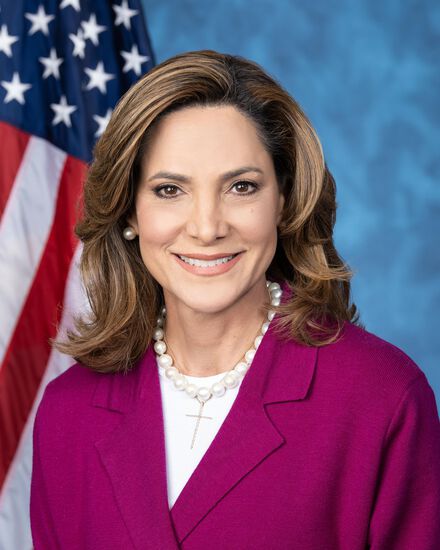
Rep. Maria Elvira Salazar
Sponsored bills
FDA Modernization Act of 2021 This bill allows an applicant for market approval for a new drug to use methods other than animal testing to establish the drug's safety and effectiveness. Under this bill, these alternative methods may include cell-based assays, organ chips and microphysiological systems, sophisticated computer modeling, and other human biology-based test methods.
Careful Resumption Under Improved Safety Enhancements Act or the CRUISE Act This bill requires various activities to mitigate the impact of COVID-19 on the operation of cruise ships. Specifically, the bill establishes a working group comprised of specified federal departments and industry stakeholders to develop recommendations for resuming cruise ship operations. In addition, the Centers for Disease Control and Prevention (CDC) must issue (within 30 days) separate recommendations on mitigating the introduction, transmission, and spread of COVID-19 onboard cruise ships and to communities onshore. The CDC must consult with the working group on these recommendations. Furthermore, the Department of Health and Human Services must revoke by July 4, 2021, its order issued on November 4, 2020, which restricts the operation of cruise ships in U.S. waters.
Fire Fighters and EMS Employer-Employee Cooperation Act This bill requires the Federal Labor Relations Authority to determine whether a state substantially provides fire and emergency medical services (EMS) personnel the right to form and join a labor organization; recognition by fire and EMS employers of the employees' labor organization, agreement to bargain with the organization, and reduction of any agreements to writing in a contract or memorandum of understanding; the right to bargain over hours, wages, and terms and conditions of employment; and arbitration or other mechanisms to resolve an impasse in collective bargaining negotiations. The bill makes the authority responsible for (1) determining the appropriateness of units for labor representation; (2) supervising elections; (3) conducting hearings and resolving complaints of unfair labor practices; and (4) protecting the right of employees to form, join, or assist any labor organization, or to refrain from doing so. An employer, fire and EMS personnel, or labor organization may not engage in a lockout, sickout, work slowdown, strike, or any other organized job action that will measurably disrupt the delivery of emergency services and is designed to compel an employer, fire and EMS personnel, or labor organization to agree to the terms of a proposed contract.
Accelerate Long-term Investment Growth Now Act or the ALIGN Act This bill makes permanent the expensing of certain new business equipment. Expensing allows the deduction of the full amount of an expense item in the same taxable year.
Comprehensive Care for Alzheimer's Act This bill allows the Center for Medicare and Medicaid Innovation (CMMI) to test a Dementia Care Management Model that provides comprehensive care to Medicare beneficiaries with Alzheimer's disease or a related dementia. Under the model, participating health care providers receive payment under Medicare for comprehensive care management services that are provided to individuals with diagnosed dementia, excluding Medicare Advantage enrollees, hospice care recipients, and nursing home residents. Required services include medication management, care coordination, and health, financial, and environmental monitoring, as well as trainings and other support services for unpaid caregivers. Providers must furnish services through interdisciplinary teams and must ensure access to a team member or primary care provider 24-7. The CMMI must set payments and determine quality measures for the model in accordance with specified requirements. The bill also allows the CMMI to design a similar model under Medicaid.
Assessing China's Presence and Influence in Latin America and the Caribbean Act of 2021 This bill requires the Department of State to report to Congress an assessment of China's efforts to expand its presence in Latin America and the Caribbean and how these efforts affect U.S. interests. The report shall include (1) a list identifying the countries that maintain the closest diplomatic, military, and economic relationships with China; (2) an analysis of which countries have received foreign assistance from China, including access to COVID-19 vaccines, and the conditions attached to that assistance; (3) a detailed description of sales or transfers of Chinese defense articles to countries in the region; and (4) an assessment of China's relationship with the Community of Latin American and Caribbean States.
U.S.-Israel Cooperation Expansion Act This bill states U.S. policy concerning U.S. and Israeli law enforcement training and threats to U.S. and Israeli security and embassy protection. Specifically, the bill provides that it is U.S. policy to (1) support bilateral training between U.S. and Israeli law enforcement for sharing best practices related to anti-terrorism, community policing, and managing mass casualties; and (2) continue to counter threats to U.S. and Israeli security and embassy protection posed by illicit cross-border tunneling and unmanned aerial systems.
Community Navigator Reporting Act of 2021 This bill requires the Small Business Administration to report annually on the performance and effectiveness of the Community Navigator pilot program, which was established to improve access to assistance programs and resources for small businesses in response to COVID-19 (i.e., coronavirus disease 2019).
Providing Responsible Emergency Plans for Animals at Risk of E merging Disasters Act or the PREPARED Act This bill establishes requirements governing the care of animals by entities, such as zoos, in emergencies or disasters. Specifically, the bill requires each research facility, dealer, exhibitor, intermediate handler, and carrier to develop and follow a contingency plan to provide for the humane handling, treatment, transportation, housing, and care of their animals in the event of an emergency or disaster.