Maddy summaryThis symbolic resolution designates July 20, 2022, as "Glioblastoma Awareness Day" to highlight the challenges of glioblastoma, a devastating brain cancer with a very poor survival rate (median survival of 8 months). It encourages public awareness, honors individuals affected by the disease, and supports research efforts like the Glioblastoma Therapeutics Network. The resolution does not create new laws or allocate funds but serves as a formal statement to elevate attention on this aggressive cancer.
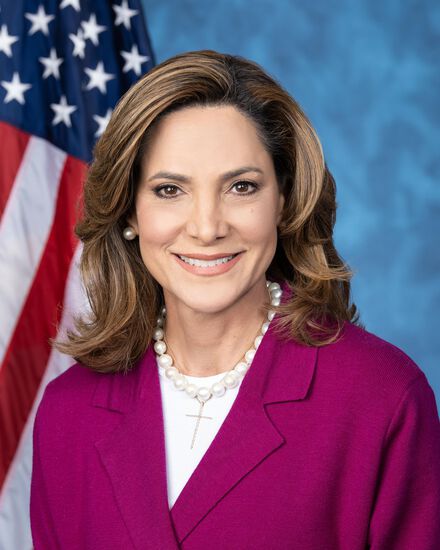
Rep. Maria Elvira Salazar
Sponsored bills
America Reopens Act This bill restricts the implementation and enforcement of various COVID-19 response measures in transportation, education, and other areas. Specifically, the bill prohibits any federal agency or federally funded entity from requiring that U.S. citizens or permanent residents wear face coverings or show proof of COVID-19 vaccination or testing when using public conveyances (e.g., planes or trains) or transportation hubs when traveling domestically or returning from foreign countries. Further, Canadian and Mexican nationals may enter the United States for business through land ports of entry without regard to their COVID-19 vaccination status. The bill also restricts federal funding of public institutions of higher education unless the institution (1) makes in-person instruction available to all students; and (2) allows students to opt out of COVID-19 requirements concerning vaccination, testing, and face covering. This restriction does not apply to distance education programs offered for reasons unrelated to COVID-19 or certain health-related educational programs. Additionally, the Department of Education must provide grants to parents for certain educational expenses, such as tuition at a private school, if their child lacks access to in-person instruction at a public elementary or secondary school due to COVID-19. The bill also prohibits the use of federal funds to implement or enforce a system or plan for verifying an individual's COVID-19 vaccination status, such as vaccine passports.
Burma Unified through Rigorous Military Accountability Act of 2022 or the BURMA Act of 2022 This bill imposes sanctions pertaining to Burma (Myanmar) and addresses related issues. The President must impose property- and visa-blocking sanctions on certain foreign persons (i.e., an individual or entity), including those that (1) knowingly operate in Burma's defense sector, (2) are responsible for or complicit in undermining Burma's democratic processes, or (3) are senior leaders in Burma's military or government. The Department of the Treasury must prohibit or impose strict conditions on certain accounts used to facilitate transactions for such sanctioned persons. The President may impose sanctions on Myanma Oil and Gas Enterprise if such sanctions would support certain objectives, including reducing the Burmese military's ability to undermine democracy in Burma. Before removing certain foreign persons from a list of specially designated nationals and blocked persons (commonly known as the SDN list), the President must certify to Congress that the person in question has not knowingly engaged in certain activities, such as supporting terrorism. The bill authorizes Department of State and U.S. Agency for International Development activities in Burma and the surrounding region to support democracy activists, humanitarian assistance, and reconciliation efforts. The State Department may (1) continue to assist organizations supporting political prisoners in Burma, and (2) provide assistance to entities investigating crimes against humanity. The President must direct U.S. representatives to the United Nations to vote and advocate for certain actions related to Burma, such as cutting off assistance to Burma's government.

Ensuring Lasting Smiles Act This bill requires private health insurance plans to cover diagnosis and treatment of congenital anomalies and birth defects, such as reconstructive services and items. Coverage must include services and items that functionally improve, repair, or restore any body part that is medically necessary for normal bodily functions or appearance, as determined by the treating physician. Coverage limits and cost-sharing requirements for such services and items may not be more restrictive than those applicable to all medical and surgical benefits under the plan.
Supply Chain Disruptions Relief Act This bill modifies the treatment of liquidations of new motor vehicle inventory as qualified LIFO (last in first out accounting method) inventory. It allows new motor vehicle dealers to elect to wait until the end of 2025 to replace their inventory for purposes of determining income attributable to the sale of such inventory during 2020 and 2021.
John W. Walsh Alpha-1 Home Infusion Act of 2022 This bill provides for Medicare coverage of treatment for alpha-1 antitrypsin (AAT) deficiency (a protein deficiency that raises the risk of lung and other diseases). Specifically, the bill provides for coverage of at-home augmentation therapy for beneficiaries with emphysema as a result of severe hereditary AAT deficiency. Treatment must be provided through qualified home infusion therapy suppliers; beneficiaries must be under the care of a physician, nurse practitioner, or physician assistant.
Small Business Regulatory Reduction Act This bill requires the Small Business Administration to ensure that for each fiscal year the cost to small businesses of the administration's rulemaking (including the modification or repeal of a rule) is not greater than zero. The administration also must report on any regulations issued by other federal agencies that have an impact on small businesses.
Keeping Israel Safe from Iranian Proxies Act This bill prohibits the Department of Defense from making federal funds available to specified entities that are backed by Iran.
Anti-Border Corruption Improvement Act This bill revises the waiver authority of the U.S. Customs and Border Protection (CBP) for polygraph examinations of applicants for law enforcement positions in the CBP. Any individual who receives such a waiver and holds a current background investigation may be subject to further background investigation. The CBP may administer a polygraph examination to an applicant for employment or an employee who is eligible for a waiver if information is discovered prior to the completion of a background investigation that makes necessary a final determination regarding suitability for employment or continued employment.
Securing a Strong Retirement Act of 2022 This bill makes various changes with respect to employer-sponsored retirement plans, including providing for the automatic enrollment of employees in certain plans and increasing the age at which participants are required to begin receiving mandatory distributions.