

Washington, D.C. Admission Act This bill provides for the establishment of the State of Washington, Douglass Commonwealth, and its admission into the United States. The state is composed of most of the territory of the District of Columbia (DC), excluding a specified area that encompasses the U.S. Capitol, the White House, the U.S. Supreme Court building, federal monuments, and federal office buildings adjacent to the National Mall and the U.S. Capitol. The excluded territory shall be known as the Capital and serve as the seat of the government of the United States, as provided for in Article I of the Constitution. The state may not impose taxes on federal property except as Congress permits. The bill provides for the DC Mayor to issue a proclamation for the first elections to Congress of two Senators and one Representative of the state. The bill eliminates the office of Delegate to the House of Representatives. The bill applies current DC laws to the state. DC judicial proceedings and contractual obligations shall continue under the state’s authority. The bill also provides for specified federal obligations to transfer to the state upon its certification that it has funds and laws in place to assume the obligations. These include maintaining a retirement fund for judges and operating public defender services. The bill establishes a commission that is generally comprised of members who are appointed by DC and federal government officials to advise on an orderly transition to statehood.
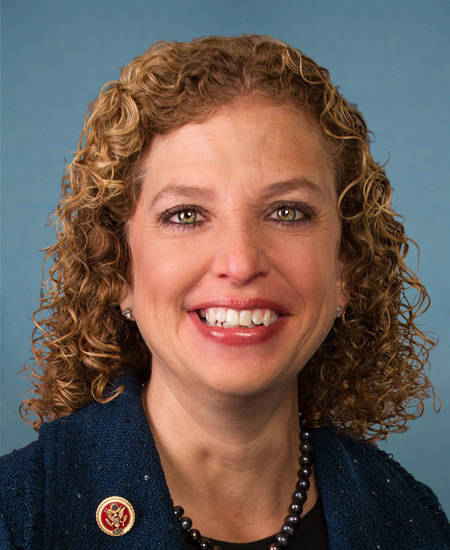
Rep. Debbie Wasserman Schultz
Sponsored bills
Maddy summaryThis bill renames a U.S. Postal Service facility at 518 North Ridgewood Drive in Sebring, Florida, as the "U.S. Army Air Corps Major Thomas B. McGuire Post Office Building." It updates all official federal references to this specific location to reflect the new name. The bill has no policy impact - it does not change postal services, funding, or operations, and only affects the building's official designation.
Maddy summaryThis bill designates the U.S. Postal Service facility at 14280 South Military Trail in Delray Beach, Florida, as the "Benjamin Berell Ferencz Post Office Building." It is a ceremonial naming resolution with no substantive policy changes or impacts on residents, services, or regulations. The bill simply updates official references (such as maps or documents) to use the new name for this specific post office location. It was enacted on January 2, 2025, following passage by both House and Senate in December 2024.
Maddy summaryThis bill designates the U.S. Postal Service facility at 109 Live Oaks Boulevard in Casselberry, Florida, as the "Colonel Joseph William Kittinger II Post Office Building." It directly affects the postal facility and all official U.S. government references to it. The key provision changes the building's official name in all federal laws, documents, maps, and records to reflect this designation. The bill does not create new policies or funding; it is purely a ceremonial naming action.
Maddy summaryThis bill (HR 1823) officially renames the U.S. Postal Service facility at 207 East Fort Dade Avenue in Brooksville, Florida, as the "Specialist Justin Dean Coleman Memorial Post Office Building." It directly affects the building's official name and all future references to it in government documents, maps, or records. The key provision is a simple name change to honor Specialist Justin Dean Coleman, a U.S. Army veteran. This is a procedural bill with no new policies or funding, solely commemorating an individual through the building's designation.
Maddy summaryThe Stop Campus Hazing Act requires colleges and universities to publicly report hazing incidents involving student organizations. It defines hazing as intentional acts causing physical or psychological harm during initiation or membership in student groups, including activities like forced substance consumption, sleep deprivation, or sexual acts. Institutions must include hazing statistics in annual security reports and publish a "Campus Hazing Transparency Report" on their websites by July 1, 2025, detailing findings about organizations violating hazing policies. The reports must include organization names, violation descriptions, and key dates while excluding personally identifiable student information. This applies to all colleges participating in federal student aid programs.
Maddy summaryThis bill, HR 1097 (Everett Alvarez, Jr. Congressional Gold Medal Act of 2023), authorizes the award of a Congressional Gold Medal to Everett Alvarez, Jr., in recognition of his service as a U.S. Navy pilot and Vietnam War prisoner of war. It directly honors Alvarez, who was the first U.S. pilot shot down in the Vietnam War, spent over 8.5 years in captivity, and later served in the Peace Corps and Veterans Administration. The bill’s key mechanism is directing the U.S. Mint to strike a gold medal bearing his name and image, with bronze duplicates available for sale to cover costs. It does not create new policies or affect any group beyond the honoree.
Maddy summaryThis bill approves new agreements that amend the Compact of Free Association between the United States and the Federated States of Micronesia, the Republic of the Marshall Islands, and the Republic of Palau. It incorporates related agreements including fiscal procedures and trust fund agreements that govern how U.S. funding is managed and distributed to these nations. The bill provides funding for 2024-2043 to support programs like healthcare, education, veterans' services, and economic development in the Freely Associated States. It establishes reporting requirements and oversight mechanisms for federal agencies implementing these agreements. The bill directly affects U.S. federal agencies, the Freely Associated States, and U.S. funding mechanisms for these Pacific Island nations.
Maddy summaryHR 10506, the Mobile Cancer Screening Act, authorizes $15 million annually (2026-2030) to fund mobile cancer screening units that expand access to early detection in rural and underserved communities. The bill provides grants of up to $2 million per recipient to eligible entities like nonprofit hospitals, health centers, and academic institutions for purchasing vehicles, imaging technology, and digital tools. Grantees must cover at least one-third of costs through non-Federal funds and prioritize areas with high cancer mortality, rural populations, and Indian Health Service regions, while ensuring follow-up care within 90 minutes. The program requires a 4-year report to Congress tracking patient demographics, screening rates, and outcomes to evaluate impact.
Maddy summaryHR 5401, the 9/11 Memorial and Museum Act, provides a one-time federal grant of $5 million to $10 million to the National September 11 Memorial & Museum (operated by the World Trade Center Foundation). The grant funds the museum's operations, security, and maintenance, with specific requirements including free admission for veterans, first responders, and victims' families, dedicated weekly free public hours, and annual financial audits. The museum must also report annually to Congress on how the funds were used. This bill directly affects the museum's financial operations and access policies, not broader legislative changes.