

Maddy summaryThe EACH Act of 2023 would require federal health programs - including Medicaid, Medicare, the Indian Health Service, and TRICARE - to cover abortion services without restrictions. It repeals a provision in the Affordable Care Act that allowed states to limit abortion coverage in health insurance plans sold through state marketplaces. The bill also prohibits the federal government from restricting abortion coverage in private health insurance plans. This would directly affect millions of people, particularly low-income individuals and people of color, who are disproportionately enrolled in Medicaid and currently face barriers to abortion care due to coverage restrictions.
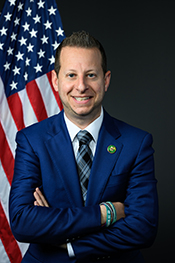
Rep. Jared Moskowitz
Sponsored bills
Maddy summaryHR 10423 (HIRE CREDIT Act) expands the Work Opportunity Tax Credit to allow employers to claim a credit for hiring workers displaced by qualifying disasters. It defines "displaced disaster victims" as individuals who lost their homes and jobs in areas declared disaster zones by the President under the Stafford Act (since 2024), were unemployed due to the disaster, and are hired within one year of the disaster's incident period. Employers cannot claim the credit for workers employed full-time outside the disaster zone. The bill applies to hires beginning January 1, 2024, or for disasters with incident periods ending before enactment but meeting specific transition rules.
Maddy summaryHR 8753 requires the U.S. Postal Service to assign a single, unique ZIP Code to 31 specific communities across 10 states, including Eastvale, CA, and The Villages, FL, within 270 days of the bill's enactment. This change directly affects residents and businesses in these communities by standardizing mail delivery addresses. The key mechanism mandates the USPS to establish one distinct ZIP Code per listed community, replacing any existing multi-part or shared codes. This is a procedural adjustment to improve mail sorting efficiency, not a substantive policy change.
Maddy summaryThis bill requires the Treasury Department to report on Hamas financing sources and U.S. efforts to disrupt those funds within 180 days of enactment. It directs Treasury to develop a multilateral strategy with international allies to prevent Hamas from financing hostilities against Israel. The bill also prohibits using the Exchange Stabilization Fund to exchange Special Drawing Rights with countries designated as state sponsors of terrorism under specific laws. These provisions directly affect U.S. financial operations and Treasury's coordination with international partners. The bill focuses on restricting financial mechanisms tied to designated terrorist entities, without altering existing sanctions.
Maddy summaryHR 7438 directs the U.S. Treasury to mint commemorative coins for the 2026 FIFA World Cup, including 100,000 $5 gold coins, 500,000 $1 silver coins, and 750,000 half-dollar coins. The coins will be sold to the public at face value plus surcharges ($35, $10, and $5 per coin, respectively), with all surcharge revenue paid to FWC2026 US, Inc. for U.S. soccer programs. These funds must support soccer initiatives, particularly in underserved communities and youth development, as specified in the bill. The coins are legal tender but will only be issued during 2026, with no net cost to the U.S. government.
Maddy summaryThis bill extends funding for the existing Public Health Service Act program focused on raising public awareness about Alzheimer's disease and related dementias. It authorizes $33 million annually for fiscal years 2025 through 2029 to support public health education and outreach initiatives. The program directly affects public health organizations and community groups that develop and distribute educational materials about Alzheimer's prevention, diagnosis, and care. The key provision is the multi-year funding extension, ensuring continued support for nationwide awareness efforts without altering the program's core structure.
Maddy summaryHR 6229, the DHS Special Events Program and Support Act, creates a new program within the Department of Homeland Security to assess security threats at pre-planned special events not already designated as National Special Security Events. It allows state, local, tribal, and territorial officials to voluntarily request a security rating for events, which could lead to DHS providing direct security and situational awareness support. The program uses a risk-based approach considering factors like event size, attendance of officials, venue, and credible threats, with expedited reassessment options. DHS must report annually on the program’s usage and support provided, and conduct research on technologies for mass gathering security. This directly affects event organizers seeking federal security assistance for non-NSS events.
Maddy summaryHR 2892, the WARN Act, directs the Comptroller General to study how local alert systems deliver weather emergency information during events like storms or power outages. The study will evaluate different alert methods - including social media - and develop best practices for clearer, faster public notifications. It requires a report to Congress within one year, but the bill itself creates no new laws or directly affects any group. This is a procedural study bill focused on improving future emergency communication systems.
Maddy summaryThe FEMA Loan Interest Payment Relief Act requires FEMA to reimburse local governments and electric cooperatives for interest paid on qualifying disaster recovery loans. A qualifying loan must be used for FEMA-covered activities with at least 90% of proceeds dedicated to those purposes. Reimbursement covers the lesser of actual interest paid or what would have been paid at the prime interest rate, as defined by the Federal Reserve. This relief applies to interest accrued in the seven years preceding the bill's enactment.
Maddy summaryThis bill allows states and tribal governments to opt for a lump sum payment instead of standard FEMA disaster aid for small disasters. Specifically, governors or tribal leaders can request 80% of the estimated damages (capped at $10 million) for disasters eligible under FEMA's Public Assistance Program, bypassing the usual reimbursement process. Funds must be used for recovery by the state or tribe, with no adjustment for actual costs later. States cannot also claim additional aid for the same disaster, and they must report expenses to FEMA. It directly affects state and tribal governments handling small-scale disasters under $10 million in eligible damages.