

Developing Responsible Individuals for a Vibrant Economy Act or the DRIVE-SAFE Act This bill directs the Department of Transportation to promulgate regulations to implement an apprenticeship program for licensed commercial motor vehicle drivers under the age of 21. Under the program, an apprentice must complete two probationary periods that total 400 hours of on-duty time, of which at least 240 hours must be driving time in a commercial motor vehicle. Additionally, the apprentice must be accompanied in the cab of the commercial motor vehicle by an experienced driver. Further, the bill requires all commercial motor vehicles used in the program for training to be equipped with safety technology such as active braking collision mitigation systems and video event capturing systems. An employer shall not knowingly allow, require, permit, or authorize a driver under the age of 21 to operate a commercial motor vehicle unless the driver is participating in, or has completed, an apprenticeship program that meets the requirements set forth in this bill.
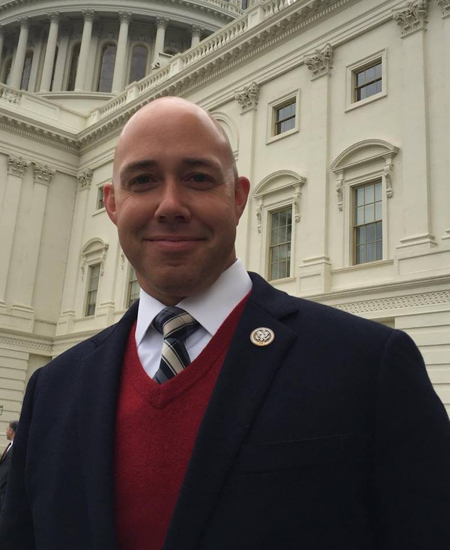
Rep. Brian J. Mast
Sponsored bills
Support Children Having Open Opportunities for Learning Act of 2021 or the SCHOOL Act of 2021 This bill allows certain federal funds for elementary and secondary education to follow the student to the school that they attend (i.e., public, private, or home school), regardless of whether the student is learning in person or remotely. These funds may be used for educational and instructional materials, tutoring, tuition for private school, and extracurricular activities.
TRICARE Reserve Select Improvement Act This bill expands TRICARE Reserve Select eligibility to include members of the Selected Reserve who are enrolled or eligible to enroll in the Federal Employees Health Benefits Program.
Death Tax Repeal Act This bill repeals the estate and generation-skipping transfer taxes. It also makes conforming amendments related to the gift tax.
Treatment and Relief through Emerging and Accessible Therapy for PTSD Act or the TREAT PTSD Act This bill requires the Department of Veterans Affairs (VA) and the Department of Defense (DOD) to furnish stellate ganglion block to certain veterans or members of the Armed Forces (including reserve components) diagnosed with post-traumatic stress disorder (PTSD). Blocking the stellate ganglion (a group of nerves at the base of the neck) by injecting a local anesthetic is a treatment that may alleviate PTSD symptoms. The bill authorizes this treatment for any veteran or member of the Armed Forces who (1) is enrolled in the VA health care system or TRICARE program, (2) has been diagnosed with PTSD, and (3) has elected to receive stellate ganglion block after being informed by a physician of the risks and benefits. Such treatment may be furnished at a VA medical center, DOD medical facility, or through health care provider under the Veterans Community Care Program or TRICARE health insurance program. The bill also requires the VA and DOD to update the VA/DOD Clinical Practice Guideline (CPG) for the Management of PTSD to ensure that information about stellate ganglion block is included.
Dismemberment Abortion Ban Act of 2021 This bill restricts the performance of dismemberment abortions. It defines the term dismemberment abortion . Specifically, the bill prohibits a physician from knowingly performing a dismemberment abortion. It provides an exception for a dismemberment abortion that is necessary to save the life of a mother whose life is endangered by a physical disorder, illness, or condition. The bill establishes criminal penalties—a fine, a prison term of up to two years, or both—for a physician who performs a prohibited dismemberment abortion. It also authorizes civil remedies for a woman or parent of a minor who undergoes a dismemberment abortion. A woman who undergoes a dismemberment abortion may not be prosecuted or held civilly liable.
This joint resolution proposes a constitutional amendment limiting Representatives to three terms and Senators to two terms. Terms beginning before the ratification of this amendment do not count towards these term limits.
Verification and Oversight for Transparent Elections, Registration, and Identifications Act or the VOTER ID Act This bill requires states to conduct post-election audits of federal elections and attest to the integrity and security of voting procedures in those elections. Specifically, states must conduct a post-election audit after each federal election. The audit must include the accuracy of voting systems used in the election and an assessment of state compliance with applicable election laws and procedures, including those governing the requirements for voter identification and use of mail-in voting. The Election Assistance Commission (EAC) must develop best practices for conducting post-election audits, including recommendations to (1) conduct an audit using a bipartisan entity, and (2) complete an audit within 30 days after the state certifies the results of a congressional election. Additionally, states must attest to the integrity and security of their voter identification procedures and maintenance of voter registration lists. States must submit to the EAC, and make publicly available on their websites, these audit results and attestations.
Curbing Realistic Exploitative Electronic Pedophilic Robots Act 2.0 or the CREEPER Act 2.0 This bill establishes new criminal offenses for conduct involving child sex dolls. Specifically, it makes it a crime to import, transport, buy, sell, distribute, or possess a child sex doll. A violator is subject to criminal penalties—a fine, a prison term, or both.
Concealed Carry Reciprocity Act This bill establishes a federal statutory framework to regulate the carry or possession of concealed firearms across state lines. Specifically, an individual who is eligible to carry a concealed firearm in one state may carry or possess a concealed handgun (other than a machine gun or destructive device) in another state that allows its residents to carry concealed firearms. It sets forth requirements for the lawful concealed carry across state lines. The bill preempts most state and local laws related to concealed carry and establishes a private right of action for a person adversely affected by interference with a concealed-carry right established by this bill.