

Supply Chain Emergency Response Act This bill directs the Maritime Administration to establish a program to provide grants to certain owners of cargo vessels to cover toll costs associated with rerouting cargo vessels from ports along the western seaboard of the United States through the Panama Canal to ports along the Gulf of Mexico and the eastern seaboard of the United States. To receive a grant, an owner of a cargo vessel shall submit documentation that such owner intends to reroute a cargo vessel and has the corresponding docking agreements. The bill allows states and localities to use COVID-19 relief funds for costs related to rerouting cargo vessels. Any marine terminal operator who is operating a port located along the western seaboard of the United States may not collect port fees from a recipient of a grant who has rerouted a cargo vessel from such port due to the inability of such port to receive such vessel. Any individual who is a member of the Chinese Communist Party or any company owned, in whole or in part, by the Chinese Communist Party may not receive a grant under this bill.
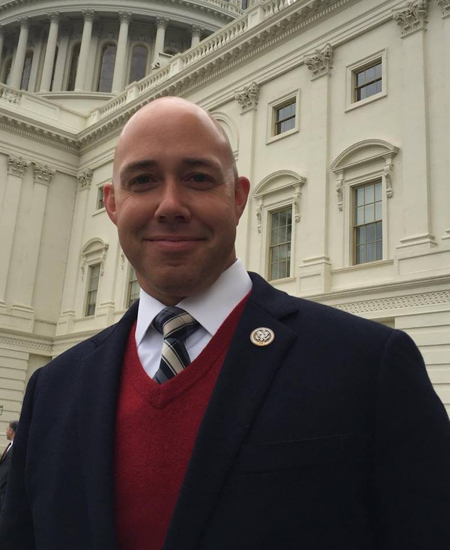
Rep. Brian J. Mast
Sponsored bills
Maddy summaryHRES 386 is a symbolic resolution introduced in the U.S. House of Representatives that expresses support for recognizing "National Police Week" each year. The resolution acknowledges law enforcement officers' sacrifices, particularly during the pandemic, and encourages the public to honor their service. As a non-binding statement, this resolution does not create new law or change policy but serves as a formal expression of support for law enforcement officers across the United States.
This bill prohibits military departments from taking any adverse action against a member of the Armed Forces based solely on the member's refusal to receive a COVID-19 vaccination or to disclose whether they have received such vaccination.
Protect and Serve Act of 2021 This bill establishes a new criminal offense for knowingly assaulting a law enforcement officer and causing serious bodily injury (or attempting to do so) in circumstances that affect interstate commerce. It imposes criminal penalties—a prison term, a fine, or both—on a violator.
Common Sense Cannabis Reform for Veterans, Small Businesses, and Medical Professionals Act This bill removes federal restrictions on, and creates new protections for, marijuana-related conduct and activities that are authorized by state or tribal law. Among other things, the bill does the following: removes marijuana from the list of scheduled substances under the Controlled Substances Act and eliminates criminal penalties for an individual who manufactures, distributes, or possesses marijuana; directs the Food and Drug Administration and the Alcohol and Tobacco Tax and Trade Bureau of the Department of the Treasury to issue rules to regulate marijuana that are similar to the federal rules regulating alcohol; creates protections for depository institutions that provide financial services to marijuana-related businesses; creates protections for veterans who use, possess, or transport medical marijuana; and requires the National Institutes of Health to study and report on the effects of medical marijuana on individuals who are impaired or in pain and the relationship between state-approved treatment programs involving medical marijuana, access to such programs, and a reduction in opioid abuse.
Stop Vaccine Mandates Act This bill rescinds the executive order titled Ensuring Adequate COVID Safety Protocols for Federal Contractors and the executive order titled Requiring Coronavirus Disease 2019 Vaccination for Federal Employees , both published on September 9, 2021. The bill provides that these executive orders shall have no force or effect.
Keeping Our COVID-19 Heroes Employed Act This bill exempts essential workers from COVID-19 vaccination requirements imposed by the federal government and contractors, public entities that received federal COVID-19 relief funds, and private entities that received any federal funds. An essential worker is an individual who was deemed to be essential or exempted from response measures during the COVID-19 pandemic by a state, tribe, or territory.
Fiscal State of the Nation Resolution This concurrent resolution requires the congressional budget committees to conduct an annual joint hearing to receive a presentation from the Comptroller General regarding (1) the Government Accountability Office's audit of the financial statement of the executive branch, and (2) the financial position and condition of the federal government.
Employment Freedom for All Act This bill prohibits an employer from enforcing a noncompete agreement with an employee, or former employee, who has been fired for not receiving a COVID-19 vaccine. The Federal Trade Commission and state attorneys general are authorized to enforce this bill.
Extending Limits of U.S. Customs Waters Act This bill extends the customs waters territory of the United States. Under current law, customs waters means waters within four leagues of the coast of the United States. This bill revises the definition to include (1) the territorial sea of the United States to the limits permitted by international law in accordance with Presidential Proclamation 5928, dated December 27, 1988, that extended such limits to 12 nautical miles from the baselines of the United States; and (2) the contiguous zone of the United States to the limits permitted by international law in accordance with Presidential Proclamation 7219, dated September 2, 1999, that extended such limits to 24 nautical miles from the baselines of the United States.