No OSHA Authority to Mandate Vaccines Act This bill specifies that the Department of Labor may not, under its authority to regulate workplace safety and health, require the administration of any drug, vaccine, or other biological product to an employee.
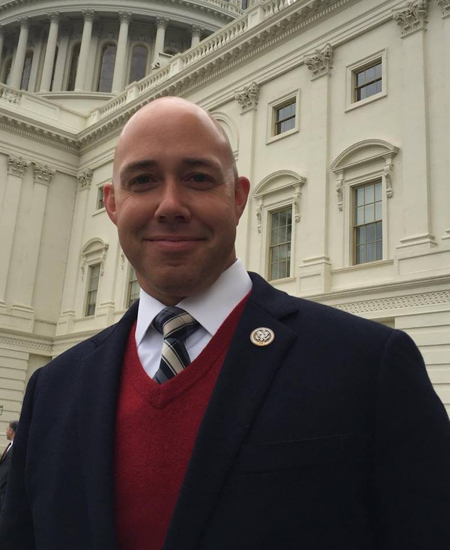
Rep. Brian J. Mast
Sponsored bills
Maddy summaryH.J. Res. 46 is a joint resolution seeking to terminate the national emergency declared by President Trump on March 13, 2020, under the National Emergencies Act. If enacted, it would end the legal authority allowing federal agencies to bypass standard procedures during the pandemic response. This action would directly affect government operations relying on emergency powers, requiring agencies to revert to regular processes for ongoing programs. The resolution does not alter existing laws or create new policies - it solely ends the emergency designation.
This resolution urges the government of Argentina to bring the perpetrators of the March 17, 1992, terrorist attack on the Embassy of Israel in Buenos Aires to justice (in 1999 the Supreme Court of Argentina found that the transnational terrorist organization Hezbollah was responsible for the attack). The resolution commends the Argentinian government for designating Hezbollah as a terrorist organization and urges other U.S. allies and partners in Latin America and the Caribbean to do the same. The resolution urges these allies and partners to condemn and counter regional governments in the hemisphere that aid and abet Iran and Hezbollah. The resolution also commends the Argentinian government for adopting the International Holocaust Remembrance Alliance working definition of antisemitism and encourages other partners and allies to do the same. Finally, the resolution commends the Secretary General of the Organization of American States for appointing a Commissioner to Monitor and Combat Anti-Semitism in the Western Hemisphere.
Consolidated Appropriations Act, 2022 This bill provides appropriations to federal agencies for the remainder of FY2022, provides supplemental appropriations for activities to support Ukraine, and modifies or establishes various programs that address a wide range of policy areas. The bill includes the 12 regular appropriations bills that fund federal agencies for FY2022. These bills include the Agriculture, Rural Development, Food and Drug Administration, and Related Agencies Appropriations Act, 2022; the Commerce, Justice, Science, and Related Agencies Appropriations Act, 2022; the Department of Defense Appropriations Act, 2022; the Energy and Water Development and Related Agencies Appropriations Act, 2022; the Financial Services and General Government Appropriations Act, 2022; the Department of Homeland Security Appropriations Act, 2022; the Department of the Interior, Environment, and Related Agencies Appropriations Act, 2022; the Departments of Labor, Health and Human Services, and Education, and Related Agencies Appropriations Act, 2022; the Legislative Branch Appropriations Act, 2022; the Military Construction, Veterans Affairs, and Related Agencies Appropriations Act, 2022; the Department of State, Foreign Operations, and Related Programs Appropriations Act, 2022; and the Transportation, Housing and Urban Development, and Related Agencies Appropriations Act, 2022. The bill provides supplemental appropriations for several federal agencies to assist Ukraine in responding to the attack by Russia. For example, the bill provides funding for emergency food assistance, migration and refugee assistance, defense equipment, economic assistance, and enforcing sanctions against Russia. In addition, the bill reauthorizes several expiring programs and authorities, including the National Flood Insurance Program; several immigration-related authorities and programs; the Department of Agriculture's livestock mandatory reporting program; the special assessment on nonindigent people or entities convicted of certain criminal offenses (e.g., sexual abuse and trafficking); the authority for the Department of Health and Human Services to make certain appointments for the National Disaster Medical System; the temporary scheduling order issued by the Drug Enforcement Administration to place fentanyl-related substances in Schedule I of the Controlled Substances Act; the Temporary Assistance for Needy Families (TANF) program; the U.S. Anti-Doping Agency; programs and activities under the Violence Against Women Act that seek to prevent and respond to domestic violence, sexual assault, dating violence, and stalking; intelligence activities and programs; and the National Aeronautics and Space Administration's (NASA's) enhanced-use leasing authority. The bill also includes several additional provisions that address a wide range of policy issues and programs, including: the regulation of synthetic nicotine; Medicare, Medicaid, and other health programs; fraud targeting the elderly; deceptive acts or practices targeting Native Americans; carbon monoxide poisoning; salaries for certain Department of Veterans Affairs (VA) medical positions; VA cemetery grants; credit union governance; the replacement of the London Interbank Offered Rate (LIBOR) benchmark interest rate; recovery and assistance efforts for Haiti; reporting requirements and law enforcement activities related to cybercrimes; the Trans-Sahara Counterterrorism Partnership Program; the EB-5 immigrant investor visa program; and the normalization of relations between Israel and Arab countries.

Prohibiting Oil Trade with Venezuela's Tyrant Act This bill requires the President to prohibit the importation of petroleum products from Venezuela. Petroleum product means crude oil, residual fuel oil, or any refined petroleum product, including natural gas liquid product. Further, the bill authorizes the President to use appropriate authorities to impose civil or criminal penalties as necessary to enforce the prohibition. The prohibition shall terminate after the Department of State certifies that Venezuela has held free and fair elections and all political prisoners have been released.
This resolution condemns the terrorist attack on Congregation Beth Israel in Colleyville, Texas, on January 15, 2022. It also expresses support for the affected community, commends the actions of law enforcement and emergency responders, and reaffirms a commitment to combat hate, bigotry, anti-Semitism, and violence against Jewish Americans.
American Ammo in Defense of Ukraine Act This bill authorizes the President to waive certain payments and requirements for deliveries of ammunition to Ukraine until the armed conflict in Ukraine ends. Specifically, for certain types of ammunition or ordnance to be delivered to a qualified entity providing such items to Ukraine, the President may transport the items without charging the transportation costs to Ukraine. The President may also, to expedite delivery of such items, waive any applicable Department of State or Department of Commerce export criteria.
Direct Investigations on China, Take Action To Oppose Russia Act of 2022 or the DICTATOR Act of 2022 This bill requires the Department of State to report to Congress on entities in China that assist or have assisted Russia's efforts to evade sanctions imposed by the United States following Russia's invasion of Ukraine. The bill also requires the relevant federal agencies to brief Congress on U.S. efforts to (1) identify and sanction such entities, and (2) economically isolate Russia from outside support and economic assistance from China.
No Energy Revenues for Russian Hostilities Act of 2022 This bill prohibits, with some exceptions, the Department of the Treasury from authorizing certain energy-related transactions that would otherwise be blocked by an executive order barring transactions related to specified harmful foreign activities of the Russian government. The bill also revokes a license issued February 28, 2022, by the Office of Foreign Assets Control within Treasury that authorized certain transactions barred by the executive order. The bill allows a waiver from the limitation on an energy transaction if the transaction involves funds owed to a Russian person and the funds are to be used for the sale of agricultural commodities, food, medicine, or medical devices. The bill terminates on the earlier of five years after its enactment, or 30 days after the President reports to Congress that Russia has ceased activities destabilizing the sovereignty and territorial integrity of Ukraine.
This concurrent resolution condemns Russia's invasion of Ukraine and its ongoing support of proxy militias in the region. The concurrent resolution also states that these actions pose a direct threat to international peace and security and run contrary to Russia's responsibilities and obligations as a permanent member of the U.N. Security Council. The concurrent resolution urges the President to direct the U.S. representative to the United Nations to use the voice, vote, and influence of the United States to take all necessary steps to remove Russia as a permanent member of the U.N. Security Council. Finally, the concurrent resolution urges other member states to support such efforts to hold Russia accountable at the United Nations.