

Maddy summaryThis bill requires states to ensure autonomous vehicle (AV) licensing doesn't discriminate against people with disabilities, aligning with existing civil rights law. It mandates a National Academies study to identify physical infrastructure changes - like curb designs, dedicated pickup zones, and non-visual access tools - that would help individuals with disabilities safely access driverless ride-hail vehicles during pickup and dropoff. The study, funded by $5 million, focuses on practical solutions for navigating sidewalks, curbs, and vehicle entry/exit. The bill directly affects people with disabilities using AV services, states issuing vehicle licenses, and ride-hail companies operating driverless vehicles.
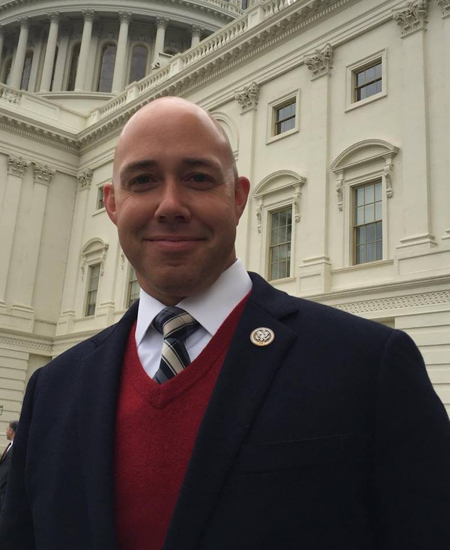
Rep. Brian J. Mast
Sponsored bills
Maddy summaryHR 7275, the Comprehensive National Mercury Monitoring Act, establishes a federal program to track mercury pollution across U.S. ecosystems. The bill directs the Environmental Protection Agency (EPA) to create a national monitoring network at sites in national parks, wildlife refuges, and ecologically sensitive areas, measuring mercury levels in air, water, soil, and wildlife like fish and birds. It requires standardized data collection, a public online database for all collected information, and biennial reports to Congress on mercury trends. The program is authorized to receive $37 million in fiscal year 2025 and $29 million each in 2026-2027, with data intended to inform public health and environmental decisions. This legislation directly affects federal agencies managing environmental monitoring and provides the public with accessible data on mercury contamination.
Maddy summaryHJRES 114 is a joint resolution seeking congressional disapproval of a Federal Highway Administration (FHWA) rule that would have required tracking greenhouse gas emissions as part of assessing performance for the National Highway System. The rule, published in the Federal Register in December 2023, aimed to establish specific metrics for evaluating highway system performance, including emissions data. If approved, this resolution would nullify the rule, preventing the FHWA from implementing the emissions tracking requirement. This action directly affects how the FHWA measures highway system performance, specifically regarding environmental metrics.
This resolution expresses the sense of the House of Representatives that former President Trump did not engage in insurrection or rebellion against, nor give aid or comfort to the enemies of, the United States.
Maddy summaryThe AFIDA Improvements Act of 2024 updates the Agricultural Foreign Investment Disclosure Act to require foreign individuals or entities owning at least 1% of U.S. agricultural land (directly or through multiple ownership tiers) to report their holdings. It creates new enforcement duties for the Farm Production and Conservation Business Center (FPAC-BC) to validate data, ensure compliance, and identify violators. The bill mandates the Secretary of Agriculture to share foreign ownership reports with the Committee on Foreign Investment in the United States (CFIUS) and update agency handbooks using recommendations from a 2024 Government Accountability Office report. These changes apply directly to foreign landowners and agricultural agencies like the Farm Service Agency, aiming to improve transparency around foreign ownership of U.S. farmland.
Maddy summaryThis bill, HR 7111 (UNRWA Elimination Act), ends all U.S. funding for the United Nations Relief and Works Agency for Palestine Refugees (UNRWA) and prohibits future U.S. support for its programs, staff, or activities. It requires the President to advocate for disbanding UNRWA and transferring its refugee services in the West Bank and Gaza to the UN High Commissioner for Refugees (UNHCR). The bill also conditions U.S. foreign aid on recipient countries publicly supporting UNRWA's disbandment. It directly affects UNRWA, which provides critical aid to Palestinian refugees, and U.S. foreign aid recipients who must align with this policy to receive funding.
Maddy summaryThis resolution (HRES 923) designates the main hearing room of the House Committee on Transportation and Infrastructure (Room 2167 in the Rayburn Building) as the "Chairman Don Young Hearing Room." It requires the Architect of the Capitol to place a commemorative plaque over the room's doorways with the inscription "The Chairman Don Young Hearing Room - Congressman for ALL Alaska." The bill directly affects the physical space of the committee's hearing room and honors Don Young, a former Alaska congressman and committee chairman. As a ceremonial resolution, it does not create new policy or affect legislation.
Maddy summaryThe STATES 2.0 Act would allow states to regulate cannabis according to their own laws without federal interference, while establishing a federal framework for interstate commerce. It would create a federal excise tax on marijuana to support regulation without adding excessive costs to consumers, and would require the FDA to regulate marijuana products as drugs, food, or cosmetics. The bill would exempt state-legal cannabis activities from federal prohibition, including removing cannabis from the federal controlled substances schedule when sold in compliance with state law. It would also allow federally recognized tribes to regulate cannabis within their jurisdictions under tribal law, and would require a study on how cannabis legalization affects traffic safety.
Maddy summaryThis bill requires the President to block transactions involving "covered Iranian funds" processed by foreign or international financial institutions. These funds refer specifically to money transferred from South Korea to Qatar under certain Iran sanctions waivers. The law imposes sanctions under existing U.S. authorities to block all U.S.-related transactions with institutions handling these funds. Sanctions can be lifted if Iran stops supporting terrorism and dismantles its weapons programs, as certified by the President. The bill directly affects global financial institutions processing these specific Iranian-linked transfers.
Maddy summaryThis bill targets U.S. business activities that could help specific countries of concern (North Korea, China, Russia, and Iran) develop critical technologies. It requires the President to identify "covered sectors" (including semiconductors, artificial intelligence, quantum technology, hypersonics, and high-performance computing) and prohibit U.S. persons from engaging in certain activities involving these technologies with entities in countries of concern. The bill also mandates that U.S. persons submit notifications about certain activities involving these technologies, with requirements for public comment and transparency. It establishes reporting requirements for the President to Congress on implementation and impact, and includes provisions for national interest waivers.