

Lower Costs, More Cures Act of 2021 This bill establishes and modifies several programs and requirements to address prescription drug prices. The bill modifies provisions under Medicare and Medicaid relating to prescription drug coverage and price transparency. Among other changes, the bill requires the Centers for Medicare & Medicaid Services to publish certain information, as reported by pharmacy benefit managers (PBMs), relating to generic dispensing rates, drug discounts and rebates, and payments between PBMs, health plans, and pharmacies; caps annual out-of-pocket spending under the Medicare prescription drug benefit; allows prescription drug plan sponsors under the Medicare prescription drug benefit to offer additional plans in a region; requires pass-through pricing models, and prohibits spread-pricing, for payment arrangements with PBMs under Medicaid; and allows states to include in the Medicaid Drug Rebate Program covered outpatient drugs that are provided as part of physician or outpatient hospital services. The bill also generally modifies other provisions relating to the regulation and costs of generic and brand-name drugs. Among other changes, the bill prohibits the manufacturer of a brand-name, generic, or biosimilar drug from entering into certain agreements to resolve or settle a patent infringement claim in connection with the sale of a drug or biological product; permanently allows high deductible health plans to waive deductibles for insulin and associated products; and establishes the position of Chief Pharmaceutical Negotiator in the Office of the U.S. Trade Representative.
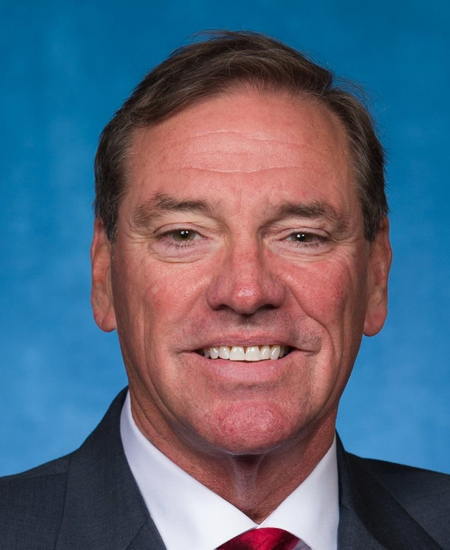
Rep. Neal P. Dunn
Sponsored bills
Maximum Pressure Act This bill expands sanctions and economic penalties on Iran. It also restricts the President from unilaterally lifting or waiving the sanctions or penalties and increases congressional oversight of them. Specifically, the bill requires the President to impose visa- and asset-blocking sanctions. Additionally, it modifies existing sanctions, including by (1) providing statutory authority for executive orders imposing sanctions; (2) applying sanctions to additional sectors of Iran's economy; and (3) broadening sanctionable conduct to cover, for example, assisting Iran with the acquisition of ballistic missiles and the complicity of Iranian officials in human rights violations in specified countries. The bill also requires reporting on licenses that authorize activities subject to sanctions. The bill prohibits U.S. representatives at the International Monetary Fund from voting to allow Iran's access to special drawing rights (a currency support tool) and places restrictions on financial transactions with Iran. The restrictions include requiring domestic financial institutions to implement special measures with respect to foreign financial institutions that conduct significant transactions connected to the Instrument in Support of Trade Exchanges (a European mechanism that bypasses U.S. sanctions when carrying out trade with Iran). The Department of State must maintain the Islamic Revolutionary Guard Corps' designation as a terrorist organization and must designate Ansharallah (or Houthis), which operates in Syria, as a foreign terrorist organization. The bill also requires reports on U.S. sanctions concerning Iran, the status of Iran's nuclear weapons program, and other matters.
Temporary Reauthorization of the Emergency Scheduling of Fentanyl Analogues Act This bill extends until May 6, 2022, the temporary scheduling order issued by the Drug Enforcement Administration to place fentanyl-related substances in schedule I of the Controlled Substances Act. The temporary order expires on May 6, 2021.
Camp Lejeune Justice Act of 2021 This bill allows certain individuals to sue and recover damages for harm from exposure to contaminated water at Camp Lejeune in North Carolina between August 1, 1953, and December 31, 1987. This action is available only to individuals who were exposed to contaminated water for at least 30 days. The bill prohibits the U.S. government from asserting specified immunity from litigation in response to such a lawsuit. The bill also prohibits an individual who brings such an action from bringing a separate tort action against the United States based on the same harm.
Prohibiting IRS Financial Surveillance Act This bill prohibits the Department of the Treasury from requiring a financial institution to report the transfers into and out of a financial account. This prohibition does not apply to laws or regulations in effect on October 1, 2021.
Prostate Cancer Prevention Act This bill reauthorizes through FY2026 a program within the Centers for Disease Control and Prevention that provides funding to states and local health departments for prostate cancer screening and related activities.
Protecting Americans' Genomic Information Act of 2021 This bill requires the Department of Health and Human Services (HHS) to address national security concerns when conducting or supporting biomedical research that involves human genomic sequencing and sensitive, identifiable information. Specifically, HHS must implement a risk framework to assess whether such research conducted by the National Institutes of Health or other HHS agencies and offices poses risks to national security and identify approaches to mitigate those risks, including through security controls and training for those that manage or have access to such research. After the framework is developed, HHS must implement data access controls, ensure that data access committees include members with national security expertise, and update relevant data access and sharing policies. The bill also requires HHS to brief Congress about these activities.
Fishery Resource Disasters Improvement Act This bill revises the Fisheries Resource Disaster Relief Program and repeals or revises certain reporting requirements. The bill revises the procedures and process for determining whether there has been a commercial fishery failure as a result of a fishery resource disaster because of natural, man-made, or undetermined causes. The Department of Commerce shall have the sole authority to determine the existence, extent, and beginning and end dates of a fishery resource disaster. Additionally, Commerce must include in its budget justification materials submitted to Congress in support of the budget of Commerce for each fiscal year, (as submitted with the President's budget) a separate statement of the amount requested to be appropriated for that fiscal year for outstanding unfunded fishery resource disasters. The bill repeals a program that provides disaster relief assistance to fishermen, charter fishing operators, and others affected by a catastrophic regional fishery disaster, known as the regional coastal disaster assistance, transition, and recovery program. With respect to reporting requirements, the bill requires (1) biennial rather than annual reports (under current law, annual reports) relating to the recovery of Klamath River Coho salmon, and (2) inclusion of additional information in the biennial reports on international compliance regarding the conservation of living marine resources. The bill also repeals the requirement for annual reporting to Congress on bycatch reduction agreements.
Ensuring Medicaid Continuity for Children in Foster Care Act of 2021 This bill allows states to receive federal Medicaid payment for services provided to foster care children in qualified residential treatment programs (i.e., programs with trauma-informed treatment models that address the needs of children with serious emotional or behavioral disorders or disturbances).
National POW/MIA Memorial and Museum Act This bill designates the memorial and museum that is being constructed on an approximately 26-acre area on the POW-MIA Memorial Parkway in Jacksonville, Florida, as the National POW/MIA Memorial and Museum. The director of the memorial and museum shall submit a report to Congress that includes a budget for the memorial and museum.