

Maddy summaryThis bill, titled the Safeguarding Women from Chemical Abortion Act, aims to revoke federal approval for the drug mifepristone (also known as RU-486) for use in terminating pregnancies. If enacted, the Food and Drug Administration's approval for mifepristone for this indication would be withdrawn within 14 days, making its introduction into interstate commerce for pregnancy termination a violation of federal law. Additionally, the bill establishes a new federal right for individuals to sue manufacturers of mifepristone if they experience bodily injury or harm to mental health attributed to its use for pregnancy termination. This legislation directly affects drug manufacturers, distributors, healthcare providers, and individuals seeking or having used medication abortion.
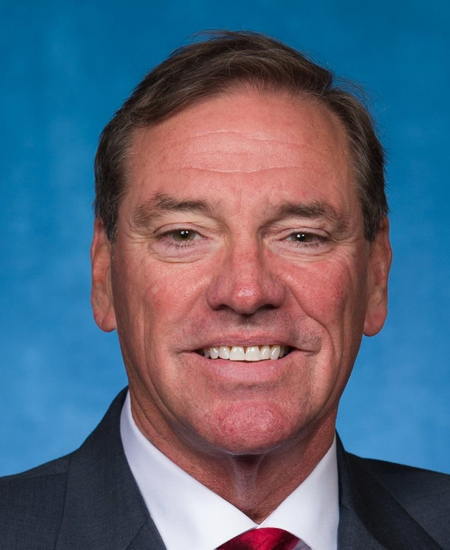
Rep. Neal P. Dunn
Sponsored bills
Maddy summaryHR 7871 (MVP Act) updates Medicaid drug rebate rules to allow manufacturers to report multiple "best price points" for drugs sold under outcome-based payment arrangements, requiring these arrangements to be offered to all states. It clarifies how average manufacturer price is calculated for such drugs and exempts certain outcome-linked payments from anti-kickback laws. The bill also mandates a GAO study to assess whether these arrangements improve patient access, lower costs, and reduce disparities in drug coverage. This affects Medicaid programs nationwide, drug manufacturers, and patients receiving covered outpatient drugs under Medicaid.
Maddy summaryThis bill establishes the Red Star Service Banner as an officially recognized symbol to honor U.S. service members and veterans who died by suicide, as well as first responders who died by suicide. The banner features a white field with a blue border and a single red star, and it may be displayed at private residences, workplaces, public buildings, community spaces, and other appropriate locations to recognize the sacrifice of those who died and support their families. The legislation clarifies that displaying the banner does not create new eligibility for benefits, requires VA approval for individual display, or establish any legal status beyond recognition. It also allows the Secretary of Veterans Affairs to promote awareness of the banner in coordination with the Department of Defense without requiring additional funding.
Maddy summaryThis bill clarifies that temporary medical staff (locum tenens physicians and advanced practitioners) working in rural or underserved areas are treated as independent contractors - not employees - by federal programs for key purposes. It specifically affects how these temporary workers are classified under the Fair Labor Standards Act, Civil Rights Act, Medicare, Medicaid, and other federal health programs, ensuring they aren’t deemed employees of the healthcare facility they temporarily serve. The bill requires a written agreement between the temporary staff and the facility, with an exception for cases where an explicit employer-employee contract is signed. It explicitly does not change tax treatment, state licensing rules, or eligibility for Medicare/Medicaid benefits.
Maddy summaryHR 7563 prohibits imports of rare earth magnets from "covered nations" (primarily China, as defined by existing law) into the U.S., except for limited cases where domestic supply is unavailable or national security requires it. It also restricts exporting electronic waste containing rare earth magnets to encourage domestic recycling and allows the Commerce Secretary to provide financial support (like price guarantees) to U.S. or partner-country manufacturers building rare earth magnet production facilities. The law applies to products containing these magnets, directly affecting U.S. manufacturers, importers, and recyclers of electronics and defense equipment. A report on implementation must be submitted to Congress within three years.
Maddy summaryThis bill amends the Department of Energy Organization Act to define "critical energy resources" as those essential to U.S. energy systems with vulnerable supply chains. It directs the Energy Secretary to assess supply chain risks, diversify sources, boost domestic production of these resources, develop alternatives, and improve recycling. The law specifically requires evaluating reliance on imports, adversarial nation tactics (like price manipulation), and impacts on energy technology development. The Department of Energy and energy sector stakeholders will implement these measures, directly affecting how the federal government manages energy security. The bill focuses on concrete policy actions, not outcomes or political advocacy.
Maddy summaryThe Undersea Cable Protection Act of 2025 prohibits the National Marine Sanctuaries Act from requiring additional authorizations for undersea fiber optic cables that already have federal or state permits. It directly affects cable operators who have obtained licenses, leases, or permits from any federal or state agency for cable installation or maintenance in national marine sanctuaries. The bill prevents the Secretary from blocking or demanding new permits for these cables once they have valid existing authorization. This simplifies regulatory processes by eliminating redundant federal oversight for cables already approved by other agencies.
Maddy summaryThe REPAIR Act requires motor vehicle manufacturers to provide car owners and independent repair shops with full access to vehicle data and repair information, prohibiting technological or legal barriers that restrict this access. It mandates that manufacturers share vehicle-generated data, critical repair information, and tools on equal terms with dealers and authorized service providers, without requiring consumers to use specific brands of parts or tools. The law establishes an advisory committee to monitor implementation and ensure fair competition in vehicle repair, while giving the Federal Trade Commission authority to enforce these requirements as unfair or deceptive practices. This legislation directly affects car owners, independent repair facilities, aftermarket parts manufacturers, and motor vehicle manufacturers by shifting control of repair information and data from manufacturers to consumers.
Maddy summaryThis bill modifies tax credit rules to help businesses recover after disasters. It allows businesses operating in designated disaster areas to treat certain unused tax credits (carryforwards) as transferrable credits against current tax liability, rather than letting them expire. Specifically, it applies to taxpayers making eligible expenditures for business operations in areas with a major disaster declaration after December 31, 2023, or a state-declared disaster meeting specific criteria. The change affects businesses in affected zones by providing immediate tax relief for qualifying expenses incurred within two years of the disaster declaration. It does not involve energy policy or new funding, but adjusts existing tax credit rules for disaster recovery.
Maddy summaryThis bill prevents state or local governments from banning or restricting energy connections (like installation, modification, or access) based on the type or source of energy, such as electricity, natural gas, or renewable fuels. It directly affects consumers choosing energy providers and energy companies seeking to offer services. The key provision prohibits local laws, regulations, or policies that limit energy services sold in interstate commerce, covering all energy types listed in the bill’s definitions. It does not create new programs but limits regulatory authority at the state or local level. The law aims to ensure open access to diverse energy sources without source-based restrictions.