This joint resolution nullifies a Department of Labor emergency temporary standard for preventing the transmission of COVID-19 in employment settings. Under the standard issued on November 5, 2021, employers with 100 or more employees must require their onsite employees to either be fully vaccinated against COVID-19 or undergo weekly COVID-19 testing.
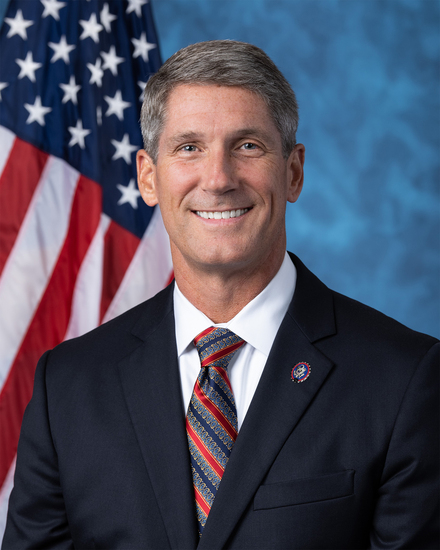
Rep. Scott Franklin
Sponsored bills
This resolution prohibits consideration of a bill or joint resolution, or a related amendment or conference report, that includes reconciliation language prior to the committee of jurisdiction receiving the cost analysis for that legislation from the Congressional Budget Office.
This concurrent resolution declares that Congress should not impose any new performance fee, tax, royalty, or other charge relating to the public performance of sound recordings on a local radio station for broadcasting sound recordings over the air, or on any business for such public performance of sound recordings.
Maddy summaryHRES 386 is a symbolic resolution introduced in the U.S. House of Representatives that expresses support for recognizing "National Police Week" each year. The resolution acknowledges law enforcement officers' sacrifices, particularly during the pandemic, and encourages the public to honor their service. As a non-binding statement, this resolution does not create new law or change policy but serves as a formal expression of support for law enforcement officers across the United States.
Honoring Our Promises through Expedition for Afghan SIVs Act of 2021 or the HOPE for Afghan SIVs Act of 2021 This bill authorizes the Department of State and the Department of Homeland Security (DHS) to postpone the medical exam requirement for qualifying citizens or nationals of Afghanistan seeking entry into the United States as special immigrants. Specifically, this bill applies to an existing program that provides special immigrant status to an individual (or the spouse or child of such an individual) who (1) faithfully performed sensitive and trusted duties for the U.S. government or the International Security Assistance Force in Afghanistan on or after October 7, 2001, and (2) has experienced or is experiencing an ongoing serious threat due to the performance of those duties. Under this bill, the State Department and DHS may jointly issue a blanket waiver of any requirement for such individuals to undergo a medical exam before admission into the United States. DHS shall ensure, to the greatest extent practicable, that individuals admitted under such a waiver undergo medical exams no later than 30 days after admission into the United States. Such an individual shall be admitted as a conditional permanent resident. DHS shall remove the conditions once the individual receives and passes a medical examination.

Protecting America From Spies Act This bill expands the grounds for barring aliens who have engaged in acts relating to espionage or sabotage from entering the United States. Specifically, any alien shall be inadmissible if the alien has engaged in or will engage in an act that (1) violates a U.S. law relating to espionage or sabotage; (2) would violate any U.S. law relating to espionage or sabotage if it occurred in the United States; or (3) violates any U.S. law prohibiting the export of goods, technology, or sensitive information. Currently, an alien shall be inadmissible if the alien seeks to enter the United States to engage in such an action. Furthermore, the bill expands these grounds of inadmissibility and other security-related grounds to cover the spouse or child of the barred alien if the act occurred in the last five years. The bill also modifies the authority of the Department of Justice to waive certain security-related grounds of inadmissibility for an alien applying for a nonimmigrant visa.
Federal Initiative to Guarantee Health by Targeting Fentanyl Act This bill places fentanyl-related substances as a class into schedule I of the Controlled Substances Act. A schedule I controlled substance is a drug, substance, or chemical that has a high potential for abuse; has no currently accepted medical value; and is subject to regulatory controls and administrative, civil, and criminal penalties under the Controlled Substances Act. Additionally, the bill prohibits the application of a mandatory minimum prison term for certain drug offenses involving fentanyl-related substances.
Temporary Family Visitation Act This bill establishes a new nonimmigrant visa classification for an alien temporarily entering the United States to visit a relative who is a U.S. citizen or lawful permanent resident. The maximum period of stay for a family visitor visa shall be 90 days. An alien seeking such a visa must have health insurance for the duration of the stay. An alien who holds such a visa may not change to another nonimmigrant visa classification except in certain limited instances. If an alien has been approved for a family-based immigrant visa and is waiting for one to become available, the alien may obtain a family visitor visa if the alien meets the eligibility requirements.
Protect and Serve Act of 2021 This bill establishes a new criminal offense for knowingly assaulting a law enforcement officer and causing serious bodily injury (or attempting to do so) in circumstances that affect interstate commerce. It imposes criminal penalties—a prison term, a fine, or both—on a violator.
Chinese Communist Party (CCP) Politburo Accountability Act This bill authorizes the President to impose visa- and property-blocking sanctions on certain senior officials of the Chinese Communist Party (CCP) and addresses related issues. The President may impose sanctions on senior CCP officials who have engaged in or provided support for (1) any malign disinformation campaign or political warfare operation against the United States; (2) the theft of intellectual property belonging to a U.S. individual or entity; (3) actions undermining Taiwan's sovereignty; or (4) restrictions against the practice of religion in China, including the forced closure of any place of worship. The President must impose sanctions on four named senior CCP officials. The Department of State must report to Congress on whether any CCP Politburo members meet the criteria for sanctions under various authorities. (The Politburo and the Politburo Standing Committee are China's highest decision-making bodies.)