

Stop the Sexualization of Children Act This bill prohibits the presentation of sexually oriented materials to children under the age of 10. The bill defines sexually oriented material as any (1) depiction or description of sexual activity; (2) lewd or lascivious depiction or description of human genitals; or (3) topic involving gender identity, gender dysphoria, transgenderism, sexual orientation, or related subjects. Specifically, the bill prohibits (1) the use of federal funds to develop, implement, facilitate, or fund any sexually oriented program, event, or literature for children under the age of 10; and (2) the use of federal facilities or properties to host or promote such programs, events, or literature. The bill grants a parent or guardian a private right of action against a government official, government agency, or private entity that violates this bill. Additionally, the bill prohibits federal agencies from disbursing federal funds to a government agency or private entity for three fiscal years if the agency or entity has received two or more injunctions for violations of the bill in a five-year period.
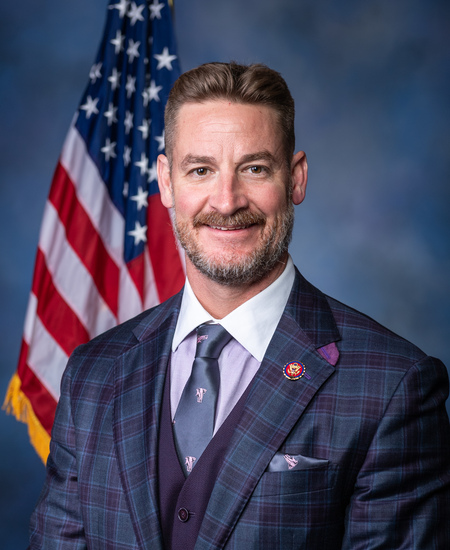
Rep. W. Gregory Steube
Sponsored bills
State Immigration Enforcement Act This bill authorizes state and local governments to enact and enforce laws that penalize conduct prohibited under federal immigration law. Such state and local laws may only impose civil and criminal penalties that do not exceed the penalties imposed by federal law. The bill also revokes a federal law that preempts (blocks) state and local laws that impose civil or criminal penalties for employing non-U.S. nationals who are not authorized to work in the United States.
Combating the Persecution of Religious Groups in China Act This bill expresses the sense of Congress that the United States should promote religious freedom in China and makes statements of policy related to such freedom. In particular, the bill states that it is U.S. policy to consider senior Chinese government officials who are responsible for the persecution of Christians or other religious minorities in China to have committed (1) a gross violation of internationally recognized human rights for the purpose of imposing certain sanctions, and (2) a particularly severe violation of religious freedom for the purpose of determining whether such an individual is admissible into the United States.
This bill designates the facility of the United States Postal Service located at 3900 Crown Road Southwest in Atlanta, Georgia, as the John R. Lewis Post Office Building.
The Taliban Sponsor Terrorism Act This bill requires the Department of State to designate Afghanistan as a country where the government has repeatedly provided support for international terrorism. (Generally, such a designation imposes various penalties, such as limiting the country's eligibility for U.S. foreign assistance and arms exports.)
Maddy summaryThis bill designates the Department of Veterans Affairs clinic in Mishawaka, Indiana, as the "Jackie Walorski VA Clinic" to honor former U.S. Representative Jackie Walorski, who served on the House Committee on Veterans' Affairs and advocated for veterans. The law requires all federal references - including laws, documents, and maps - to use the new name for the clinic, effective upon enactment. It does not change the clinic’s services, funding, or operations, as it is a purely commemorative naming resolution.
Protect Farmers from the SEC Act This bill prohibits the Securities and Exchange Commission from requiring the disclosure of greenhouse gas emissions related to agricultural products.
Diverting IRS Resources to the Exigent Crisis Through Funds for Border Security Act or the DIRECT Funds for Border Security Act This bill rescinds unobligated amounts for Internal Revenue Service enforcement activities enacted by the Inflation Reduction Act of 2022 and redirects such amounts to the U.S. Customs and Border Protection for the hiring of new agents and officers for the security of the southern border of the United States.
Educational Choice for Children Act This bill allows individuals and corporations a new tax credit after 2022 for charitable contributions to tax-exempt organizations that provide scholarships to elementary and secondary school students. Such students must be members of a household with incomes not greater 300% of the area median gross income and be eligible to enroll in a public elementary or secondary school. The bill excludes from the gross income of taxpayer dependents any scholarship amount for the elementary or secondary education expenses of eligible students. It also prohibits governmental control over scholarship granting organizations.
This bill abolishes the Department of Education and terminates any applicable program for which it has administrative responsibility, except for the Federal Pell Grant Program and the Federal Direct Loan Program. The bill transfers administrative responsibility for these programs to the Department of the Treasury. The bill also directs Treasury to make allocations to states to support elementary and secondary education.