

Maddy summaryThis bill modifies Medicaid and CHIP rules to let eligible out-of-state healthcare providers enroll without extra state screening. It applies to providers already in Medicare or their home state program, with low fraud risk, serving children under 21 with complex medical conditions. Providers would receive 5 years of enrollment under this streamlined process, eliminating state-level barriers. The change directly affects children seeking specialized care across state lines and the providers who serve them.
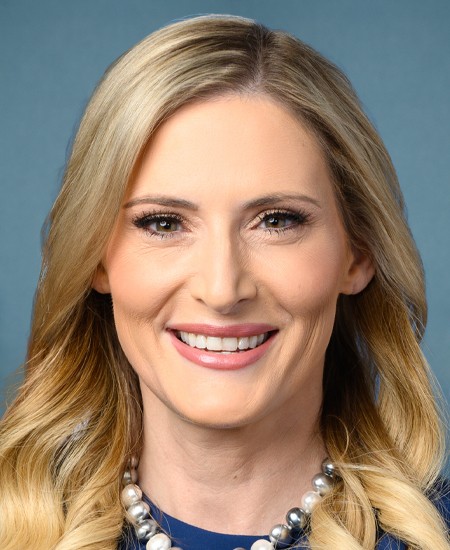
Rep. Laurel M. Lee
Sponsored bills
Maddy summaryThe JUDGES Act of 2024 authorizes new federal district court judgeships across multiple states to address rising case backlogs in the federal judiciary. It specifies new permanent judgeships for districts including California (multiple districts), Florida, Texas, Delaware, Indiana, Iowa, New Jersey, and New York, with implementation phased through 2035, and creates temporary judgeships for Oklahoma districts with specific vacancy rules. The bill authorizes funding for these positions and requires reports on judicial caseloads and detention space needs, while mandating public access to the Judicial Conference's judgeship recommendations. The bill directly affects federal district courts in the specified locations by increasing judicial staffing to handle growing case volumes.
Maddy summaryThe PROTECT Our Children Reauthorization Act of 2024 reauthorizes and updates the 2008 PROTECT Our Children Act, primarily focusing on strengthening federal efforts to combat child exploitation. It requires the National Strategy for Child Exploitation Prevention to be updated every four years instead of every two, with detailed provisions including trend analysis, resource estimates, and assessments of Internet Crimes Against Children (ICAC) task forces. The bill also modifies ICAC task force operations to include liability protections for prioritization decisions (unless misconduct occurs), expands coordination requirements with Tribal and military agencies, and increases funding to $70 million for 2025, $80 million for 2026, and $90 million for 2027. These changes directly affect federal agencies like the DOJ, FBI, and ICAC task forces, as well as state and local law enforcement partners working on child exploitation cases. The legislation aims to enhance data-driven coordination and resource allocation for preventing and prosecuting child exploitation crimes.
Maddy summaryHR 8399, the Preventing Foreign Interference in American Elections Act, expands restrictions on foreign contributions to U.S. elections by prohibiting foreign individuals or entities from funding specific activities like voter registration, ballot collection, voter identification, get-out-the-vote efforts, communications about political parties, or election administration. It also treats indirect funding (e.g., through intermediaries) as direct violations and requires political committees to certify compliance under penalty of perjury. The bill includes additional provisions protecting donor privacy for tax-exempt organizations by restricting federal agencies from collecting or disclosing donor identities, with limited exceptions for agencies like the IRS or FEC. These changes directly affect foreign actors attempting to influence U.S. elections and political committees handling campaign finances.
Maddy summaryThis bill blocks U.S. Department of Homeland Security (DHS) funding to colleges and universities that maintain relationships with Confucius Institutes or "Chinese entities of concern" (defined as institutions linked to China's military or defense sectors). It requires affected schools to terminate such relationships within 12 months of the bill's enactment to regain eligibility for DHS funds. The law directly impacts higher education institutions receiving DHS funding, not all schools or federal programs. Key provisions mandate DHS to deny funding to institutions with ongoing ties to these entities, with eligibility restored only after relationship termination.
Maddy summaryThe context provided for HR 9146 does not include the full text of the amendment or the specific language added to Section 1703(d)(2) of title 38, U.S. Code. Without the actual provisions of the new subparagraph (F) titled "Continuity of care," it is impossible to describe the bill's key mechanisms, who it affects, or its concrete policy changes. The bill's title suggests it relates to veterans' health care continuity under the Veterans Community Care Program, but the details are omitted in the provided excerpt. Therefore, a complete and accurate summary cannot be generated from the available information.
Maddy summaryHR 6242, the VOTES Act of 2023, expands voting rights for military service members overseas by updating the definition of eligible voters under the Uniformed and Overseas Citizens Absentee Voting Act (UOCAVA). The bill replaces "active duty" with "active duty, active service, or inactive duty-training" throughout UOCAVA, ensuring service members in reserve training (inactive duty) qualify for absentee voting just like those on active duty. This change directly affects U.S. military personnel serving overseas in any duty status under Title 10 of the U.S. Code. The law takes effect for elections after January 1, 2025, making absentee voting procedures more inclusive for all uniformed service members.
Maddy summaryHR 9523, the Renewed Hope Act of 2024, directs the Department of Homeland Security to hire 200 additional personnel (including 40 forensics analysts and 30 child exploitation investigators for the Victim Identification Laboratory, plus 130 more staff) to support identifying and rescuing victims of child sexual exploitation. It also authorizes temporary hiring of experts for image/audio forensic analysis at specified rates and requires DHS to establish joint procedures for coordinating child exploitation investigations across agencies. The bill mandates a new Victim Identification Training Program at the Cyber Crimes Center, providing annual training on advanced victim identification technology to DHS personnel and external law enforcement agencies (federal, state, local, tribal, military, and foreign) upon request. These provisions directly affect DHS investigative units and law enforcement agencies actively working on child exploitation cases nationwide.
Maddy summaryHR 9532, the Renewed Hope Act of 2024, requires the Department of Homeland Security to hire 200 additional personnel (40 computer forensics analysts, 30 criminal analysts, and 130 combined analysts) for the Victim Identification Laboratory within Homeland Security Investigations to identify victims of child sexual exploitation. It also authorizes temporary hiring of forensic experts at GS-15 equivalent rates to support victim identification efforts and mandates coordination procedures to synchronize child exploitation investigations across DHS. The bill establishes a new Victim Identification Training Program to teach DHS and external law enforcement agencies (federal, state, local, tribal, military, and foreign) advanced tools for identifying victims in abusive images and enhancing audio/video evidence. These provisions directly affect Homeland Security Investigations personnel and law enforcement agencies conducting child exploitation investigations.
This resolution supports the designation of National FFA Week. It also (1) recognizes the important role of the National FFA Organization (Future Farmers of America) in developing the next generation of globally conscious leaders who will change the world; and (2) celebrates the 10th anniversary of the Give the Gift of Blue program, which has donated more than 17,000 FFA blue jackets to FFA members in need.