

Access to Birth Control Act This bill requires pharmacies to comply with certain rules related to ensuring access to contraceptives. Specifically, pharmacies must provide without delay a customer with any contraceptive or related medication that is in stock. If the contraceptive is not in stock, the pharmacy must immediately inform the customer and either order the contraceptive or refer the customer to a pharmacy that has it in stock. Laws in some states provide pharmacists with the right to refuse to dispense contraceptive-related drugs on religious or conscience grounds. Pharmacies may refuse to provide a contraceptive to a customer (1) if the customer lacks a valid prescription for a prescription contraceptive or is unable to pay for the contraceptive, or (2) based on a pharmacy employee's professional clinical judgment. The bill also establishes a private cause of action and civil monetary penalties for violations of the bill.
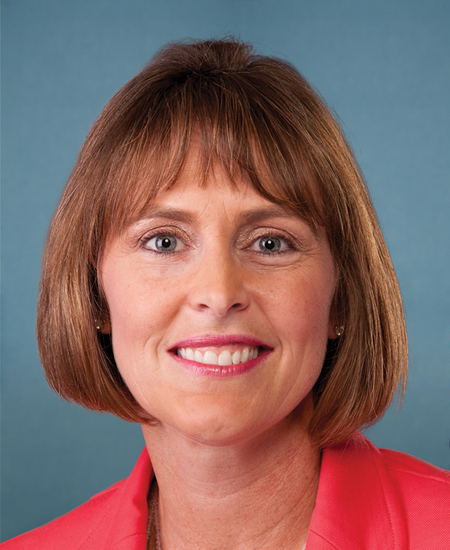
Rep. Kathy Castor
Sponsored bills
This resolution (1) censures Representative Paul Gosar for posting a certain video on his social media accounts that depicts violence against Representative Alexandria Ocasio-Cortez and President Joseph R. Biden , and (2) removes him from the Committee on Natural Resources and the Committee on Oversight and Reform.
Restoring Brand USA Act This bill requires the Department of the Treasury to make $250 million available (out of unobligated balances remaining from certain fees collected by Treasury) for the Corporation for Travel Promotion, also known as Brand USA.
Veterans and Consumers Fair Credit Act This bill applies certain military consumer credit protections to all consumers. Specifically, the bill caps the interest rate on extensions of consumer credit at 36%.
This concurrent resolution declares that Congress should not impose any new performance fee, tax, royalty, or other charge relating to the public performance of sound recordings on a local radio station for broadcasting sound recordings over the air, or on any business for such public performance of sound recordings.
United States Postal Service Shipping Equity Act This bill authorizes the mailing of alcoholic beverages by certain entities in accordance with the delivery requirements otherwise applicable to a privately carried shipment. The authorization applies to an entity (including a winery, brewery, beverage distilled spirits plant, or other wholesaler, distributer, importer, or retailer of alcoholic beverages) that has registered with, obtained a permit from, or obtained approval of an application from the Department of the Treasury. The bill directs the U.S. Postal Service (USPS) to prescribe regulations (1) requiring direct delivery to a duly authorized agent at a postal facility or to the addressee, who must be at least 21 years of age and present a valid, government-issued photo identification at the time of delivery; (2) prohibiting such alcoholic beverages from being for resale or any other commercial purpose; and (3) requiring such entity to certify that the mailing is not in violation of applicable laws or regulations and to provide other information as directed by the USPS. The U.S. district courts shall have jurisdiction to render judgment upon any claim brought by a state, local, or tribal government against the USPS of a violation of state, local, or tribal law regarding the sale, mailing, transportation, or importation of alcoholic beverages into any U.S. state, territory, or district. The USPS shall not be liable for interest prior to judgment or for punitive damages.
Untraceable Firearms Act of 2021 This bill establishes a federal statutory framework to regulate the manufacture, sale, offer to sell, transfer, purchase, and receipt of ghost guns (i.e., guns without serial numbers). Additionally, the bill revises the federal statutory framework regulating the manufacture, possession, sale, import, shipment, delivery, receipt, and transfer of undetectable firearms. Among the revisions, the bill defines undetectable firearm as a firearm without a major component wholly made of detectable material.
Raise the Age Act This bill establishes new restrictions on the sale or transfer of certain semiautomatic firearms to individuals under 21 years of age. Specifically, this bill makes it unlawful for a licensed gun dealer, importer, manufacturer, or collector to sell or deliver a semiautomatic center-fire rifle that has (or has the capacity to accept) an ammunition feeding device with a capacity of more than five rounds to an individual who the licensee knows or has reasonable cause to believe is under age 21. The prohibition does not apply if the individual under age 21 is a full-time law enforcement officer or active-duty member of the Armed Forces. The bill also requires the Federal Bureau of Investigation to report on the operation of its public access line, including a description of information sharing protocols and recommendations for improving such protocols.
Let Our Cities And Local businesses Help Employees Achieve Long-Term Health Act or the LOCAL HEALTH Act This bill authorizes private businesses and local governments and agencies to require the use of face masks and take other measures aligned with Centers for Disease Control and Prevention guidelines to prevent the spread of COVID-19, provided that the required measures accommodate individuals with disabilities and include exemptions for sincerely held religious beliefs. The bill also (1) prohibits a state from establishing or enforcing a law that restricts an authorized measure, and (2) provides immunity to private businesses and local government entities from federal or state claims arising from an authorized measure unless the claim involves negligent behavior or willful misconduct.
Commission to Study the Stigmatization, Criminalization, and Ongoing Exclusion and Inequity for LGBTQ Servicemembers and Veterans Act This bill establishes the Commission to Study the Stigmatization, Criminalization, and Ongoing Exclusion and Inequity for LGBTQ Servicemembers and Veterans. The Commission must identify and compile information about the history of military policy regarding homosexuality from 1778 onward, including regarding lesbian, gay, bisexual, transgender, and queer (LGBTQ) sexual orientation and gender identity. The Commission must hold public hearings, gather public testimony, examine lasting and disparate impacts of the discriminatory policies on the physical and mental well-being of members of the Armed Forces, and make recommendations on appropriate remedies.