

Maddy summaryThis bill requires all U.S. flags displayed on federal property or purchased by federal agencies to be 100% made in the United States, meaning all materials and manufacturing must occur domestically. It directly affects federal agencies (including military departments, legislative/judicial branches, and U.S.-owned corporations) and their procurement of flags for display on government property. Key provisions include a 90-day implementation for new flag purchases and a 2-year phase-in for display requirements, with a separate mandate for the FTC to study and report on country-of-origin labeling enforcement for flags within one year. The bill does not apply to private entities or flags displayed off federal property.
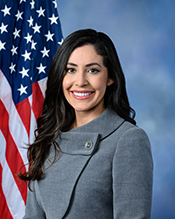
Rep. Anna Paulina Luna
Sponsored bills
Maddy summaryHRES 512 is a formal resolution passed by the U.S. House of Representatives to censure and condemn Representative Adam Schiff (D-CA) for conduct deemed misleading to the public. The resolution cites specific allegations, including Schiff's role in promoting false claims about Russian collusion in the 2016 election, misusing classified information in a FISA warrant application, and distorting facts during the Trump impeachment inquiry. It requires Schiff to appear before the House for the public reading of the censure and directs the Ethics Committee to investigate his conduct. As a procedural resolution, it does not enact new law but serves as a formal rebuke by the House.
Maddy summaryThis bill redesignates a specific street area in Washington, D.C. (between International Drive, Van Ness Street, and International Place, NW) and the address 3505 International Place, NW as "Tiananmen Square Memorial Boulevard." It requires the General Services Administrator to install new street signs matching DC's Metro station style at designated locations. The bill has no policy impact beyond administrative naming changes and does not affect any legislation, regulations, or residents.
Maddy summaryHR 1640, the Save Our Gas Stoves Act, prevents the Department of Energy from implementing energy efficiency standards for gas stoves that would make them unavailable in the U.S. market. It amends federal law to require that any new standard for gas stoves must not result in the unavailability of gas stove types, directly affecting gas stove manufacturers and consumers who rely on these appliances. The bill specifically blocks the implementation of the 2023 proposed rule (Energy Conservation Program: Energy Conservation Standards for Consumer Conventional Cooking Products) and any similar rule. This is a policy change focused on maintaining the availability of gas stoves by altering the criteria for energy standard approval.
Maddy summaryThis resolution formally censures Rep. Adam Schiff (CA-30) for alleged misconduct related to his role on the House Intelligence Committee. It demands he appear before the House for a public censure and directs the Ethics Committee to investigate claims that he made false statements and misused classified information during investigations into the Trump-Russia matter. The resolution does not create new laws or policies but is a procedural action expressing the House's disapproval. It directly affects Rep. Schiff as the named recipient of the censure.
Maddy summaryThe Protecting Veteran Community Care Act expands access to mental health and substance-use services through the Veterans Community Care Program for veterans who cannot get timely care in VA residential treatment facilities. It requires community providers to meet state licensing and accreditation standards and prohibits the VA from denying community care solely because community providers cannot meet the same wait time standards as VA facilities. The bill also mandates the VA to track and report on requests for mental health care, including approvals, denials, and appeals. This applies directly to veterans facing delays in accessing VA residential mental health programs.
Maddy summaryHJRES 42 is a congressional resolution disapproving the District of Columbia Council's approval of the *Comprehensive Policing and Justice Reform Amendment Act of 2022* (D.C. Act 24-781), which the Council enacted on January 19, 2023. This resolution, introduced by 18 House members on March 9, 2023, formally expresses Congress's objection to the DC law but does not alter the law itself or its implementation in the District. The resolution targets the DC Council’s action under the Home Rule Act, requiring Congress to formally disapprove such local legislation before it takes effect. It affects DC’s local policing policies but does not directly change federal law or impact residents beyond this procedural disapproval.
Maddy summaryHRES 499 is a symbolic House resolution expressing support for designating June 12, 2023, as "Women Veterans Appreciation Day." It honors women veterans' service throughout U.S. military history, highlighting their current representation in the armed forces (17% active duty as of 2021) and their growing numbers in the veteran population. The resolution does not create new policies or funding but formally recognizes women veterans' contributions through a commemorative designation. This is a procedural resolution with no binding legal effect, solely serving to acknowledge their service.
Maddy summaryThis bill designates the POW/MIA Memorial and Museum under construction in Jacksonville, Florida, as the "National POW/MIA Memorial and Museum." It requires the museum to submit a detailed report to Congress within 90 days, including its five-year budget, organizational structure, bylaws, and accreditation status. The designation may be withdrawn if the museum is not operational within five years of enactment or if the required report is submitted late. The bill formalizes an existing project honoring over 224,000 service members captured or unaccounted for since World War II, without creating new policies or affecting public programs.
Maddy summaryHR 3901, the Agency Subpoena Compliance Act, requires federal agencies to comply with congressional subpoenas or face potential funding reductions. It mandates the President to annually report to Congress on agency subpoena compliance, triggering committee hearings to review each case. If an agency ignores a valid subpoena, the committees may propose a 0.5% funding cut in the next year's budget for each ignored subpoena. Agencies failing to submit the required report on time risk a 2% annual budget cut for each week of delay. This bill directly affects all federal agencies covered by annual budget bills.