

Maddy summaryThe Clean Energy Minerals Reform Act of 2023 establishes a new regulatory framework for hardrock mineral mining on federal lands, replacing the 1872 Mining Law. It requires permits for exploration and operations, imposes new royalty rates (minimum 8-12.5% of gross value), and creates a new Abandoned Hardrock Mine Reclamation Program funded by fees and royalties. The bill establishes a "small miner's lease" program with reduced fees for small operations (up to 200 acres) and requires financial assurance to cover reclamation costs. It also mandates consultation with Indian Tribes before mineral activities that may impact tribal lands or resources, and prohibits mining in protected areas including National Parks, wilderness areas, and sacred sites. The bill applies to all existing mining claims and new mineral activities on federal lands, with new rules taking effect upon enactment.
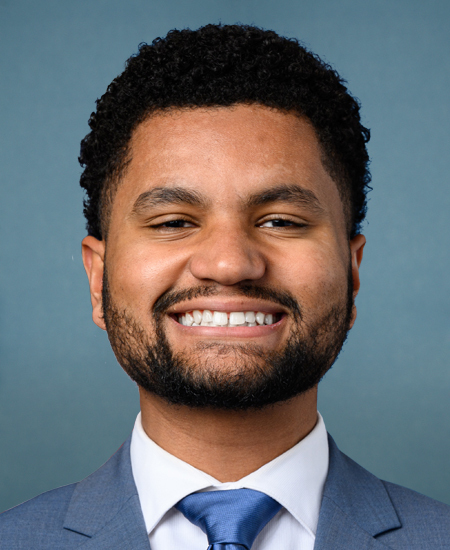
Rep. Maxwell Frost
Sponsored bills
Maddy summaryHR 3537 authorizes the minting of commemorative coins to mark the 100th anniversary of the U.S. Foreign Service, established by the 1924 Rogers Act. The bill specifies three coin types ($5 gold, $1 silver, and half-dollar clad) with limited mintage (50,000 gold, 400,000 silver, 750,000 half-dollars) to be issued in 2025, featuring designs honoring diplomatic history. A surcharge on each coin sale ($35 for gold, $10 for silver, $5 for half-dollars) will fund the Association for Diplomatic Studies and Training (ADST) to support its oral history program and diplomatic preservation efforts. The coins will be legal tender, sold at cost-plus-surcharge, with all revenue directed to ADST per the bill's provisions.
Maddy summaryHCONRES 44 is a non-binding congressional resolution urging the creation of a U.S. Commission on Truth, Racial Healing, and Transformation. It does not establish the commission itself but calls for its formation to acknowledge historical injustices against Black, Indigenous, and other people of color - including systemic discrimination in housing, Social Security, the GI Bill, and land policies - and to address ongoing racial inequities. The resolution emphasizes the need to dismantle the "belief in a hierarchy of human value" and promote racial healing as a national priority. It complements ongoing efforts like H.R. 40 (a bill to study reparations) but does not create new legal requirements or funding.
Maddy summaryHR 3409, the Healthy Families Act, requires most employers to provide employees with paid sick leave. Employees earn 1 hour of paid sick time for every 30 hours worked, up to a maximum of 56 hours per year, which can be used for their own illness, caring for family members, or addressing domestic violence, sexual assault, or stalking situations. Smaller employers with fewer than 15 employees can provide unpaid sick leave instead of paid leave. The bill includes protections against retaliation for using sick leave and requires employers to inform employees about their rights under this law.
Maddy summaryHR 3422, the Judiciary Act of 2023, would amend the structure of the U.S. Supreme Court by increasing the number of associate justices from eight to twelve. It would also raise the required quorum for court proceedings from six to eight justices. This bill directly affects the Supreme Court's operational structure and composition. The change is purely procedural, altering the Court's size and voting requirements without impacting other legal processes or specific groups of people.
Maddy summaryThe Strength in Diversity Act of 2023 creates a federal grant program to help school districts address racial and socioeconomic isolation in public schools (K-12). Eligible school districts, states, or consortia with significant segregation gaps can apply for planning or implementation grants to develop strategies like equitable school assignments, transportation plans, or teacher recruitment programs. Grants require community engagement, data tracking on academic outcomes and diversity metrics, and plans to sustain efforts after funding ends. The program aims to increase student diversity and improve outcomes for students of color and low-income students in segregated schools.
Maddy summaryHRES 319 is a symbolic resolution passed by the U.S. House of Representatives on April 24, 2023, recognizing the federal government's duty to develop a Green New Deal. It states the House believes the government should create a comprehensive plan to address climate change and economic inequality through a 10-year national mobilization. The resolution outlines goals like achieving net-zero emissions by 2050, creating high-wage union jobs, upgrading infrastructure, and prioritizing frontline communities, but it does not establish binding policy or funding mechanisms. As a non-binding resolution, it serves as a statement of legislative intent rather than a law.
Maddy summaryThe FIGHT Act (HR 2742) amends the Animal Welfare Act to specifically target animal fighting events, such as cockfighting, by defining "rooster" as any male chicken over six months old and banning the live broadcasting (simulcasting) of such events. It prohibits using the postal service or interstate transport to move roosters for animal fighting purposes and adds civil enforcement tools allowing citizens to sue violators after a 60-day notice period. Fines up to $5,000 per violation may be imposed, and property used in animal fighting ventures can be seized. These changes strengthen enforcement against animal fighting by expanding legal remedies for the public and authorities.
This resolution supports the designation of ALS Awareness Month. Amyotrophic lateral sclerosis (ALS) is a progressive neurodegenerative disease, also known as Lou Gehrig's disease, that affects nerve cells in the brain and spinal cord.
Targeting Resources for Equitable Access to Treatment for Long COVID Act or the TREAT Long COVID Act This bill requires the Department of Health and Human Services to award competitive grants to create or expand the capacity of clinics that treat patients with persistent, long-term symptoms following recovery from acute COVID-19 (i.e., Long COVID) and associated conditions. Eligible recipients include federally qualified health centers, rural health clinics, urban Indian health centers, and state and local health departments.