

Rebuild America’s Health Care Schools Act of 2025 This bill allows hospitals to receive reimbursement under Medicare for certain costs associated with training nursing and allied health students in settings other than the hospital itself. Currently, hospitals may receive reimbursement under Medicare for the reasonable costs associated with training nursing and allied health students if certain conditions are met; the criteria vary depending on whether the students are enrolled in an educational program that is operated by the hospital or another entity. If the students are part of a program that is operated by another entity, the training must occur at the hospital itself or in areas immediately surrounding the hospital in order to qualify for reimbursement (among other requirements). The bill allows hospitals to receive reimbursement for these costs if the training is conducted at an entity that is related to the hospital (i.e., common ownership or control). The bill requires the Centers for Medicare & Medicaid Services (CMS) to update regulations to reflect these changes. Additionally, the CMS may not recoup or reduce payments to hospitals with respect to costs that are allowed under the bill and must refund any such recoupments or reductions that occurred during the six-year period prior to the bill's enactment.
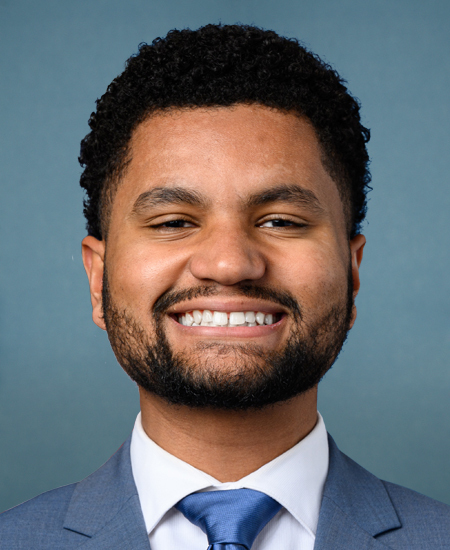
Rep. Maxwell Frost
Sponsored bills
Maddy summaryThe Keep Americans Safe Act (HR 1674) restricts the sale, transfer, and possession of large capacity ammunition feeding devices (LCFDs) - defined as magazines or similar devices holding more than 15 rounds of ammunition - for most individuals. Exceptions allow law enforcement officers (including campus law enforcement), retired officers, and nuclear security personnel to possess LCFDs under specific conditions. The bill requires new LCFDs to have serial numbers and manufacturing dates, permits federal seizure of violative devices, and authorizes federal grant programs to fund buy-back initiatives for LCFDs. It directly affects gun owners and manufacturers while preserving access for covered law enforcement and security personnel.
Maddy summaryHR 1657, the Humane Cosmetics Act of 2025, prohibits cosmetic companies from conducting or contracting animal testing for products sold in the U.S. beginning one year after the law takes effect. It also bans the sale or transport of cosmetics developed using such testing after that date, with limited exemptions (e.g., for foreign regulatory requirements or when no non-animal safety alternatives exist). The bill directly affects cosmetic manufacturers, retailers, and distributors by requiring them to shift to non-animal testing methods. The Food and Drug Administration (FDA) will enforce the law, including reviewing records and imposing civil penalties for violations.
Maddy summaryThe American Dream and Promise Act of 2025 would create pathways to permanent residency for certain immigrant youth who entered the U.S. as children (Dream Act component) and for individuals from countries with Temporary Protected Status or Deferred Enforced Departure (American Promise Act component). To qualify, applicants must meet continuous physical presence requirements (since January 1, 2021 for Dream Act applicants, and for 3+ years for American Promise applicants), pass background checks, and satisfy educational or employment criteria. Conditional permanent resident status would be granted initially, with the option to convert to full permanent residency after meeting additional requirements like earning a degree, serving in the military for two years, or demonstrating three years of earned income. The bill includes fee exemptions for low-income applicants, establishes a grant program to assist applicants with legal help, and creates specific procedures for background checks and appeals.
Maddy summaryHR 1638, the CROWN Act of 2025, prohibits discrimination based on hair texture or hairstyle that is commonly associated with race or national origin, particularly affecting Black individuals who wear natural or protective styles like braids, locs, cornrows, twists, or Afros. The bill explicitly expands protections under existing federal civil rights laws (including the Civil Rights Act of 1964 and the Fair Housing Act) to cover hair-based discrimination in federally funded programs, housing, public accommodations, employment, and equal rights. It requires schools, employers, and other entities receiving federal funds to eliminate grooming policies that disproportionately target these hairstyles. The law clarifies that such discrimination violates federal law and provides enforcement through existing civil rights mechanisms.
Maddy summaryEthan's Law requires gun owners to store firearms securely in homes where minors live or where residents are legally prohibited from owning guns. It makes it unlawful to leave firearms unsecured if a minor or ineligible person could access them, with fines of $500 per violation and harsher penalties if injury or death occurs. The bill creates a federal grant program to help states implement similar secure storage laws and treats unsafe storage as negligence in legal cases. It directly affects households with children or residents who cannot legally possess firearms, aiming to reduce accidental shootings and unauthorized access.
Maddy summaryHRES 159 is a symbolic resolution expressing the U.S. House of Representatives' support for designating February 24-28, 2025, as "Public Schools Week." It does not create new laws or allocate funds but aims to highlight the importance of public schools in communities. The resolution cites reasons such as public schools serving 90% of U.S. students, fostering critical thinking, and requiring equitable funding - though these are context, not policy changes. It directly affects public schools and their communities by raising awareness of their role in education. As a non-binding resolution, it has no direct impact on school operations or funding.
Maddy summaryThe Access Technology Affordability Act of 2025 creates a new tax credit for individuals who purchase technology designed to assist blind people, such as screen readers or braille displays. This credit covers up to $2,000 in expenses per three-year period for qualified access technology used by the taxpayer, their spouse, or a blind dependent. The credit adjusts for inflation after 2026 but does not apply to costs already covered by other tax benefits. The credit expires after 2030, with adjustments for cost-of-living changes starting in 2027.
More Options to Develop and Enhance Remote Nutrition in WIC Act of 2025 or the MODERN WIC Act of 2025 This bill permanently allows individuals to remotely certify their eligibility for, and receive benefits through, the Special Supplemental Nutrition Program for Women, Infants, and Children (WIC). Specifically, the bill requires that a state agency allow an individual seeking a WIC certification, recertification, or a nutritional risk evaluation to do so by phone or through video teleconference, in addition to the in-person option. A state agency has 90 days to collect data for a nutritional risk evaluation for a remotely certified individual. Further, a state agency may consider an applicant who meets the income eligibility standards to be temporarily eligible on an interim basis to participate in the program and may certify the individual for immediate participation without waiting for a nutritional risk evaluation. The bill also allows states to provide benefits on WIC electronic benefit transfer cards through mail or remote issuance instead of requiring participants to pick up or reload benefits in person at a WIC office. Further, the Department of Agriculture must report to Congress about the use of remote technologies and other digital tools in the WIC program. Currently, individuals are generally required to be physically present to certify their WIC eligibility and receive benefits, with exceptions. The Food and Nutrition Service has temporarily waived these requirements and allowed remote certification and benefits using authorities that were provided by laws that were enacted to address COVID-19.
Buffalo Soldiers Congressional Gold Medal Act of 2025 This bill provides for a Congressional Gold Medal to be awarded to the Buffalo Soldier regiments (six all-Black cavalry and infantry regiments authorized by Congress in 1866 to serve in the Armed Forces) in recognition of their vital service to the United States.