

Maddy summaryThe Wall Street Tax Act of 2025 imposes a transaction tax on securities trading in the U.S. market, starting at 0.02% for trades after December 2025 and gradually increasing to 0.1% after 2029. It applies to most stock, bond, and derivative transactions occurring on U.S. exchanges or involving U.S. persons, with the tax paid by exchanges, brokers, or the relevant parties (purchaser/seller) depending on the transaction type. The bill exempts initial security issuances and short-term debt (under 100 days) from taxation. This directly affects investors, brokers, and financial institutions conducting covered transactions in the U.S. market.
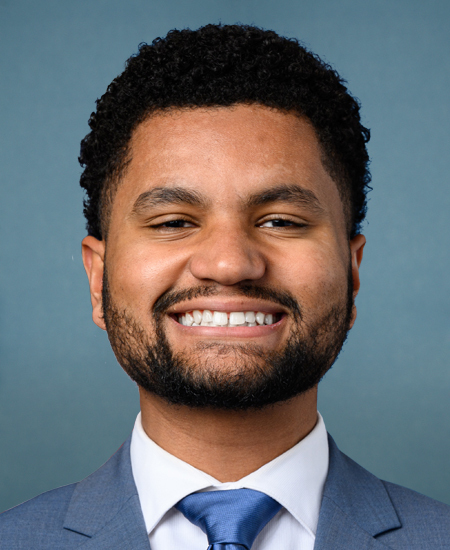
Rep. Maxwell Frost
Sponsored bills
Maddy summaryHCONRES 37 is a non-binding congressional resolution urging the President to establish a U.S. Commission on Truth, Racial Healing, and Transformation. The resolution does not create the commission itself but calls for its formation to acknowledge historical racial injustices (like discriminatory housing policies, the Chinese Exclusion Act, and forced Native American boarding schools) and catalyze efforts to eliminate racial inequities. The commission would focus on dismantling the "belief in a hierarchy of human value" and advancing racial healing, complementing ongoing efforts like H.R. 40 (the reparations study bill). It directly affects federal leadership (via the President) and aims to guide national policy, though it has no legal force.
Maddy summaryHRES 509 is a symbolic resolution expressing the U.S. House of Representatives' support for designating June 2025 as "Black Music Month." It does not create new laws or directly affect any individuals or entities; instead, it urges the public to recognize and celebrate Black music's cultural impact through voluntary actions like promoting artists and spreading awareness. The resolution highlights Black music's historical influence across genres - from spirituals to hip-hop - and calls for honoring its legacy in education, media, and community initiatives. It follows a tradition started by President Carter in 1979 but has no legal force.
Maddy summaryHRES 514 is a resolution commemorating the ninth anniversary of the June 12, 2016, Pulse nightclub shooting in Orlando, Florida, which killed 49 people. It honors the victims and their families, recognizes the bravery of first responders, and affirms the need for continued efforts on gun safety and mental health legislation. The resolution does not create new laws or policies but serves as a symbolic statement of remembrance and support for the affected community. It directly addresses the House of Representatives and the public, emphasizing unity in the face of hate.
Maddy summaryThe Firearm Destruction Licensure Act of 2025 requires businesses that destroy firearms to obtain a federal license. It defines a "covered method" of destruction that permanently renders firearms unusable and scrap, mandating licensed destroyers to use this method (unless agreed otherwise with government entities). Licensed destroyers must annually report to the Bureau of Alcohol, Tobacco, Firearms and Explosives on the number of firearms destroyed - including those received from government agencies - and publicly disclose their fees for such services. The bill also creates a grant program to help state and local governments pay licensed destroyers for firearm destruction using covered methods. This law directly affects businesses offering firearm destruction services and government entities contracting for those services.
Maddy summaryThis bill requires U.S. Immigration and Customs Enforcement (ICE) agents to visibly identify themselves during enforcement operations in the United States by not wearing facial coverings and wearing garments showing their name and agency affiliation. It directly affects ICE agents conducting activities like arrests, raids, or investigations. Exceptions exist for imminent threats or safety gear, but supervisors must review and document such uses within 48 hours. The bill also mandates annual reports to Congress on disciplinary actions and complaints related to violations.
Improving Access to Medicare Coverage Act of 2025 This bill deems an individual receiving outpatient observation services in a hospital as an inpatient for purposes of satisfying the three-day inpatient hospital-stay requirement with respect to Medicare coverage of skilled nursing facility (SNF) services. (Generally, individuals must have been an inpatient at a hospital for at least three days in order to qualify for SNF services. An individual's time spent under observation at a hospital for purposes of determining whether the individual should be admitted does not count towards this requirement.)
Maddy summaryThe Domestic Workers Bill of Rights Act (HR 3971) would establish key labor protections for domestic workers, including nannies, housekeepers, and caregivers who work in private homes. The bill requires written agreements for workers employed 8+ hours per week, provides earned sick days (1 hour for every 30 hours worked), mandates fair scheduling practices with 72-hour notice for schedule changes, and extends overtime protections to live-in domestic employees. It also prohibits unfair wage deductions, guarantees meal and rest breaks, and ensures privacy protections including no monitoring in private living spaces. The bill directly affects approximately 2.2 million domestic workers across the U.S., who are disproportionately women of color and immigrants. Enforcement would be handled by the Department of Labor through new complaint resolution mechanisms and oversight.
Maddy summaryThis resolution (HRES 501) amends House rules to allow two members - one from the majority party and one from the minority party - to jointly sponsor public bills or resolutions. It directly affects House members by changing the sponsorship process for legislative proposals. The key provision adds a new paragraph to Rule XII, permitting this cross-party sponsorship structure while updating related procedures for naming cosponsors and submitting constitutional statements. The change aims to facilitate bipartisan collaboration on legislative proposals within the House rules framework.
Maddy summaryThis bill requires private firearm transfers between individuals to go through a licensed dealer who must conduct a background check. It applies to most private sales but includes exceptions for transfers between family members (like parents and children), law enforcement, emergencies preventing harm, and temporary loans at shooting ranges or for hunting. Dealers must provide background check notices in both English and Spanish. The law aims to prevent prohibited individuals from obtaining firearms through private transactions while maintaining existing state authority on firearm laws.