

FEMA Climate Change Preparedness Act This bill requires the Federal Emergency Management Agency (FEMA) to (1) revise its 2018-2022 Strategic Plan to ensure that the plan explicitly mentions climate change and addresses the implications of climate change on homeland security and near- and long-term national disaster risk, and (2) ensure that future strategic plans do likewise. The Department of Homeland Security must establish, as a subcommittee of the National Advisory Council, the Climate Change Subcommittee, which shall advise FEMA on how to best incorporate climate change, including risk assessments and strategies for adaptation and mitigation, into and throughout FEMA's policies, plans, programs, and operations. FEMA must publish as a report, submit to specified congressional committees, and make available to Congress and the public, a comprehensive assessment of climate change risks and preparedness.
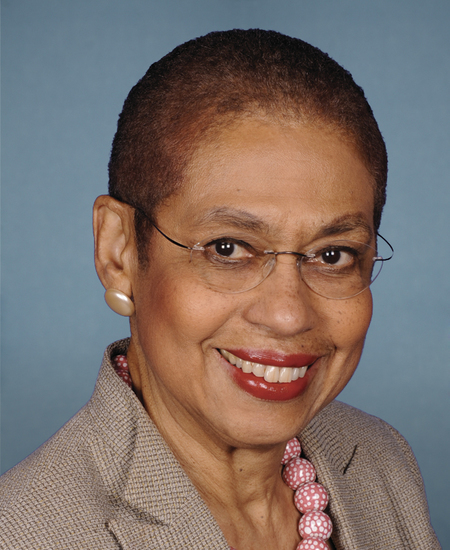
Rep. Eleanor Holmes Norton
Sponsored bills
Air Traffic Noise and Pollution Expert Consensus Act of 20 21 This bill requires the Federal Aviation Administration to enter into an arrangement with the National Academies of Sciences, Engineering, and Medicine to examine and report on the various health impacts of air traffic noise and pollution.
Metro Accountability and Investment Act This bill reauthorizes for FY2022-FY2031 authority for the Department of Transportation (DOT) to provide grants to the Washington Metropolitan Area Transit Authority (WMATA) to finance in part the capital and preventive maintenance projects included in its Capital Improvement Program. It conditions the availability of funds, in part, on the WMATA Board of Directors certifying to DOT that it has adopted and will keep certain resolutions in effect for the entire funding period, including (1) establishing an independent budget authority, procurement authority, and hiring authority for its Office of the General Inspector; (2) ensuring its Inspector General (IG) can obtain legal advice from a counsel reporting directly to the IG; (3) requiring the IG to submit recommendations for corrective action to the General Manager and the Board of Directors of WMATA; (4) requiring the IG to publish such recommendations on its website; (5) requiring the WMATA Board of Directors to provide written notification to Congress at least 30 days in advance of the removal of an IG; and (6) prohibiting the WMATA Board of Directors from removing its Inspector General without a 30-day written notification that documents specific reasons for removal, including an abuse of authority.
No Congressional Gun Loophole Act This bill prohibits the Capitol Police Board from allowing Members of Congress or their staff to carry firearms on the grounds of the U.S. Capitol or in its buildings. Members and their staff may store firearms in their cars in Capitol complex garages if their possession complies with the firearms laws of the District of Columbia and the firearms are locked with gun locks while on the complex. Current board regulations allow Members of Congress to keep firearms in their offices; the regulations also allow Members and their staff to transport unloaded and securely wrapped firearms within the Capitol grounds. Firearms are prohibited inside the chambers of the Senate and the House of Representatives, as well as in adjacent lobbies and cloakrooms, the galleries, the Marble Room of the Senate, and the Rayburn Room of the House, unless approved by the Sergeants at Arms for security purposes.
Aviation Manufacturing Jobs Protection Act of 202 1 This bill makes available payroll assistance to eligible aviation employers impacted by the COVID-19 (i.e., coronavirus disease 2019) public health emergency. Specifically, aviation employers demonstrating at least a 15% decline in revenues and economic conditions that justify assistance may enter an agreement with the Secretary of the Treasury to receive up to 50% of the amount of total compensation for the 25% of its workforces most at risk of permanent reduction or furlough, excluding senior executive and highly-compensated employees. Assistance under this program is available through April 30, 2023, and Treasury must establish an application process and minimum eligibility requirements for participation in the program not later than 10 days after the enactment of this bill.
Kobe Bryant & Gianna Bryant Helicopter Safety Act This bill directs the Federal Aviation Administration (FAA) to issue regulations to implement National Transportation Safety Board recommendations for crash-resistant systems with respect to existing and new U.S.-registered turbine-powered rotorcraft (e.g., a helicopter) certificated for six or more passenger seats. Specifically, the FAA must require all U.S.-registered turbine-powered rotorcraft certificated for six or more passenger seats to be equipped with a flight data recorder, a cockpit voice recorder, and a terrain awareness and warning system. The FAA may exempt any civilian helicopter from one or more of the equipment requirements.
Innovation Centers Acceleration Act This bill establishes a program to advance economic development by designating nine cities as innovation centers and providing and modifying certain related grants. It also establishes the Innovation Center Selection Committee to designate these cities. The innovation center designation entitles selected cities—and the businesses, research institutions, and other organizations that operate within them—to various federal funding and benefits for research activities, business and workforce development, and transportation infrastructure projects. These benefits include expanding various tax credits and incentives for businesses. The bill also makes it easier for those businesses to access loans and other financial instruments to raise capital. In addition, the bill establishes a grant program for local and tribal governments that partner with innovation centers to develop and preserve affordable housing. It also modifies existing grants, loans, and other programs that support transportation infrastructure to specifically target initiatives in innovation centers.
Health Force, Resilience Force, and Jobs to Fight COVID-19 Act of 2021 This bill establishes and expands programs to bring on individuals to perform public health functions, such as contact tracing and vaccine administration, to respond to the COVID-19 (i.e., coronavirus disease 2019) emergency and meet future public health needs. The bill provides funding for the Centers for Disease Control and Prevention (CDC) to establish a Health Force. The funds are designated as an emergency requirement, which exempts the funds from discretionary spending limits and other budget enforcement rules. To establish the force, the CDC must award grants within 30 days to state, tribal, territorial, and local governments and community health centers to recruit and train individuals for roles in public health and health care. The Federal Emergency Management Agency (FEMA) must hire and train additional individuals for its Cadre of On-Call Response/Recovery Employees. These employees may be detailed to certain federal agencies or to state, local, or tribal governments to support response efforts related to COVID-19 or other disasters or emergencies.
Safe and Quiet Skies Act of 2021 This bill sets forth requirements for commercial air tour flights. Among other requirements, the bill prohibits tour flights within a half mile of military installations, national cemeteries, national wilderness areas, national parks, and national wildlife refuges; prohibits tour flights from operating at an altitude of less than 1,500 feet; requires tour flights over occupied areas (e.g., residential, commercial, and recreational areas) to be no louder than 55dbA; and allows states and localities to impose additional requirements that are stricter than the minimum federal requirements.
Wear Your Mask Act This bill requires each federal agency to take action to ensure that an individual is required to wear a face mask inside a federal facility under its jurisdiction if the individual is within six feet of another individual to minimize the transmission of COVID-19 (i.e., coronavirus disease 2019). Each agency shall make face masks available at each entrance to a federal facility at which such agency maintains a presence. The bill terminates such requirements when the National Institute of Allergy and Infectious Diseases determines, and publishes in the Federal Register a notification, that the requirement to wear a mask is no longer necessary to prevent such transmission.