Ellie Helton, Lisa Colagrossi, Kristen Shafer Englert, Teresa Anne Lawrence, and Jennifer Sedney Focused Research Act or Ellie's Law This bill authorizes appropriations for the National Institute of Neurological Disorders and Stroke to conduct or support research on unruptured brain aneurysms in a patient population diversified by age, sex, and race.
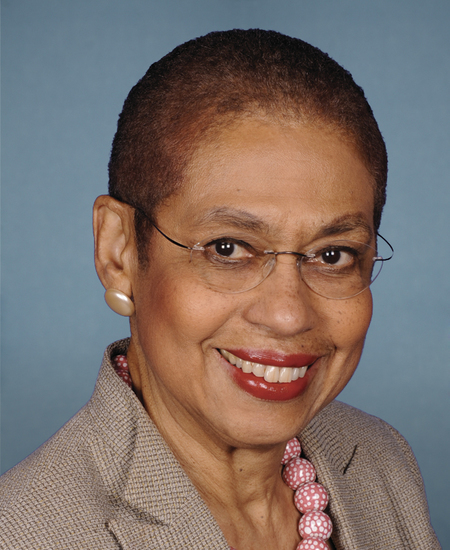
Rep. Eleanor Holmes Norton
Sponsored bills
Nutrition Counseling Aiding Recovery for Eating Disorders Act of 2021 or the Nutrition CARE Act of 2021 This bill provides for Medicare coverage of medical nutrition therapy services for individuals with eating disorders. Such services must be furnished by a registered dietitian or nutrition professional pursuant to a referral from a physician, psychologist, or other authorized mental health professional.
Treat and Reduce Obesity Act of 2021 This bill expands Medicare coverage of intensive behavioral therapy for obesity. Specifically, the bill allows coverage for therapy that is provided by (1) a physician who is not a primary care physician; or (2) other health care providers (e.g., physician assistants and nurse practitioners) and approved counseling programs, if provided upon a referral from, and in coordination with, a physician or primary care practitioner. Currently, such therapy is covered only if provided by a primary care practitioner. The bill also allows coverage under Medicare's prescription drug benefit of drugs used for the treatment of obesity or for weight loss management for individuals who are overweight.
Federal Death Penalty Prohibition Act This bill prohibits the imposition of a death penalty sentence for a violation of federal law. A person sentenced to death before enactment of this bill must be resentenced.
Protect Patriot Spouses Act This bill makes certain alien military spouses eligible for adjustment to permanent residence status. An eligible alien shall be an individual who is or was a spouse of a U.S. citizen who serves or served in the Armed Forces, either on active duty or in a reserve component. If the U.S. citizen has been discharged from the Armed Forces, such discharge must be under honorable conditions. Certain factors that would otherwise make an alien inadmissible, such as having entered the United States without being admitted, shall not make such an alien spouse inadmissible or ineligible for permanent residence status under the bill. The Department of Homeland Security (DHS) may also waive certain factors that would otherwise make an alien inadmissible, such as having misrepresented a material fact to secure a visa, if the alien does not pose a threat to the public and has not committed any crimes that are unrelated to immigration status. The bill also requires DHS and the Department of State to allow a qualifying alien spouse to (1) apply for an immigrant visa to enter the United States under this bill; and (2) enter and stay in the United States to reunite with their U.S. citizen spouse while the application is pending, if the alien spouse does not pose a threat to the public or national security.
Restricting the Use of Solitary Confinement Act This bill imposes restrictions on the use of solitary confinement for inmates in federal custody. Among the restrictions, the bill prohibits placement in solitary confinement for nondisciplinary reasons; it limits the duration of such placement; and it provides an administrative review process for inmates to contest such placement.
Preventing Future Pandemics Act of 2021 This bill establishes measures to address global public health risks posed by wildlife markets, which are commercial markets that sell or slaughter wildlife for human consumption as food or medicine in communities where alternative nutritional or protein sources are available. Specifically, the bill prohibits importing, exporting, purchasing, or selling live wild animals in the United States for human consumption as food or medicine. The Department of the Interior must hire, train, and deploy at least 50 new U.S. Fish and Wildlife Service law enforcement attachés around the world, and the U.S. Agency for International Development must increase specified activities to address the threats and causes of zoonotic (animal-to-human transmission) disease outbreaks. Additionally, the United States must work with other United Nations member states to urge a global ban on commercial wildlife markets and enforcement of laws to end wildlife trafficking. Further, the President may impose sanctions against a foreign country or foreign nationals that the Department of State has determined are taking certain actions that enable or facilitate commercial wildlife markets. Among other reports required by the bill, the National Academies of Sciences, Engineering, and Medicine must conduct a study and submit a report that includes an evaluation of (1) the impact that consumption of terrestrial wildlife as food or medicine has on the transmission of novel viral and other pathogens, (2) the role of consuming terrestrial wildlife as food or medicine in the transmission of microbes from animals to humans, and (3) the conditions at live wildlife markets that lead to this transmission.

COVID Economic Injury Disaster Loan Relief Act This bill extends the deferment of a borrower's payments on an economic injury disaster loan taken in response to COVID-19 (i.e., coronavirus disease 2019) from one year to two years from the date on which the loan is made.
Build America's Libraries Act This bill establishes and provides funds through FY2024 for the Build America's Libraries Fund, from which the Institute of Museum and Library Services (IMLS) must allocate funding to states and, through them, need-based grants to libraries to make long-term improvements to library facilities. The IMLS must also award grants to Indian tribes and organizations that primarily serve and represent Native Hawaiians. Specifically, the bill requires each state that receives an allocation, and each library that receives a grant, to carry out certain activities to improve library facilities. These activities include constructing and renovating library facilities, investing in infrastructure projects to improve internet access and connectivity, improving indoor air quality, and making facilities accessible to individuals with disabilities. The bill also outlines administrative and oversight provisions, including by requiring library projects to use iron and steel products that are produced in the United States.
COVID-19 Eviction Consumer Report Fairness Act This bill prohibits from inclusion in a consumer credit report information related to an eviction occurring during the COVID-19 (i.e., coronavirus disease 2019) national emergency or occurring in the 120 days after the termination of such emergency.