

Electric Vehicles for Underserved Communities Act of 2021 This bill requires the Department of Energy (DOE) to support the deployment of electric vehicle charging infrastructure in underserved or disadvantaged communities. Specifically, DOE must establish an EV Charging Equity Program. Under the program, DOE must provide technical assistance and award grants to increase the deployment and accessibility of electric vehicle charging infrastructure in such communities. If practicable, DOE must ensure that relevant programs promote electric vehicle charging infrastructure, support clean and multimodal transportation, provide improved air quality and emissions reductions, and prioritize the needs of such communities.
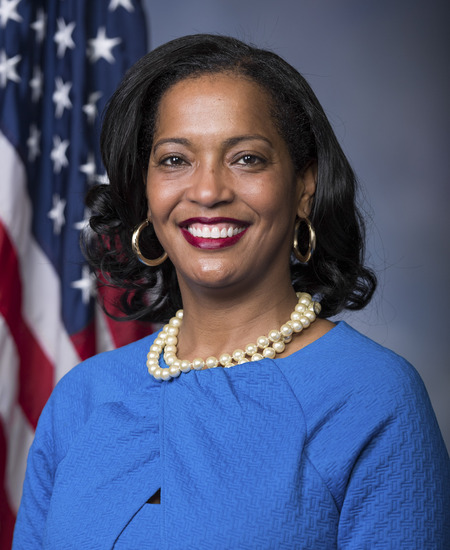
Rep. Jahana Hayes
Sponsored bills
Kira Johnson Act This bill establishes grants to improve maternal health outcomes for racial and ethnic minority groups and other underserved populations. Specifically, the Department of Health and Human Services must award grants for community-based programs to improve maternal health outcomes for Black pregnant and postpartum individuals, as well as individuals in other underserved groups; training for health care providers and others who work in maternity care settings on reducing and preventing racism, bias, and discrimination; and respectful maternity care compliance programs in specified health care facilities. The National Academies of Sciences, Engineering, and Medicine must study issues related to the training programs, and the Government Accountability Office must study issues related to the compliance programs.
Assuring You Uniform Dietary Assistance (AYUDA) Act of 2021 This bill makes the Commonwealth of the Northern Mariana Islands eligible to participate in the Supplemental Nutrition Assistance Program (SNAP, formerly known as the food stamp program).
Ending Corporal Punishment in Schools Act of 2021 This bill prohibits the Department of Education (ED) from providing funding to any educational agency or institution that allows its school personnel to inflict corporal punishment upon a student as a form of punishment or to modify undesirable behavior. First, the bill requires each state educational agency (SEA), in order to receive education funds, to submit to ED a state plan for eliminating the use of corporal punishment in schools. Additionally, the bill authorizes ED to award three-year grants to SEAs and, through them, subgrants to local educational agencies (LEAs) to assist them with improving school climate and culture. Grants must be used to implement school-wide positive behavioral intervention and support programs. Further, LEAs that receive subgrants must ensure that private school personnel are able to participate in grant activities. ED may also allocate funds to the Department of the Interior for schools operated or funded by Interior. Next, the bill directs ED to carry out a national assessment to determine compliance with the requirements of the bill and identify best practices for professional development and training programs. Finally, the bill gives protection and advocacy systems the authority to investigate, monitor, and enforce protections for students that are provided by the bill.
Electric Credit Access Ready at Sale Act of 2021 or the Electric CARS Act of 2021 This bill modifies and extends tax credits for electric cars and alternative motor vehicles. The bill extends the tax credit for new qualified plug-in electric drive motor vehicles through 2031. In addition, the bill modifies the credit to remove the limitation on the number of vehicles per manufacturer that are eligible for the credit, allow a taxpayer to assign the credit to a financing entity, and allow an unused credit to be carried forward for five years. The bill also extends through 2031 the tax credits for (1) alternative fuel vehicle refueling property, and (2) alternative motor vehicles.
Food Allergy Safety, Treatment, Education, and Research Act of 2021 or the FASTER Act of 2021 This bill expands the definition of major food allergen for purposes of certain food-labeling requirements to specifically include sesame. In addition, the Department of Health and Human Services must report on certain information related to food allergy research and data collection activities.
This resolution supports the designation of Public Schools Week.
Teacher Diversity and Retention Act This bill revises certain grant programs related to teacher recruitment and training. First, the bill reauthorizes through FY2027 and otherwise revises the Augustus F. Hawkins Centers of Excellence program, which provides grants to establish teacher preparation programs at minority-serving institutions. It allows grants to be used for school leader preparation programs. In addition, the bill consolidates certain grant programs for teacher preparation into a single grant program. In particular, the Department of Education must award grants to eligible partnerships (e.g., high-need local educational agencies and certain programs at institutions of higher education) to expand teacher preparation programs that embed dual certification in special education and training on social and emotional learning competencies and behavior management practices.
Vaccine Administration Centralization to Coordinate and Improve National Execution Act or the VACCINE Act This bill establishes a grant program for states, tribal nations, and territories to set up or expand COVID-19 (i.e., coronavirus disease 2019) vaccine registration systems. The system must be the jurisdiction's sole means of registering an individual for a vaccine. The Department of Health and Human Services (HHS) must set up a website and a call center to share information with the public about each registration system. HHS must also develop standards to allow for electronic information exchange among the systems. To carry out the program, HHS may use funds from the Public Health Emergency Fund. The authority for this program terminates at the end of the COVID-19 emergency period.
Commission on Domestic Terrorism Act of 2021 This bill establishes in the legislative branch the National Commission on Domestic Terrorism. The commission shall investigate relevant facts and circumstances relating to the federal government's failure to respond to and prevent acts of domestic terrorism in the past 20 years, including relating to the attack on the Capitol on January 6, 2021; identify, review, and evaluate the lessons learned from such acts regarding the structure, coordination, and management arrangements of the federal government, and, if appropriate, state and local governments and nongovernmental entities, relative to detecting, preventing, and responding to domestic terrorist attacks; and report to the President and Congress.