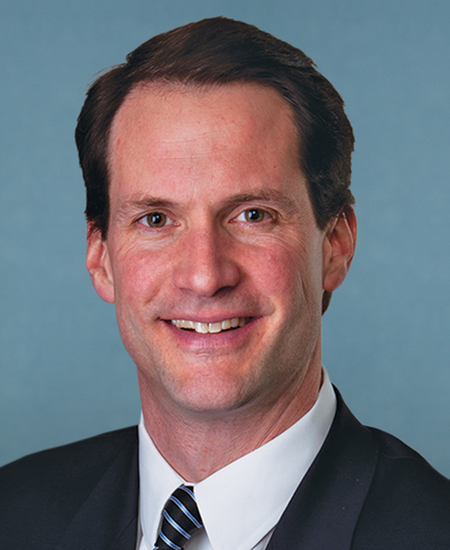
Photo of James A. Himes
D United States House · District 4 · Connecticut On the 2026 ballot

Rep. James A. Himes

Compare
Total votes
2,837
all sessions
Attendance
99%
30 missed
Higher than 75% of chamber peers
With party
96%
of cast votes
Near the chamber average
Bipartisan score
2%
crosses aisle rarely
Near the chamber average
Sponsored
734
bills & resolutions
Lower than 79% of chamber peers
Committees
2
assignments
734 bills and resolutions

Sponsored bills

Total
734
Primary
22
Co-sponsor
712
This page
734
matching current filters
Co-sponsor HR 8246
In committee · Indiana House · Co-sponsor
Disclosing Foreign Influence in Lobbying Act

Disclosing Foreign Influence in Lobbying Act This bill requires registered lobbyists to disclose any foreign countries or political parties that are involved in the direction, planning, supervision, or control of the lobbyist's activities.

In committee Nov 1, 2022 1 co-sponsor
Co-sponsor HR 7904
In committee · Indiana House · Co-sponsor
Multiple Firearm Sales Reporting Modernization Act of 2022

Multiple Firearm Sales Reporting Modernization Act of 2022 This bill expands reporting requirements with respect to sales or dispositions of multiple firearms. Currently, a federal firearms licensee (e.g., a gun dealer) must report multiple sales or dispositions of pistols or revolvers to the same person within five business days. This bill requires a federal firearms licensee to report multiple sales or dispositions of any firearms to the same person within five business days.

In committee Nov 1, 2022 1 co-sponsor
Co-sponsor HR 7533
In committee Nov 1, 2022 1 co-sponsor
Co-sponsor HR 6860
In committee · Indiana House · Co-sponsor
Latonya Reeves Freedom Act of 2022

Latonya Reeves Freedom Act of 2022 This bill prohibits government entities and insurance providers from denying community-based services to individuals with disabilities that require long-term service or support that would enable such individuals to live in the community and lead an independent life. Specifically, these entities may not discriminate against such individuals in the provision of community-based services by such actions as imposing prohibited eligibility criteria, cost caps, or waiting lists or failing to provide a specific community-based service. Additionally, community-based services must be offered to individuals with such disabilities prior to institutionalization. Institutionalized individuals must be notified regularly of community-based alternatives. The bill requires the Department of Justice to issue regulations requiring government entities and insurance providers to offer community-based long-term services to individuals with such disabilities who would otherwise qualify for institutional placement. Government entities must ensure sufficient availability of affordable, accessible, and integrated housing that is not a disability-specific residential setting or a setting where services are tied to tenancy. Regulations shall also (1) require government entities and insurance providers to perform self-evaluation on current services, policies, and practices and concerning compliance with requirements of this bill; and (2) require government entities to submit a transition plan. The bill provides funds for FY2022 for the Department of Health and Human Services to provide technical assistance with respect to transition plans. The bill allows civil actions by individuals subjected to, or about to be subjected to, a violation of its requirements.

In committee Nov 1, 2022 1 co-sponsor
Co-sponsor HR 6853
In committee · Indiana House · Co-sponsor
Russian Travel Sanctions for a Democratic Ukraine Act

Russian Travel Sanctions for a Democratic Ukraine Act This bill imposes visa-blocking sanctions on certain citizens of Russia. Specifically, the President must impose such sanctions on citizens of Russia who are (1) Russian oligarchs, (2) employees of Russia's government, or (3) employees of companies that are owned by or receive funding from Russia's government. The President must also impose the sanctions on family members of such individuals. The President must coordinate with allies, including NATO member states, on the imposition of such sanctions. The President may waive the application of such sanctions in certain instances.

In committee Nov 1, 2022 1 co-sponsor
Co-sponsor HR 5994
In committee · Indiana House · Co-sponsor
BE HEARD in the Workplace Act

Bringing an End to Harassment by Enhancing Accountability and Rejecting Discrimination in the Workplace Act or the BE HEARD in the Workplace Act This bill expands protections against discrimination and harassment in the workplace and raises the minimum wage for tipped employees. Specifically, the bill (1) makes it an unlawful employment practice to discriminate against an individual in the workplace based on sexual orientation, gender identity, pregnancy, childbirth, a medical condition related to pregnancy or childbirth, or a sex stereotype; and (2) provides a statutory definition for what constitutes workplace harassment. Further, these protections apply to all workplaces, regardless of size, and to all workers, including independent contractors, interns, volunteers, and trainees. The bill prohibits employers from entering into contracts or agreements with workers that contain certain nondisparagement or nondisclosure clauses and prohibits certain predispute arbitration agreements and postdispute agreements. It also establishes grant programs to (1) prevent and respond to workplace discrimination and harassment, (2) provide legal assistance for low-income workers, and (3) establish a system of legal advocacy in states to protect the rights of workers. The bill further provides employees the right to retain their tips and it increases, in specified annual increments, the minimum wage for tipped employees to match the federal minimum wage for nontipped employees. Additionally, the bill requires the Equal Employment Opportunity Commission to provide specified training and resource materials, establish and convene a harassment prevention task force, and establish an Office of Education and Outreach with regard to prohibited discrimination and harassment in employment. The bill also requires specified studies, reports, and research on prohibited workplace harassment.


In committee Nov 1, 2022 1 co-sponsor
Co-sponsor HR 5008
In committee · Indiana House · Co-sponsor
Frank Harrison, Elizabeth Peratrovich, and Miguel Trujillo Native American Voting Rights Act of 2021

Frank Harrison, Elizabeth Peratrovich, and Miguel Trujillo Native American Voting Rights Act of 2021 This bill addresses the voting rights of Native American and Alaska Native voters and voting access on tribal lands. The bill includes provisions expanding the types of facilities that can be used as voter registration agencies; increasing polling site accessibility, including by expanding early in-person voting and providing ballot drop boxes; providing enforcement power to citizens and attorneys general; requiring approval for actions like moving a polling place; validating certain tribal identification for voting or registering to vote; permitting voters to designate another individual to return a ballot on their behalf; and expanding requirements for bilingual voting accessibility. In addition, the bill establishes a Native American voting task force grant program for the purpose of increasing voter outreach, education, registration, turnout, and accessibility for Native American communities. The bill also directs the Government Accountability Office to study and report on (1) the prevalence of nontraditional or nonexistent mailing addresses among Indians, members of tribes, and individuals residing on Indian lands; and (2) the alternatives for removing barriers to voter registration, receipt of voter information and materials, and receipt of ballots.

In committee Nov 1, 2022 1 co-sponsor
Co-sponsor HR 4736
In committee · Indiana House · Co-sponsor
Improving Access for Afghan Refugees Act

Improving Access for Afghan Refugees Act This bill requires the Department of State to provide priority refugee status to eligible habitual residents of Afghanistan. To be eligible for such priority status, a habitual resident of Afghanistan must also be a national of Afghanistan or stateless. Such an individual shall receive priority refugee status if the individual (1) has suffered persecution or has a well-founded fear of persecution and worked in a specified field that makes the individual a target of persecution on account of race, religion, or other characteristics; (2) was employed for at least one year in Afghanistan by U.S.-based media or nongovernmental entities or an entity that received a contract or grant from the U.S. government; or (3) is the beneficiary of a visa petition sponsored by a relative who is a U.S. citizen or permanent resident. The State Department may also provide priority status to other groups of individuals who are nationals and residents of Afghanistan. Certain annual numerical limits on refugee admissions shall not apply to individuals who receive priority status under this bill. For refugee applications under this bill, the State Department and the Department of Homeland Security shall ensure that all steps in the approval process in the U.S. government's control are completed within six months of an application's submission, with exceptions for cases that need more time to address national security concerns.

In committee Nov 1, 2022 1 co-sponsor
Co-sponsor HR 4681
In committee · Indiana House · Co-sponsor
LIKE Act

Let Immigrants Kickstart Employment Act of 2021 or the LIKE Act This bill establishes a new class of nonimmigrant visa (W visa) for qualifying start-up owners and essential employees (and the accompanying spouse or child of such aliens) and addresses related issues. Under this bill, a start-up is a U.S. entity that has lawfully conducted business and was formed in the five years preceding an application for a start-up owner visa. To be eligible for an initial visa as a start-up owner, an individual must (1) possess at least a 10% interest in the start-up; (2) play a central and active role in the start-up's management or operations; (3) possess knowledge, skills, or experience to substantially assist in the start-up's growth and success; and (4) provide evidence that the start-up has received certain investments, created jobs, or generated revenue. The holder of a nonimmigrant start-up owner visa may receive lawful permanent resident status upon meeting certain requirements, including by establishing that the start-up has created a certain number of jobs and has met certain revenue targets. To be eligible for a visa as an essential employee of a start-up, an individual must (1) have an offer of employment in an executive or managerial capacity at a start-up; and (2) possess knowledge, skills, or experience to substantially assist in the start-up's growth and success. The bill limits the number of employees on essential employee visas that a start-up may have.

In committee Nov 1, 2022 1 co-sponsor
Showing 461 to 470 of 734 bills
Previous 1 … 46 47 48 … 74 Next