Colorado River Basin Conservation Act This bill reauthorizes the Department of the Interior to fund or participate in pilot projects to increase Colorado River System water in Lake Mead and the Colorado River Storage Project reservoirs through FY2026. Interior administers these pilot projects to address the effects of drought conditions on the Colorado River Basin, which includes the Upper Basin states (Colorado, New Mexico, Utah, and Wyoming) and Lower Basin states (Arizona, California, and Nevada). The bill also requires Interior to submit an updated report to Congress by the end of FY2027 on the effectiveness of the pilot projects and a recommendation on whether to continue the program.
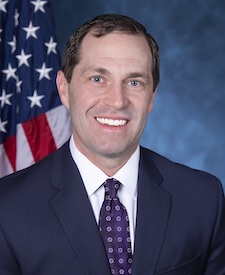
Rep. Jason Crow
Sponsored bills
Credit Union Board Modernization Act This bill revises the frequency of meetings required to be held by a credit union's board of directors. Specifically, the bill requires monthly meetings for new credit unions during their first five years and for credit unions with a low soundness rating. All other credit unions must hold at least six meetings annually, with at least one meeting held during each fiscal quarter. Currently, all credit union boards must meet at least once a month.
American Technology Leadership Act of 2022 This bill establishes an Office of Global Competition Analysis. The purposes of the office are to carry out a program of analysis on U.S. leadership in technology and innovation sectors critical to national security and economic prosperity relative to other countries, particularly those countries that are strategic competitors of the United States; and support policy development and decision-making to ensure U.S. leadership in technology and innovation sectors critical to national security and economic prosperity. To carry out the purposes, the office may enter into an agreement with a public-private or a federally funded research and development center, a university affiliated research center, or consortium of such centers. Periodically, the Office of Science and Technology Policy, the National Economic Council, and the National Security Council, in coordination with other executive agencies, shall jointly determine the analytical priorities of the office.
This bill designates the facility of the United States Postal Service located at 3900 Crown Road Southwest in Atlanta, Georgia, as the John R. Lewis Post Office Building.
Humane Retirement Act This bill requires animal care committees at certain federal agencies conducting biomedical or behavioral research to make reasonable efforts to find parties to adopt dogs, cats, rabbits, and guinea pigs that have been retired from research. Prior to euthanizing, the animal care committee must assess the temperament of any such animal to determine whether it is suitable for adoption and, if so, make reasonable efforts to arrange for an adoption.
National Center for the Advancement of Aviation Act of 202 2 This bill establishes the National Center for the Advancement of Aviation to (1) develop a skilled and robust U.S. aviation and aerospace workforce; (2) serve as a national independent forum to support collaboration and cooperation between aviation and aerospace stakeholders regarding the advancement of the U.S. aviation and aerospace workforce; and (3) serve as a repository for research conducted by institutions of higher education, research institutions, or other stakeholders regarding the aviation and aerospace workforce, or related technical and skill development. The center must perform the following duties improve access to aviation and aerospace education and related skills training to help grow the U.S. aviation and aerospace workforce; support Armed Forces personnel and veterans seeking to transition to a career in civil aviation or an aerospace-related field through outreach, training, apprenticeships, or other means; and amplify and support the research and development efforts conducted as part of the National Aviation Research Plan and work done at the Federal Aviation Administration Technical Centers regarding the aviation and aerospace workforce. Additionally, the center may issue grants to certain entities to create, develop, deliver, or update middle and high school aviation curricula and aviation curricula used at institutions of higher education, secondary educations institutions, or by technical training and vocational schools; support the professional development of educators using the curricula; establish new education programs that teach technical skills used in aviation maintenance; establish scholarships, internships or apprenticeships for individuals pursuing employment in the aviation maintenance industry; support outreach about educational opportunities and careers in the aviation maintenance industry; and support the transition to career in aviation maintenance, including for members of the Armed Forces.
This resolution condemns Azerbaijan's violations of the 1949 Geneva Conventions, encourages investigation of war crimes committed by Azerbaijani forces, and reaffirms the House of Representatives' support of Armenia's sovereignty and territorial integrity.
This resolution condemns the Iranian regime's torture and murder of Mahsa Amini. The resolution condemns the Iranian regime's laws that discriminate against women. The resolution also condemns the Iranian regime's use of violence against those peacefully protesting the government and seeking freedom. Finally, the resolution recognizes the right to self-determination for the Iranian people struggling to establish a democratic, secular, and nonnuclear Iran.
Maximizing Outcomes through Better Investments in Lifesaving Equipment for (MOBILE) Health Care Act This bill allows a health center that currently receives funding through a Health Resources & Services Administration Health Center Program grant to use a New Access Point grant to set up a mobile unit regardless of whether the health center also establishes a permanent health care delivery site. New Access Point grants help health centers establish new delivery sites to provide comprehensive primary care to medically underserved populations. Under current law, health centers may only use the grants to set up a mobile unit if they also establish a permanent site.
Buy Low and Sell High Act This bill revises requirements concerning the Strategic Petroleum Reserve (SPR), establishes an Economic Petroleum Reserve, creates a national network of Strategic Refined Petroleum Product Reserves, increases the size of the Northeast Home Heating Oil Reserve, limits the sale and exportation of petroleum products, and sets forth provisions to reduce the demand for petroleum fuel and increase fuel supply. Specifically, the bill directs the Department of Energy (DOE) to establish within the SPR an Economic Petroleum Reserve of up to 350 million barrels of crude oil. DOE may acquire crude oil from domestic producers at low prices and then sell the oil when the prices are high as specified by the bill. DOE must also establish a national network of Strategic Refined Petroleum Product Reserves to store up to 250 million barrels of gasoline and diesel fuel, which may be sold when there is a severe fuel supply interruption within the district in which the reserve is located. In addition, the bill increases the cap on the amount of barrels of petroleum distillate that may be stored in the Northeast Home Heating Oil Reserve from two million to four million. It also establishes limits on the sale and exportation of petroleum products from such reserves. For example, the bill prohibits the sale or export of fuel from the reserves to (1) China, North Korea, Russia, or Iran; (2) any other country under U.S. sanctions; or (3) any entity owned, controlled, or influenced by one of those countries or the Chinese Communist Party. However, DOE may issue a waiver of the prohibition if it is in the national security interests of the United States to allow such a sale or export. Finally, the bill establishes requirements and incentives to reduce fuel demand and increase fuel supply, including by (1) providing financial assistance for projects to electrify the transportation sector, (2) setting requirements concerning the minimum percentage of federal vehicles that must be zero-emission vehicles, and (3) directing DOE to establish a program to increase the amount of crude oil refined in oil refineries in certain countries in the Western Hemisphere.