This resolution impeaches Secretary of Homeland Security Alejandro Nicholas Mayorkas for high crimes and misdemeanors related to his actions regarding border security and immigration.
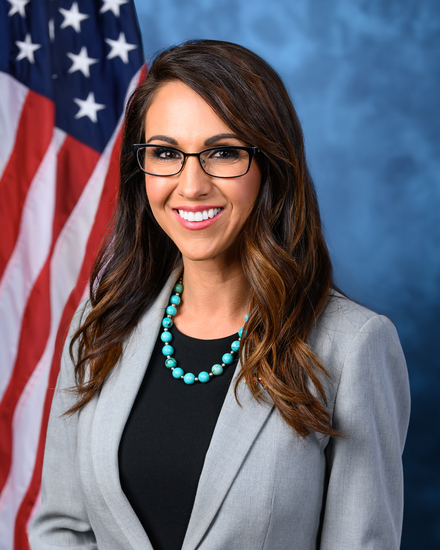
Rep. Lauren Boebert
Sponsored bills
Securing America's Land from Foreign Interference Act This bill requires the President to take actions as necessary to prohibit members of the Chinese Communist Party from purchasing real estate located in the United States.
Restoring Military Focus Act This bill eliminates the position of Chief Diversity Officer within the Department of Defense (DOD), as well as the position of Senior Advisor for Diversity and Inclusion within the military departments. Additionally, the bill prohibits the use of federal funds to establish similar positions to that of Chief Diversity Officer or Senior Advisor for Diversity and Inclusion within DOD.
Securing Our Border States Act This bill requires the Department of the Treasury to provide grants to states for building barriers and related infrastructure along the U.S.-Mexico border. Within 30 days of receiving a certification from a border state that it intends to use such grant funding for constructing a border barrier, Treasury must disburse funds to the state, with the amount based on the number of miles of border in that state that currently does not have a border barrier. The bill provides $22 billion of funding for this grant program and permanently rescinds $22 billion from funds made available for various assistance programs related to COVID-19.
This resolution denounces socialism and opposes the implementation of socialist policies in the United States.
Protecting Life on College Campus Act of 2021 This bill prohibits the award of federal funds to an institution of higher education (IHE) that hosts or is affiliated with a school-based service site that provides abortion drugs or abortions to its students or to employees of the IHE or the site. An IHE that hosts or is affiliated with a site must, in order to remain eligible for federal funds, annually certify that the site does not provide abortion drugs or abortions to students or employees.
Less Imprecision in Species Treatment Act of 2021 or the LIST Act of 2021 This bill revises the process for removing a species from the endangered or threatened species lists. A species must be removed from the endangered or threatened species lists if the Department of the Interior produces or receives substantial scientific or commercial information demonstrating that the species is recovered or that recovery goals set for the species have been met. The publication and notice of a proposed regulation to remove a species from the lists must consist solely of a notice of the removal. The bill establishes a process for removing species from the lists if they were erroneously or wrongfully listed. The bill prohibits a person from submitting a petition to list a species as a threatened or endangered species for 10 years if the person knowingly submitted a petition with information that was inaccurate beyond scientifically reasonable margins of error, fraudulent, or misrepresentative.
Wildfire Prevention and Drought Mitigation Act of 2021 This bill categorically excludes forest management activities carried out on specified public lands from requirements to conduct environmental assessments and environmental impact statements. In order to be excluded from environmental review, the primary purposes of such activities must be to protect a municipal or tribal water source from damage caused by wildfire; improve watershed or habitat conditions; improve, maintain, or restore water yield or quality; improve, maintain, or restore snowpack; or adapt the forest landscape to an increased threat of drought. The bill limits the categorical exclusion to activities that manage up to 10,000 acres of land. However, activities that manage up to 30,000 acres of land may be categorically excluded from environmental review if the activities are located in areas that (1) are in a severe, extreme, or exceptional drought; or (2) have been in such droughts in the previous five years.
Processing Revival and Intrastate Meat Exemption Act or the PRIME Act This bill expands the exemption of custom slaughtering of animals from federal inspection requirements. Under current law, the exemption applies if the meat is slaughtered for personal, household, guest, and employee uses. The bill expands the exemption to include meat that is slaughtered and prepared at a custom slaughter facility in accordance with the laws of the state where the facility is located; and prepared exclusively for distribution to household consumers in the state or restaurants, hotels, boarding houses, grocery stores, or other establishments in the state that either prepare meals served directly to consumers or offer meat and food products for sale directly to consumers in the state. The bill does not preempt any state law concerning (1) the slaughter of animals or the preparation of carcasses, parts thereof, meat and meat food products at a custom slaughter facility; or (2) the sale of meat or meat food products.

Veterans Health Care Freedom Act This bill requires the Center for Innovation for Care and Payment within the Department of Veterans Affairs (VA) to implement a three-year pilot program to improve the ability of veterans who are enrolled in the VA health care system to access hospital care, medical services, and extended care services through the covered care system by providing such veterans with the ability to choose health care providers. Under the bill, the covered care system includes VA medical facilities, health care providers participating in the Veterans Community Care Program (VCCP), and eligible entities or providers that have entered into a Veterans Care Agreement. A veteran participating in the program may elect to receive care at any provider in the covered care system. The pilot program removes certain requirements (e.g., location of the veteran) to access care at VA and non-VA facilities. After four years, the bill permanently phases out the requirements for accessing care under the VCCP and Veterans Care Agreements and requires the VA to provide such care under the same conditions of the pilot program. Additionally, after four years, veterans may receive care at a VA medical facility regardless of whether the facility is in the same Veterans Integrated Service Network as the veteran.