

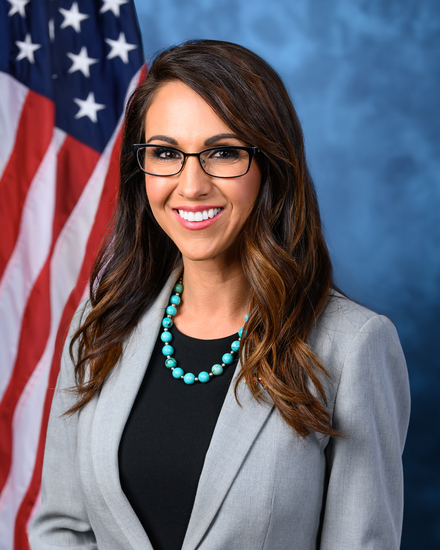
Photo of Lauren Boebert
R United States House · District 4 · Colorado On the 2026 ballot

Rep. Lauren Boebert

Compare
Total votes
2,837
all sessions
Attendance
96%
120 missed
Lower than 78% of chamber peers
With party
82%
of cast votes
Lower than 96% of chamber peers
Bipartisan score
9%
crosses aisle rarely
Higher than 94% of chamber peers
Sponsored
1,026
bills & resolutions
Near the chamber average
Committees
7
assignments
1,026 bills and resolutions

Sponsored bills

Total
1,026
Primary
89
Co-sponsor
937
This page
1,026
matching current filters
Co-sponsor HR 1310
In committee · Indiana House · Co-sponsor
SHARE Act

Maddy summaryHR 1310 (SHARE Act) requires the FBI to share criminal history records with state licensing agencies when needed for professional licensing checks across state lines through existing interstate compacts. It directly affects state licensing boards (like those for nurses or contractors) and individuals applying for licenses in multiple states. The bill mandates that states use this data *only* for license applications and prohibits sharing it with other agencies or the public, while allowing a simple "pass/fail" notification to the compact’s governing body.

In committee Mar 1, 2023 1 co-sponsor
Co-sponsor HR 1271
In committee · Indiana House · Co-sponsor
No Retaining Every Gun In a System That Restricts Your Rights Act

No Retaining Every Gun In a System That Restricts Your Rights Act This bill modifies the retention requirements for firearm transaction records of federal firearms licensees (FFLs) that go out of business. Current law generally requires FFLs that go out of business to deliver their firearm transaction records to the Bureau of Alcohol, Tobacco, Firearms and Explosives (ATF). This bill removes the requirement for FFLs that go out of business to deliver their firearm transaction records to the ATF. Further, the bill requires the ATF to destroy all out-of-business records it has collected from FFLs.

In committee Mar 1, 2023 1 co-sponsor
Co-sponsor HR 1297
In committee · Indiana House · Co-sponsor
To amend title 10, United States Code, to prohibit the Secretary of Defense from paying or reimbursing expenses relating to abortion services, and for other purposes.

Maddy summaryThis bill prohibits the Department of Defense from using funds to pay for or reimburse abortion services, except when the pregnancy endangers the mother's life, results from rape, or results from incest. It directly affects military personnel, civilian DOD employees, and contractors receiving medical care at military facilities by restricting funding for abortion-related expenses. Key provisions include amending federal law to ban reimbursement for travel or licensing costs related to abortion services and repealing a 2022 DOD memo that expanded access to such care. The bill explicitly blocks all funding for abortion services beyond the existing exceptions, with no new exceptions added. It does not change abortion access for civilians outside the military healthcare system.

In committee Mar 1, 2023 1 co-sponsor
Co-sponsor HR 1250
In committee · Indiana House · Co-sponsor
Family Farm and Small Business Exemption Act

Maddy summaryThis bill amends the Higher Education Act to exempt certain family-owned assets from being counted when calculating federal student aid eligibility. Specifically, it excludes family farms where the family resides and small businesses with 100 or fewer full-time equivalent employees owned and controlled by the family. These assets will no longer be considered when determining a student's financial need for aid programs. The change directly affects students from qualifying family farms or small businesses when applying for federal financial aid. The exemption applies to assets held by the family, not just the business itself.

In committee Feb 28, 2023 1 co-sponsor
Co-sponsor HR 1229
In committee · Indiana House · Co-sponsor
Stop CRT Act

Maddy summaryHR 1229, the "Stop CRT Act," codifies Executive Order 13950 into law and restricts federal funding for entities teaching specific concepts about race. It prohibits federal grants to organizations that teach any of six specified ideas, including that race determines moral worth, the U.S. is fundamentally racist, or individuals bear responsibility for historical actions based on race. The bill directly affects schools, nonprofits, and other recipients of federal funds by banning support for educational content matching these prohibitions. Key provisions require federal agencies to deny funding to any entity advancing these concepts, making the executive order legally binding. This policy change alters how federal funds are distributed based on mandated educational content.

In committee Feb 28, 2023 1 co-sponsor
Co-sponsor HR 1228
In committee · Indiana House · Co-sponsor
Combating Racist Training in the Military Act of 2023

Maddy summaryHR 1228 prohibits the U.S. military and Department of Defense-operated academic institutions from promoting specific anti-American or racist theories in training. It bans military programs that teach ideas such as "the U.S. is fundamentally racist," "the Constitution is fundamentally racist," or that "an individual’s worth is determined by race." The bill explicitly states it does not restrict protected speech, research access, or educational contexts that clearly disavow military endorsement of such theories. This directly affects military training curricula, workshops, and educational materials within the armed forces.

In committee Feb 28, 2023 1 co-sponsor
Co-sponsor HR 209
In committee · Indiana House · Co-sponsor
Permitting for Mining Needs Act of 2023

Maddy summaryThe Permitting for Mining Needs Act of 2023 streamlines federal permitting for mining projects on public lands by establishing specific time limits for environmental reviews (12 months for assessments, 24 months for impact statements) and allowing lead agencies to adopt applicant-prepared environmental documents that meet National Environmental Policy Act requirements. It enables mineral exploration with limited surface disturbance (up to 5 acres) to proceed without full environmental review, and creates mechanisms for coordination between agencies and project applicants through memorandums of agreement. The bill applies to all minerals, not just "critical" minerals, and ensures uranium is treated as a critical mineral for certain purposes. The legislation aims to expedite domestic mineral development while maintaining environmental review standards.

In committee Feb 28, 2023 1 co-sponsor
Co-sponsor HR 1206
In committee · Indiana House · Co-sponsor
Federal Agency Sunset Commission Act of 2023

Maddy summaryThe Federal Agency Sunset Commission Act of 2023 would establish a 13-member commission to review all federal agencies every 12 years (or less) to determine if they should be abolished, reorganized, or continued. The commission would evaluate agencies based on specific criteria including efficiency, cost-effectiveness, duplication with other agencies, and whether the agency has achieved its original purpose. Agencies would be scheduled for review and potentially abolished unless Congress reauthorizes them, with a supermajority vote allowing up to a 2-year extension. This bill directly affects all federal agencies and would require Congress to periodically assess the necessity of government programs. The commission would also monitor new legislation to prevent unnecessary creation of new agencies or programs.

In committee Feb 27, 2023 1 co-sponsor
Co-sponsor HR 597
In committee · Indiana House · Co-sponsor
Stop the Cartels Act

Maddy summaryThe Stop the Cartels Act (HR 597) aims to disrupt drug trafficking organizations and related criminal activities by requiring enhanced intelligence gathering on cartels in Mexico and Central American countries, mandating improved U.S.-Mexico law enforcement cooperation, and cutting federal funding from jurisdictions that restrict immigration enforcement. The bill creates a "Special Transnational Criminal Organization" designation for major cartels like the Sinaloa Cartel and Jalisco New Generation Cartel, requires monthly reports on migrant encounters at the border, and establishes refugee processing centers in Mexico and Central America. It also increases staffing for immigration courts by 500 judges, prohibits asylum applications from nationals of countries with refugee processing centers, and reauthorizes substance abuse prevention funding at higher levels while repealing several existing drug programs. These provisions directly affect U.S. intelligence and law enforcement agencies, Mexican and Central American governments, local jurisdictions receiving federal funds, and migrants seeking asylum or refugee status.

In committee Feb 27, 2023 1 co-sponsor
Co-sponsor HR 1183
In committee · Indiana House · Co-sponsor
Asylum Reform and Border Protection Act of 2023

Asylum Reform and Border Protection Act of 2023 This bill makes various immigration-related changes, such as restricting Department of Homeland Security (DHS) authority to parole certain aliens. The bill (1) bars the government from paying for counsel for a person in any immigration proceeding before DHS or the Department of Justice, whereas currently the prohibition only applies to removal proceedings; and (2) raises the burden on an alien to establish the alien's claimed fear of persecution when seeking asylum. DHS shall standardize questions asked in expedited removal proceedings and record such proceedings. DHS may parole an alien into the United States only on an individualized basis and may not use eligibility criteria describing an entire class of people. The bill imposes additional restrictions on such parole authority. The bill removes an exception which allows an unaccompanied alien child to seek asylum while in the United States (or upon arrival at the U.S. border) even if the child may be removed to a safe third country where the child may seek asylum. The bill also bars an alien from seeking asylum while in the United States (or upon arrival at the U.S. border) if the alien may be removed to a safe third country where the alien may seek asylum. Currently, this bar only applies if the United States has an agreement with the third country. The bill bars several grounds for asylum related to generalized violence. The bill expands what constitutes a frivolous asylum application to include those filed solely to delay removal, among others. Currently, an application is frivolous only if any material elements are deliberately fabricated.

In committee Feb 24, 2023 1 co-sponsor
Showing 581 to 590 of 1,026 bills
Previous 1 … 58 59 60 … 103 Next