

Maddy summaryThe Ending Trading and Holdings in Congressional Stocks (ETHICS) Act requires members of Congress, their spouses, and dependent children to divest or place most personal investments in qualified blind trusts. It bans the purchase of covered investments (including stocks, commodities, and derivatives) after enactment, with current members having 90 days to sell existing holdings and new members having 90 days after taking office to divest. The bill includes specific exceptions for diversified mutual funds, Treasury securities, and certain family business investments while establishing enforcement mechanisms including civil penalties of up to 10% of the value of noncompliant holdings. The law applies to members serving terms beginning after January 31, 2023, and mandates public online disclosure of financial information through updated government databases.
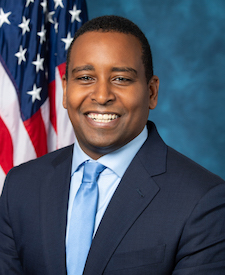
Rep. Joe Neguse
Sponsored bills
Maddy summaryThe Time Off to Vote Act requires employers with 25 or more employees to provide two hours of paid leave for federal elections. Employees can use this leave to vote in person, return mail-in ballots, or perform other voting activities during open polling hours. Employers may set the specific two-hour window (excluding lunch breaks) but cannot deny the leave, retaliate against employees who take it, or cause loss of accrued benefits. Violations could result in civil penalties up to $10,000 per violation, enforced by the Department of Labor.
Maddy summaryThe Sustaining Our Democracy Act establishes a federal program providing funding to states for election administration improvements, increased voter access, and protection of election workers. States must submit detailed plans for using funds to upgrade voting equipment, expand early and mail voting options, secure election infrastructure, and address disparities in voting access for underserved communities. The bill prohibits states from using funds for activities that restrict voting access or suppress participation, and creates an Office of Democracy Advancement and Innovation to administer the program. Funded through a $2.5 billion Trust Fund for fiscal years 2026-2035, this legislation directly affects all 50 states, the District of Columbia, and U.S. territories receiving federal election funding.
Maddy summaryThe Wildfire Emergency Preparedness Act of 2025 establishes a national training plan for structural firefighters to respond to wildfires and wildland-urban interface fires, with $5 million annually for training grants. It creates an Under Secretary of Agriculture for Fire Coordination to improve federal-state-local coordination in wildfire response and authorizes $20 million annually for research on firefighter health, including PFAS exposure in firefighting equipment. The bill also provides $100 million for supplemental grants to fire departments and EMS organizations for wildfire response equipment and training, and sets criteria for mental health support for first responders. It requires reports to Congress on training effectiveness and coordination challenges within one year of enactment.
Maddy summaryThis bill blocks the Department of the Interior from implementing layoffs or involuntary separations (except for misconduct or performance issues) at any agency or bureau until Congress passes full-year funding for fiscal year 2026. It directly affects all employees in the competitive service, excepted service, and Senior Executive Service within the Department of the Interior. The key provision creates a moratorium on workforce reductions, requiring full FY2026 appropriations before any layoff actions can proceed.
Maddy summaryThis bill prevents the Forest Service from initiating or implementing layoffs until after full-year funding for fiscal year 2026 is secured. It specifically stops reductions in force and involuntary separations for most Forest Service employees (including competitive service, excepted service, and senior executive roles), except for misconduct, poor performance, or delinquency. The moratorium applies to all personnel actions under the Secretary of Agriculture’s authority until FY2026 appropriations are enacted. This directly affects Forest Service workers and ensures their job stability during the budget process.
Maddy summaryHR 4863, the Fairness for Khobar Act of 2025, provides lump sum catch-up payments to victims of the 1983 Beirut barracks bombing and 1996 Khobar Towers bombing who were previously denied compensation due to confusing Department of Justice guidance. The bill requires the Special Master to authorize these payments to individuals who relied on outdated guidance stating they could not apply for lump sum payments if already eligible for regular distributions. Victims can prove their reliance through documentation, sworn statements, or other methods approved by the Special Master. Payments will be made from a reserve fund or the main compensation fund, ensuring those who were wrongly excluded can now receive full compensation they were entitled to under the law.
Maddy summaryHRES 617 is a symbolic resolution supporting Fentanyl Prevention and Awareness Day, observed annually on August 21. It does not create new laws or policies but formally encourages the public to promote awareness of illicit fentanyl dangers and support drug-free lifestyles. The resolution urges communities, schools, and organizations to engage in prevention education, particularly for youth, and to participate in activities that foster healthy, drug-free communities. It directly affects all U.S. citizens by calling for collective action to address the fentanyl crisis, which claimed over 82,000 lives in 2024. This resolution was introduced by Rep. Carter (GA) and Rep. Tonko and referred to the Energy and Commerce Committee.
Maddy summaryThis bill transitions individuals with disabilities from segregated employment under special certificates (which allow subminimum wages) to competitive integrated employment with fair wages. It creates grant programs for states and employers to facilitate this transition, requiring employers to pay at least minimum wage (increasing over time) and providing necessary supports. The bill phases out special certificates entirely within 4 years, while ensuring individuals with disabilities receive ongoing support during the transition. It also establishes evaluation requirements to track progress and ensure compliance with the new standards.
Maddy summaryHR 4763, the PTO Act, requires most employers to provide employees with at least 1 hour of paid annual leave for every 25 hours worked, with a maximum of 80 hours per year. It applies to private-sector workers and certain government employees, protecting their right to use paid leave for any purpose without disclosing the reason. The bill mandates employers to maintain health benefits during leave, allow carryover of up to 40 hours of unused leave, and pay out unused leave upon separation. It also prohibits employers from discriminating against employees for using paid leave or requiring them to find replacements while on leave. The law includes enforcement mechanisms, allowing employees to file complaints with the Department of Labor or pursue private lawsuits.