Climate Security Jobs Act This bill provides that for FY2022 and the fiscal years thereafter, the baseline personnel limitations for certain Department of Defense offices must not apply to personnel deemed as necessary to accommodate increases in workload or modify the type of personnel required to accomplish specified work related to military resilience to environmental risks.
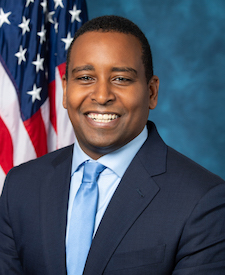
Rep. Joe Neguse
Sponsored bills
Securing Technology Against Climate Impacts Act This bill expands the Department of Defense (DOD) requirements for its annual report on the national technology and industrial base. Specifically, the bill requires DOD to include in such report information on vulnerabilities related to the current and projected impacts of climate change, as well as vulnerabilities related to cyberattacks or disruptions.
Local Resiliency Act This bill authorizes the Department of Defense to make grants, conclude cooperative agreements, and supplement other federal funds to assist a state or local government in planning and implementing measures and projects that will contribute to maintaining or improving military installation resilience. Funds that are provided for projects involving the preservation, maintenance, or restoration of natural features to maintain or enhance military installation resilience may be provided in a lump sum and include an amount intended to cover future costs.
Defense Energy Efficiency Act This bill requires the Department of Defense (DOD) to amend the Unified Facilities Criteria relating to military construction planning and design to ensure that DOD building practices and standards incorporate the latest consensus-based codes and standards for energy efficiency and conservation. Not more than 25% of the funds authorized for FY2022 for DOD planning and design accounts relating to military construction projects may be obligated until DOD certifies that it has initiated the Unified Facilities Criteria amendment process and intends to complete the process by September 1, 2022. Any DOD Form 1391 submitted after September 1, 2022, must comply with the amended Unified Facilities Criteria. Not later than March 1, 2023, DOD must certify to Congress the completion and full incorporation of the amendments to the Unified Facilities Criteria into military construction planning and design. DOD must annually review the Unified Facilities Criteria to compare it to industry best practices for energy efficiency and energy conservation.
This resolution expresses support for recognition of a National Latino Small Business Day.
Supporting Early-childhood Educators' Deductions Act or the SEED Act This bill expands the tax deduction for the expenses of elementary and secondary school teachers to include early childhood educators.
John R. Lewis Voting Rights Advancement Act of 2021 This bill establishes new criteria for determining which states and political subdivisions must obtain preclearance before changes to voting practices may take effect. Preclearance is the process of receiving preapproval from the Department of Justice (DOJ) or the U.S. District Court for the District of Columbia before making legal changes that would affect voting rights. A state and all of its political subdivisions shall be subject to preclearance of voting practice changes for a 10-year period if 15 or more voting rights violations occurred in the state during the previous 25 years; 10 or more violations occurred during the previous 25 years, at least 1 of which was committed by the state itself; or 3 or more violations occurred during the previous 25 years and the state administers the elections. A political subdivision as a separate unit shall also be subject to preclearance for a 10-year period if three or more voting rights violations occurred there during the previous 25 years. States and political subdivisions that meet certain thresholds regarding minority groups must preclear covered practices before implementation, such as changes to methods of election and redistricting. Further, states and political subdivisions must notify the public of changes to voting practices. Next, the bill authorizes DOJ to require states or political subdivisions to provide certain documents or answers to questions for enforcing voting rights. The bill also outlines factors courts must consider when hearing challenges to voting practices, such as the extent of any history of official voting discrimination in the state or political subdivision.

Ejiao Act This bill prohibits the knowing sale or transport of ejiao (or products containing ejiao) in interstate or foreign commerce. (Ejiao is a gelatin made with donkey skin and used in traditional Chinese medicine and beauty products.)
This resolution expresses the sense of the House of Representatives that the United States shall recognize kind actions in our country, encourage kindness, spread love, and foster a culture of being kind to one another.
This resolution celebrates the contributions of small businesses in every U.S. community and supports the designation of National Small Business Week. Further, it supports efforts to provide small businesses with aid and assistance through certain programs and initiatives.